Reviewed and updated: 21 July 2026.
The 60-second verdict
An AI transcript can help create a recruitment interview scorecard only when the questions, evidence and scoring criteria were defined before the interview. It should preserve what the candidate said and help reviewers locate evidence—not generate a hiring score from tone, accent, emotion or personality inference.
Decision focus: use the method below only where it produces a recoverable source, a verifiable output and a clear next action. If one of those fails, change the workflow rather than trusting a polished summary.
Quick verdict: use a structured interview, record only where authorised, separate transcript evidence from assessor judgement, score every candidate against the same job-related criteria and prohibit automated hiring decisions.
Evidence basis and limits
- Decision factors covered: Define the scorecard before interviewing; Create anchored scoring standards; Use the same interview structure.
- Evidence rule: The decision is based on the complete capture-to-action workflow, not a single feature or marketing accuracy percentage.
- Boundary: Examples and workflow recommendations must be tested with representative recordings, the intended users and the actual approval process before rollout.
Define the scorecard before interviewing
Start with the role requirements and select a small number of job-related criteria, such as:
- Technical knowledge
- Problem solving
- Stakeholder communication
- Planning and organisation
- Customer judgement
- Leadership behaviour
- Safety or compliance awareness
- Role-specific experience
Do not add criteria after hearing a candidate because their answer felt impressive or uncomfortable.
Create anchored scoring standards
| Score | Example anchor |
|---|---|
| 1 – insufficient evidence | No relevant example or answer does not address the question |
| 2 – limited | Partial example with unclear role or weak result |
| 3 – meets requirement | Relevant example showing the expected behaviour and result |
| 4 – strong | Clear evidence of judgement, ownership and measurable impact |
| 5 – exceptional | Evidence materially exceeds the role requirement in a relevant way |
Anchors should be specific enough that different assessors can apply them consistently.
Use the same interview structure
- Introduction and recording information
- Role and process explanation
- Core questions asked of every candidate
- Permitted follow-up questions
- Candidate questions
- Next-step explanation
Record deviations, technical interruptions and reasonable adjustments so reviewers understand the context.
Separate four layers
| Layer | Example | Treatment |
|---|---|---|
| Candidate statement | “I led the migration.” | Preserve as the candidate’s account |
| Interview evidence | Specific actions, decisions and result described | Map to the criterion |
| Assessor judgement | Evidence meets the role anchor | Explain the score |
| External verification | Reference or qualification check | Keep outside the interview transcript |
Map evidence to each criterion
For every score, record:
- Question asked
- Candidate’s material response
- Relevant transcript timestamp
- Evidence supporting the rating
- Evidence gap or uncertainty
- Assessor score
- Short rationale
Do not score based on general impression when no criterion-specific evidence exists.
Do not score protected characteristics or proxies
Exclude:
- Accent
- Age inference
- Emotion or sentiment score
- Facial expression
- Voice confidence
- Disability-related communication style
- Background or home environment
- Family status
- Health information unless legitimately relevant and handled through the proper process
AI should not infer personality, honesty, motivation or cultural fit from speech patterns.
Handle reasonable adjustments
Where a candidate uses extra time, an interpreter, assistive technology, alternative communication or another adjustment, evaluate the job-related evidence rather than penalising the adjustment itself. Record only the minimum information required by the recruitment process.
Workflow from interview to scorecard
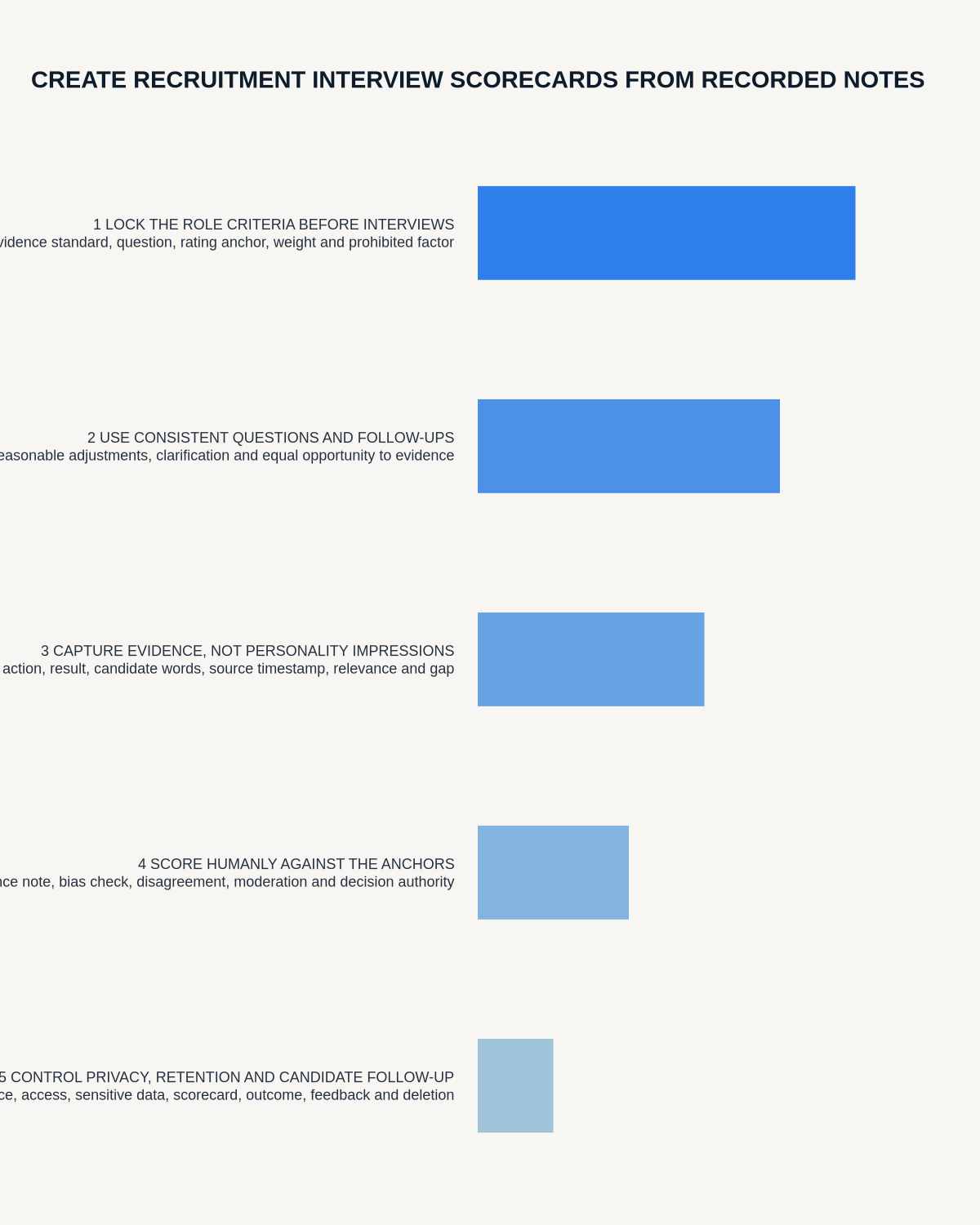
- Define criteria, questions and anchors.
- Confirm the approved recording and candidate-information process.
- Conduct the structured interview.
- Confirm the source file is complete.
- Generate and correct the transcript.
- Map evidence to each criterion.
- Score independently before panel discussion where possible.
- Compare assessor reasoning.
- Resolve material disagreements using the source evidence.
- Record the panel outcome through the authorised process.
- Apply access, retention and deletion rules.
Use panel calibration
Before live recruitment, score one sample answer together and compare:
- Which evidence each assessor used
- How anchors were interpreted
- Whether irrelevant style affected ratings
- How missing evidence was handled
- How disagreements will be resolved
Calibration improves consistency without forcing identical judgement.
Common AI and assessor failures
- Summarising away the candidate’s qualification or uncertainty
- Attributing an answer to the wrong person in a panel interview
- Turning a hypothetical answer into claimed experience
- Scoring fluency instead of job evidence
- Inferring competence from confidence
- Using a summary that omits a weaker follow-up answer
- Allowing one impressive response to influence every criterion
- Creating a numerical recommendation without transparent evidence
Protect interview information
Restrict recordings, transcripts and scorecards to authorised recruitment personnel. Define:
- Candidate notice and lawful processing
- Supplier and account approval
- Special-category information handling
- Access and sharing
- Correction and complaint route
- Retention for successful and unsuccessful candidates
- Deletion across device, app and exports
Measure the process
- Score completion rate
- Evidence-linked ratings
- Inter-rater consistency
- Candidate correction requests
- Transcript error rate on names and technical terms
- Time from interview to completed scorecard
- Panel overrides and reasons
- Adverse-impact review where appropriate
Where NERALVO Halo fits
View Halo specifications against the evidence checklist can capture approved interviews to 64GB local storage and synchronise recordings to DOWAY for transcripts, summaries and speaker-separated notes. One year of DOWAY Max is included with the current package.
Use those outputs to locate interview evidence, not to automate selection. The organisation remains responsible for fair criteria, candidate information, human assessment and retention.
Workflow choice matrix for How to Create Recruitment Interview Scorecards from Recorded Notes
Choose the method that protects the source and reduces downstream correction. The table makes the non-hardware options explicit.
| Condition | Preferred route | Why |
|---|---|---|
| Repeatable remote work with approved integrations | Cloud software | Automation and central collaboration may outweigh device independence. |
| In-person, mobile or unreliable-connectivity work | Dedicated recorder | Independent capture and a recoverable local source are usually more resilient. |
| Recording is refused, prohibited or unnecessary | Manual notes / no recording | Respecting the boundary is the correct workflow, not a product failure. |
| High-risk or mixed work | Governed hybrid | Separate capture, review, approval and retention rather than trusting one tool. |
Frequently asked questions
Can AI score candidates automatically?
It should not make or determine hiring decisions. Use it to organise evidence for accountable human assessment.
Should every candidate be recorded?
Only where the organisation has justified and approved the process and provides the required information and alternatives.
Can tone or confidence be a criterion?
Only assess a clearly defined job-related communication requirement using observable evidence—not emotion or personality inference.
Should assessors see the AI summary before scoring?
They may use it as a navigation aid, but material ratings should be checked against the candidate’s actual response.
Final checklist
- Job-related criteria defined
- Anchored score standards prepared
- Questions standardised
- Recording process approved
- Candidate evidence separated from judgement
- Every score linked to evidence
- Protected-characteristic proxies excluded
- Adjustments handled fairly
- Panel calibration completed
- Human decision authority preserved
- Retention and deletion controlled
A strong AI-assisted recruitment scorecard improves evidence access without allowing software or first impressions to decide who is hired.
Related AI voice recorder guides
Workflow map
Visual map for How to Create Recruitment Interview Scorecards from Recorded Notes
- Define the decisionState the question, required output and acceptance rule.
- Capture the sourceUse the approved route and preserve context, identity and limitations.
- Verify material detailsReplay or check names, numbers, negatives, decisions and actions.
- Move into the real recordAssign an owner, retain evidence and apply the deletion rule.
On this page
Related guides
See whether Halo fits this workflow
Review the NERALVO Halo specifications, included services, delivery information and current offer only after completing the guide.
Found an error or an out-of-date claim? Email support@neralvo.com with the article address and a supporting source.