Reviewed and updated: 21 July 2026.
A research memo should explain what the interview evidence suggests, how the interpretation was reached and where uncertainty or conflicting accounts remain. AI transcripts can accelerate retrieval and organisation, but the researcher remains responsible for methodology, coding and claims.
The 60-second verdict
Quick verdict: verify the transcript, separate participant account from researcher interpretation, code through the approved method, link themes to source extracts and preserve negative cases before writing the memo.
Decision focus: use the method below only where it produces a recoverable source, a verifiable output and a clear next action. If one of those fails, change the workflow rather than trusting a polished summary.
Evidence basis and limits
- Decision factors covered: Define the memo’s analytic purpose; Separate the analytic layers; Build an evidence table.
- Evidence rule: The decision is based on the complete capture-to-action workflow, not a single feature or marketing accuracy percentage.
- Boundary: Examples and workflow recommendations must be tested with representative recordings, the intended users and the actual approval process before rollout.
Define the memo’s analytic purpose
State:
- Research question
- Interview or source set
- Method
- Audience
- Decision or study stage supported
- Whether the memo is descriptive, interpretive or comparative
A memo for early field reflection is different from a formal cross-case analytic memo.
Verify the source before analysis
Prioritise:
- Participant and speaker identity
- Names, dates and places
- Specialist vocabulary
- Quotations likely to be used
- Negative wording
- Corrections and clarifications
- Unclear or inaudible passages
- Translation issues
Do not code an AI error as participant meaning.
Separate the analytic layers
| Layer | Example | Control |
|---|---|---|
| Participant account | What the participant said or recalled | Attribute accurately |
| Context note | Setting, interruption or relevant non-verbal context | Record appropriately and separately |
| Descriptive code | Label close to the source meaning | Use the approved codebook |
| Interpretive theme | Researcher explanation across evidence | Show supporting and conflicting material |
| Researcher inference | Provisional analytic conclusion | Label and test |
| AI suggestion | Generated theme or cluster | Treat as a candidate, not a finding |
Use a source-linked memo structure
- Memo question: what this analysis is trying to understand.
- Source scope: interviews, dates and inclusion criteria.
- Initial interpretation: concise provisional answer.
- Supporting evidence: extracts and patterns.
- Variation: differences across participants or contexts.
- Negative cases: evidence that challenges the main pattern.
- Uncertainty: missing or ambiguous information.
- Method note: coding and analytic decisions.
- Implications: what the pattern may mean for the research question.
- Next steps: further data, questions or analysis required.
Build an evidence table
For each theme, record:
- Theme or claim
- Participant code
- Transcript and timestamp
- Short verified extract
- Context
- Supporting or conflicting status
- Researcher note
- Confidence or analytic maturity
This makes the memo auditable without filling it with long quotations.
Preserve negative cases
Do not remove evidence that complicates the preferred interpretation. Ask:
- Who did not describe this pattern?
- Which context produced the opposite experience?
- Could the theme reflect the interview question?
- Could sampling or access explain the pattern?
- Does a later answer qualify an earlier one?
A strong memo explains variation rather than pretending all participants agreed.
Use AI-generated themes cautiously
AI may:
- Group similar wording while missing different meanings
- Create a theme from frequent but unimportant words
- Flatten minority or contradictory accounts
- Overgeneralise from one vivid example
- Ignore question context
- Normalise dialect or uncertainty
- Invent neat causal links
Compare every candidate theme with the source, codebook and alternative interpretations.
Maintain a coding and decision log
Record:
- Code definitions and changes
- Merged or split codes
- Reasons for excluding material
- AI prompts and generated outputs where used
- Researcher overrides
- Translation decisions
- Version history
- Peer or supervisor review
Protect participant meaning in quotations
- Locate the exact passage.
- Replay enough context.
- Verify wording and speaker.
- Check whether editing changes meaning.
- Apply pseudonymisation or attribution rules.
- Assess re-identification risk.
- Record the source reference.
A distinctive quotation may identify a participant even after the name is removed.
Compare cases deliberately
For cross-interview analysis, compare the same dimensions:
- Role or context
- Experience
- Trigger or problem
- Response
- Outcome
- Constraint
- Contradiction
- Participant’s own explanation
Do not compare one participant’s detailed narrative with another participant’s short answer as though the source depth were equal.
Workflow from recording to memo
- Confirm ethics, consent and approved processing.
- Transfer and secure the source.
- Correct the material transcript.
- Add context notes.
- Code using the approved method.
- Build the evidence table.
- Review negative cases and conflicts.
- Draft the memo.
- Link claims to sources.
- Obtain peer, supervisor or team review where required.
- Version and store the approved memo.
- Apply archive and deletion rules.
Measure memo quality
- Claims with traceable evidence
- Negative cases represented
- Participant voice separated from interpretation
- Method decisions documented
- Unsupported AI themes removed
- Quotation verification completed
- Re-identification risk reviewed
- Time from interview to analytic memo
Where NERALVO Halo fits
View Halo specifications against the evidence checklist can capture approved interviews to 64GB local storage and synchronise recordings to DOWAY for transcripts, summaries and speaker-separated notes. One year of DOWAY Max is included with the current package.
Use those outputs to navigate and organise the source, not to replace the approved research method or researcher interpretation.
Workflow choice matrix for How to Create Stronger Research Memos from Interview Transcripts
Choose the method that protects the source and reduces downstream correction. The table makes the non-hardware options explicit.
| Condition | Preferred route | Why |
|---|---|---|
| Repeatable remote work with approved integrations | Cloud software | Automation and central collaboration may outweigh device independence. |
| In-person, mobile or unreliable-connectivity work | Dedicated recorder | Independent capture and a recoverable local source are usually more resilient. |
| Recording is refused, prohibited or unnecessary | Manual notes / no recording | Respecting the boundary is the correct workflow, not a product failure. |
| High-risk or mixed work | Governed hybrid | Separate capture, review, approval and retention rather than trusting one tool. |
Frequently asked questions
Can AI write the research memo?
It can draft a structure or candidate synthesis, but the researcher must verify evidence, method and interpretation.
Should every quotation be included?
No. Select material extracts and preserve enough context to support the claim.
What is a negative case?
Evidence that does not fit or challenges the emerging pattern. It is essential to credible analysis.
Can a pseudonymised transcript be treated as anonymous?
Not automatically. Context and distinctive experiences may still identify the participant.
Final checklist
- Memo purpose and source scope defined
- Material transcript errors corrected
- Participant account separated from interpretation
- Evidence table completed
- Negative cases reviewed
- AI themes treated as candidates
- Coding decisions logged
- Quotations verified and de-identified appropriately
- Claims source-linked
- Review and version control completed
- Archive and deletion applied
A strong AI-assisted research memo is analytically useful because it remains transparent about source, method, variation and uncertainty.
Related AI voice recorder guides
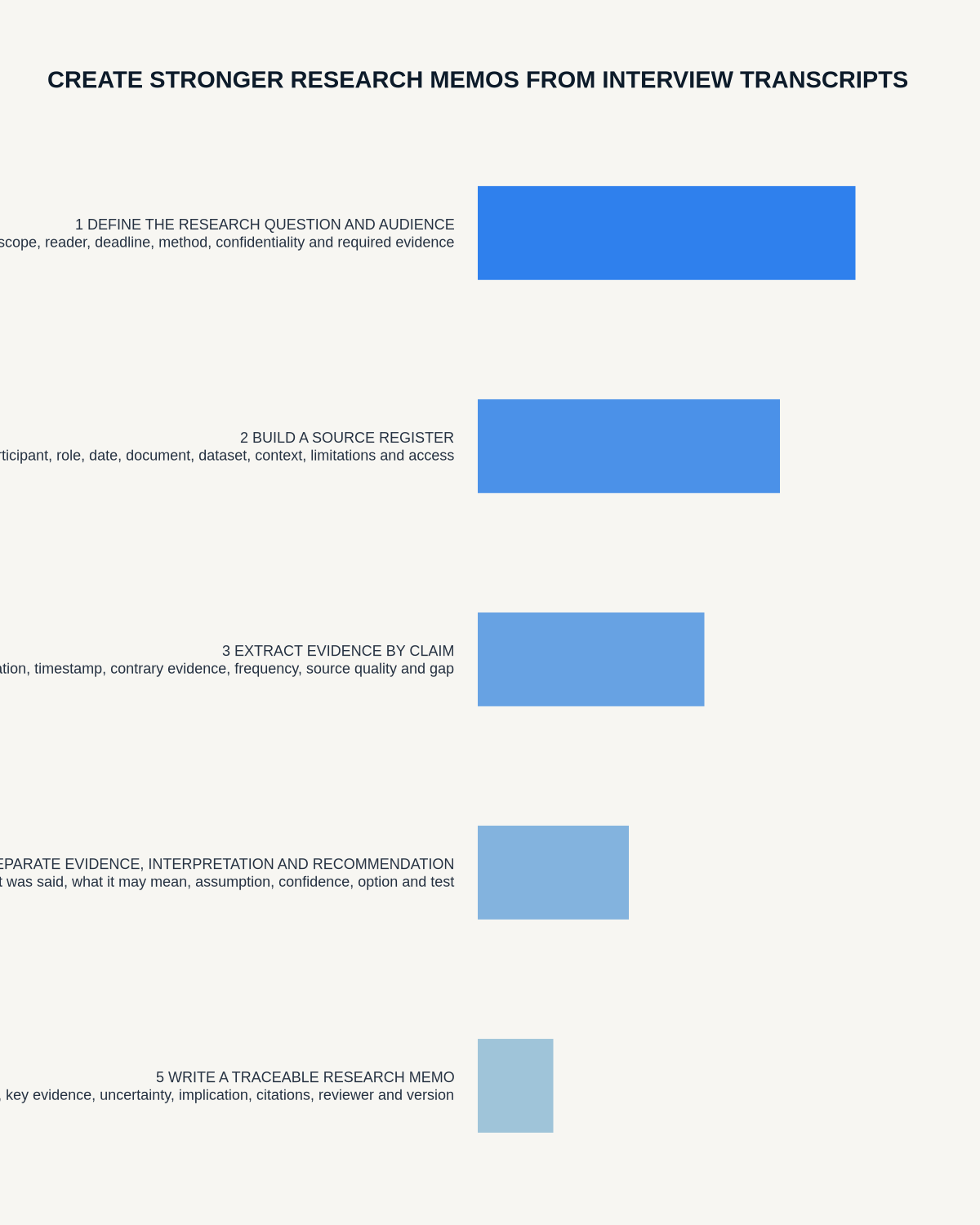
Workflow map
Visual map for How to Create Stronger Research Memos from Interview Transcripts
- Define the decisionState the question, required output and acceptance rule.
- Capture the sourceUse the approved route and preserve context, identity and limitations.
- Verify material detailsReplay or check names, numbers, negatives, decisions and actions.
- Move into the real recordAssign an owner, retain evidence and apply the deletion rule.
On this page
Related guides
See whether Halo fits this workflow
Review the NERALVO Halo specifications, included services, delivery information and current offer only after completing the guide.
Found an error or an out-of-date claim? Email support@neralvo.com with the article address and a supporting source.