Reviewed and improved: 4 August 2026.
The 60-second verdict
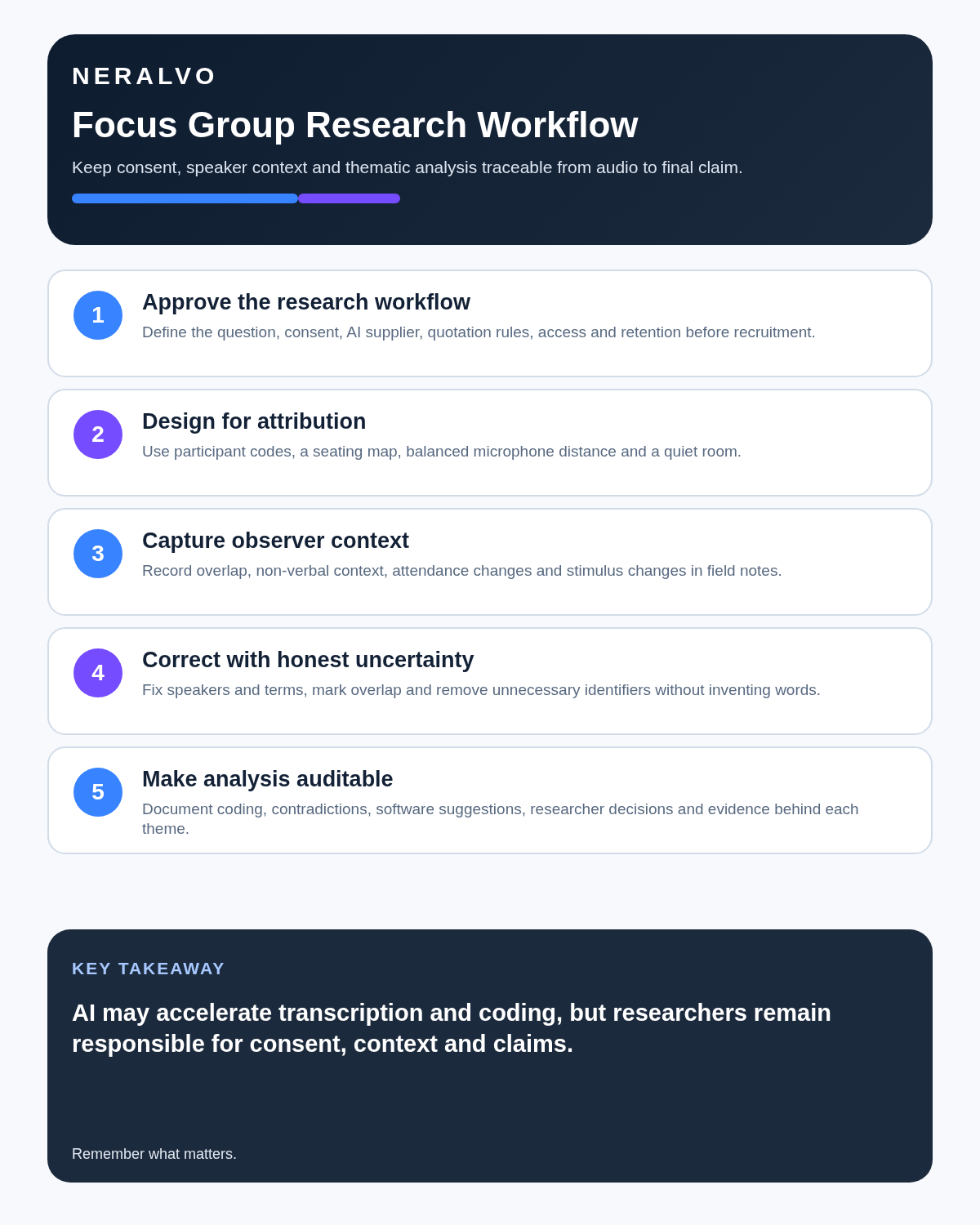
Quick answer: use an AI voice recorder for focus groups only through an approved research and participant-information process. Design the room for reliable speaker attribution, correct the transcript before analysis and preserve a traceable path from source audio to codes, themes, quotations and final claims.
Best fit: Focus Groups who need recoverable audio and human-verified notes in an authorised workflow. Use another method when: recording is prohibited, a participant declines or the approved process requires manual notes.
Focus groups create insight through interaction. Participants agree, challenge, qualify and reshape answers in response to the group. That richness cannot be reduced safely to an automatic theme list without context, uncertainty and documented researcher judgement.
Evidence basis and limits
- Decision factors covered: Explain the complete data journey; Confidentiality in a group has limits; Design the room for attribution.
- Evidence rule: Claims are weighted by consequence: capture failure, changed meaning, access and recovery matter more than polished wording.
- Boundary: Examples and workflow recommendations must be tested with representative recordings, the intended users and the actual approval process before rollout.
NERALVO sells the Halo AI voice recorder. This guide explains a general research workflow and does not claim that AI transcription or summarisation replaces ethical approval, consent, qualitative methodology or researcher accountability.

Start with the research question
Recording should serve a defined research purpose rather than becoming the default simply because the technology is available.
- What is the exact research question?
- Why is group interaction more useful than individual interviews?
- Who should participate, and who should not be grouped together?
- Is identifiable audio necessary?
- Which transcription or AI services are approved?
- Who can access audio, transcripts, coding files and reports?
- How will quotations be anonymised or attributed?
- What withdrawal arrangements apply?
- How long will each record type be retained?
- What happens if distress, safeguarding or sensitive disclosure occurs?
Explain the complete data journey
Participants should understand that the session is recorded, why audio is needed, whether AI processing is used, where processing occurs, who can access the files, how names and quotations may be used, the limits of group confidentiality, retention periods and how questions or withdrawal requests are handled.
Do not describe the process only as “recorded for notes.” Explain the material stages clearly enough for participants to make an informed decision.
Confidentiality in a group has limits
The researcher can control their own storage and reporting, but cannot guarantee that participants will never repeat what others said. Set ground rules, explain the limitation honestly and avoid grouping people where disclosure could create professional, social, financial or personal harm.
Design the room for attribution
| Control | Purpose |
|---|---|
| Manageable group size | Reduces overlap and improves participation |
| Consistent seating | Supports a speaker map |
| Similar recorder distance | Reduces volume differences |
| Quiet, soft-furnished room | Reduces noise and echo |
| Participant identifiers | Supports accurate correction and anonymisation |
| Observer field notes | Capture non-verbal context and speaker order |
| Test recording | Confirms audibility before the session begins |
Use a moderator and observer where possible
The moderator focuses on questions, participation, balance and safety. The observer can maintain a seating map, note attendance changes, capture analytically relevant non-verbal context, mark overlap, record references to visual materials and follow the approved process for distress or safeguarding concerns.
Make the session easier to transcribe
- Record introductions or participant codes in sequence.
- Ask one question at a time.
- Use participant codes when directing follow-ups.
- Allow silence rather than filling every pause.
- Stop persistent side conversations.
- Repeat material points after overlap.
- Spell specialist names and terms.
- Announce activities, stimulus changes and breaks.
- State when someone joins or leaves.
- Read back important factual claims where accuracy matters.
Separate the machine transcript from the research transcript
A machine transcript is a draft. A research-ready transcript may require corrected speaker labels, participant codes, verified terms, marked overlap, removal of identifiers, uncertainty markers, field-note links and a correction log.
Use honest uncertainty
| Problem | Safer notation |
|---|---|
| Words cannot be heard | [inaudible 00:24:11] |
| Speaker uncertain | [participant uncertain] |
| Two interpretations possible | [unclear: cost or course] |
| Several people overlap | [overlapping discussion] |
| Identifying detail removed | [workplace removed] |
| Non-verbal response relevant | [several participants nod] |
A visible gap is safer than a plausible invented phrase.
An AI summary is not thematic analysis
Researchers should define the unit of analysis, coding approach, codebook development, treatment of contradictory evidence, reviewer roles, relationship between themes and the research question, and how AI suggestions are accepted, modified or rejected.
Frequency alone does not determine importance. A rare comment may reveal a serious risk, while repeated agreement may reflect group pressure, social desirability or dominance by a confident participant.
Use a documented coding workflow
- Correct and anonymise the transcript according to the approved plan.
- Read the full transcript before accepting automated themes.
- Create initial codes linked to exact passages.
- Record code definitions and exclusions.
- Compare coding where more than one reviewer is involved.
- Search actively for contradictory and negative cases.
- Develop themes that answer the research question.
- Check every reported claim against the source evidence.
- Record material interpretation decisions.
Protect quotations from re-identification
- Check the quotation against its full context.
- Confirm that it represents the stated theme.
- Remove unnecessary identifying detail.
- Assess whether the remaining combination could identify the participant.
- Apply the approved attribution rule.
- Keep a controlled source link where required.
Changing a few words may not be enough where occupation, location, age, project or unusual circumstances identify the speaker indirectly.
Maintain an auditable evidence chain
| Stage | Required record |
|---|---|
| Recruitment | Approved participant information and eligibility process |
| Session | Audio, participant map and field notes |
| Transcription | Raw output, corrected transcript and correction log |
| Coding | Codebook, coding decisions and revisions |
| Analysis | Theme development, negative cases and interpretation |
| Reporting | Claims linked to checked evidence and approved quotations |
| Closure | Retention, archive or deletion record |
Security and retention
Use approved accounts and controlled storage. Set separate retention periods for contact details, source audio, identifiable transcripts, anonymised analysis files, coding records and final reports. Delete temporary exports and working copies when they no longer serve the approved purpose.
When a compact recorder is not enough
Use specialist multi-microphone or professional research capture where the group is large, the room is difficult, remote and in-person participants are mixed, precise attribution is critical or the consequences of error are high. Test the exact arrangement before collecting real data.
How NERALVO Halo fits
Check whether NERALVO Halo fits focus groups work provides NOTE mode, 64GB local storage, up to 35 hours of recording and Bluetooth transfer to DOWAY for transcripts and structured outputs. One year of DOWAY Max is included from activation.
Halo may support approved small-group research, pilot sessions and researcher debriefs. It does not replace participant information, ethical review, room design, transcript correction or qualitative analysis.
Cloud software, a dedicated recorder or manual notes?
For Focus Groups, the right answer changes with the setting. This matrix deliberately gives each method a situation where it can be the strongest choice.
| Situation | Best starting point | Reason |
|---|---|---|
| scheduled remote meetings | Cloud meeting software | Calendar automation and shared integrations are usually the strongest advantage. |
| in-person or mobile work | Dedicated recorder | Independent capture reduces reliance on an active phone or laptop. |
| recording is refused or prohibited | Manual notes or an approved alternative | The boundary takes priority over convenience. |
| mixed online and offline work | Governed hybrid | Use each method only in the setting it actually fits. |
Frequently asked questions
Can AI perform thematic analysis automatically?
It can suggest patterns, but researchers remain responsible for method, interpretation, contradictory evidence and the final claims.
Can one compact recorder handle every focus group?
No. Group size, room acoustics, overlap and attribution requirements may justify specialist equipment.
Can participants be promised complete confidentiality?
No. Explain that other participants may repeat what they hear, even when ground rules are agreed.
What if a speaker cannot be confirmed?
Mark the speaker as uncertain rather than guessing.
Should the raw AI transcript be shared with participants?
Only where the approved research process requires it. First consider identifiers, third-party information, access controls and whether sharing could expose other participants.
Can recordings be kept for future research?
Only where that future use is properly defined, permitted and communicated. Do not retain identifiable audio indefinitely merely because storage is available.
Useful resources
- ICO data-protection guidance
- Transcription Accuracy vs Audio Quality
- How to Compare AI Transcription Systems Fairly
- Check whether NERALVO Halo fits focus groups work
Final focus-group checklist
- Research question and processing plan approved
- Participant information accurate and complete
- Limits of group confidentiality explained
- Room and speaker mapping tested
- Overlap and uncertainty marked honestly
- Transcript corrected before analysis
- Coding method documented
- Contradictory evidence considered
- Claims linked to checked evidence
- Quotation identification risk assessed
- Retention and deletion controlled
Bottom line: AI can accelerate transcription and organisation, but accountable focus-group research depends on participant transparency, reliable capture, corrected evidence and a visible analytical trail.
On this page
More in this topic: Accessible and public-facing professional work
Show 7 closely related guides
- AI Voice Recorder for Professionals with Dyslexia: Spoken Capture and Accessible Notes
- AI Voice Recorder for Neurodivergent Professionals: Practical Meeting and Note-Taking Workflow
- AI Voice Recorder for Ombudsman Investigators: Evidence, Fairness and Decision Workflows
- AI Voice Recorder for Complaints Managers: Evidence, Findings, Remedies and Resolution
- AI Voice Recorder for Transport Planners: Consultation Evidence, Model Assumptions and Decisions
- AI Voice Recorder for Urban Designers: Better Site Notes and Consultation Evidence
- AI Voice Recorder for Renewable Energy Consultants: Site Surveys, Assumptions and Feasibility Notes
Related guides
Check permission, retention and access before choosing hardware
Once the policy requirements in this guide are satisfied, compare Halo’s specifications, local storage, included services and current offer against your approved workflow.
Found an error or an out-of-date claim? Email support@neralvo.com with the article address and a supporting source.