The 60-second verdict
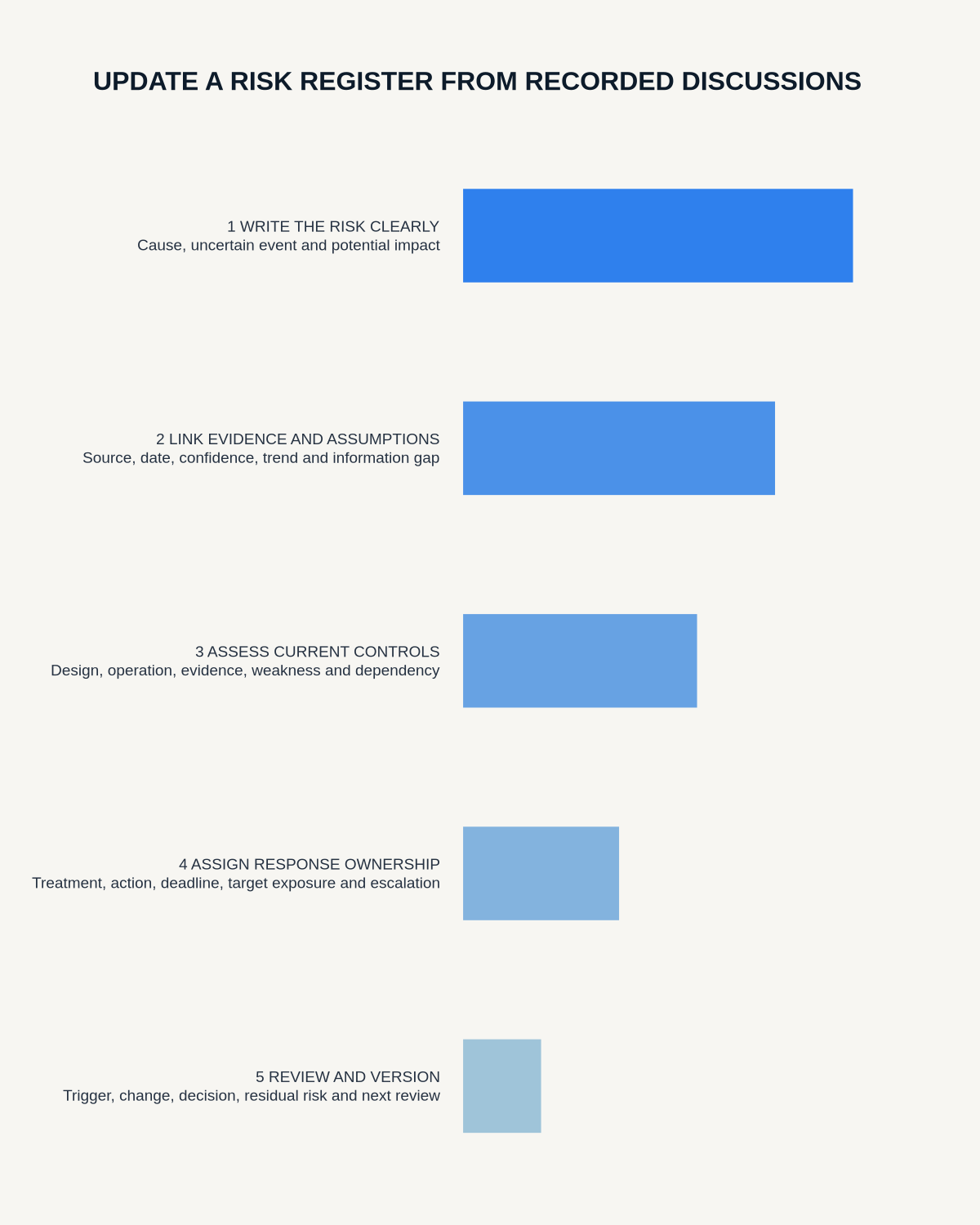
Quick answer: update a risk register from recorded discussions by rewriting each candidate as a cause-event-effect statement, verifying the evidence, checking the existing register, assessing likelihood and impact through the approved method, assigning a risk owner and control owners, and recording specific treatment actions and review triggers.
Decision focus: use the method below only where it produces a recoverable source, a verifiable output and a clear next action. If one of those fails, change the workflow rather than trusting a polished summary.
Evidence basis and limits
- Decision factors covered: Use cause-event-effect wording; Extract the supporting discussion; Update rather than duplicate.
- Evidence rule: The decision is based on the complete capture-to-action workflow, not a single feature or marketing accuracy percentage.
- Boundary: Examples and workflow recommendations must be tested with representative recordings, the intended users and the actual approval process before rollout.
Meetings often mix current issues, general concerns, assumptions and risks. The register should contain uncertain future events that may affect objectives—not every negative statement.

Separate risk from related record types
- Risk: an uncertain future event.
- Issue: a problem already exists.
- Assumption: an unverified belief used in planning.
- Dependency: an external input or condition.
- Action: work to reduce or respond to exposure.
A failed control may create an issue and increase a related risk at the same time. Keep the records linked without treating them as interchangeable.
Use cause-event-effect wording
Because of cause, there is a possibility that event may occur, leading to effect on objective.
This prevents vague entries such as “supplier risk” and helps identify the correct controls.
Extract the supporting discussion
For each candidate risk, preserve:
- Evidence that the cause exists.
- Assumptions and uncertainty.
- Current controls.
- Control weaknesses.
- Early warning indicators.
- Suggested responses.
- Dependencies and affected objectives.
- Material disagreement about exposure or treatment.
The transcript can help locate this material, but the final entry should contain concise verified evidence rather than a compressed meeting narrative.
Preserve source and evidence status
Record the meeting, timestamp, speaker role, documents and data supporting the candidate. Label direct evidence, report, estimate and interpretation separately. Confidence in the discussion is not a risk score.
Update rather than duplicate
Search the existing register for the same cause, event, objective, control or treatment before creating a new record. Add new evidence, changed indicators or revised exposure to the existing risk where appropriate.
A separate linked risk may be justified where ownership, impact, treatment or decision authority differs materially. Record the relationship so reporting does not count one underlying exposure several times.
Assess through the approved method
Use the organisation’s likelihood, impact, proximity and velocity definitions. Consider financial, safety, legal, customer, schedule, quality and reputation effects where relevant. Record rationale and uncertainties.
AI may organise evidence or draft wording, but likelihood, impact, tolerance, velocity and overall rating require the authorised human risk process.
Separate ownership
- Risk owner: accountable for monitoring and response.
- Control owner: maintains a specific control.
- Action owner: completes a treatment task.
Do not assign “the project team” where one accountable role is required. Record who approved the rating and ownership and when.
Distinguish controls from actions
A control already operates to reduce likelihood or impact. An action changes or introduces a control. Record evidence that the control exists and, where needed, whether it works.
“We have a process” is not evidence of effectiveness. Identify the control owner, operation, monitoring result, exception history and known weakness.
Preserve dissent and changing views
Where participants disagree about the cause, likelihood, impact, control effectiveness or tolerance, retain the material positions and identify the final decision authority. Do not allow an AI summary to manufacture consensus or remove a minority warning that may later become important.
Set triggers and review dates
Define indicators that increase, reduce or realise the risk. Set the next review based on exposure, decision timing and change—not an arbitrary date alone.
Handle realised risks
When the uncertain event occurs, create or link the issue or incident record. Preserve the original risk history and update treatment, impact and lessons transparently.
Close risks deliberately
Close only when the exposure no longer exists, the objective has passed, it has realised and transferred to an issue, or the authorised owner accepts another defined end state. Record the reason and evidence.
Discussion-to-register workflow
- Transcribe the authorised workshop or review.
- Extract cause, event and effect statements.
- Separate risks, issues, assumptions, dependencies and actions.
- Search for existing related records.
- Verify evidence, controls, indicators and affected objectives.
- Draft the update without assigning an automatic score.
- Preserve material dissent and unresolved uncertainty.
- Obtain risk-owner and governance review.
- Record the approved rating, response, owner and review date.
- Link issues, actions, decisions and closure evidence.
How NERALVO Halo may support risk workshops
View Halo specifications against the evidence checklist can support authorised workshops and review meetings through NOTE recording, supported CALL capture, 64GB local storage, up to 35 hours of recording and Bluetooth sync with DOWAY.
DOWAY can create transcripts, summaries, speaker-separated notes, templates, translations, mind maps and exports, with one year of DOWAY Max included from activation. Use those outputs to locate evidence and draft the candidate update; the approved risk register and human governance process remain authoritative.
Workflow choice matrix for How to Update a Risk Register from Recorded Discussions
Choose the method that protects the source and reduces downstream correction. The table makes the non-hardware options explicit.
| Condition | Preferred route | Why |
|---|---|---|
| High-risk or mixed work | Governed hybrid | Separate capture, review, approval and retention rather than trusting one tool. |
| Recording is refused, prohibited or unnecessary | Manual notes / no recording | Respecting the boundary is the correct workflow, not a product failure. |
| In-person, mobile or unreliable-connectivity work | Dedicated recorder | Independent capture and a recoverable local source are usually more resilient. |
| Repeatable remote work with approved integrations | Cloud software | Automation and central collaboration may outweigh device independence. |
Frequently asked questions
Can AI score a risk automatically?
No. It can organise candidate evidence, but scoring requires the approved human process.
Should every concern enter the register?
No. Classify it first as risk, issue, assumption, dependency or action.
What happens when a risk occurs?
Link it to an issue or incident while preserving the original risk record.
What makes a control credible?
Evidence that it operates, an accountable owner and monitoring showing whether it is effective.
Should disagreement remain in the record?
Material dissent should remain visible until the authorised decision is made and the rationale is recorded.
Useful resources
- Association for Project Management risk guidance
- How to Create an Issue Log
- How to Create a Process Exception Register
- Quarterly Governance Review Checklist
- How to Build an Incident Chronology from Recorded Debriefs
Final risk checklist
- Cause, event and effect clear.
- Evidence and uncertainty visible.
- Existing related risks checked.
- Controls supported by evidence.
- Dissent and assumptions preserved.
- Approved scoring method used.
- Risk, control and action owners named.
- Triggers and review date present.
- Realised risks linked to issues or incidents.
- Closure reason supported.
Bottom line: recorded discussion can make a risk update more traceable, but the official rating, ownership, treatment and closure remain human-governed decisions.
On this page
Related guides
See whether Halo fits this workflow
Review the NERALVO Halo specifications, included services, delivery information and current offer only after completing the guide.
Found an error or an out-of-date claim? Email support@neralvo.com with the article address and a supporting source.