The 60-second verdict
Quick answer: build a sales-objection library by preserving the customer’s exact concern, context, underlying evidence, buying stage and resolution status. Separate genuine objections from questions, constraints and polite deferrals, then connect each entry to an approved response and evidence.
Decision focus: use the method below only where it produces a recoverable source, a verifiable output and a clear next action. If one of those fails, change the workflow rather than trusting a polished summary.
Evidence basis and limits
- Decision factors covered: Classify the customer statement; Capture the complete objection record; Preserve voice-of-customer language.
- Evidence rule: A claim earns weight only when the source, date, configuration and limitation are clear enough for a reader to check.
- Boundary: Examples and workflow recommendations must be tested with representative recordings, the intended users and the actual approval process before rollout.
A useful objection library improves discovery and sales enablement. A weak one teaches teams to force every concern into a scripted rebuttal.

Define the purpose and source rules
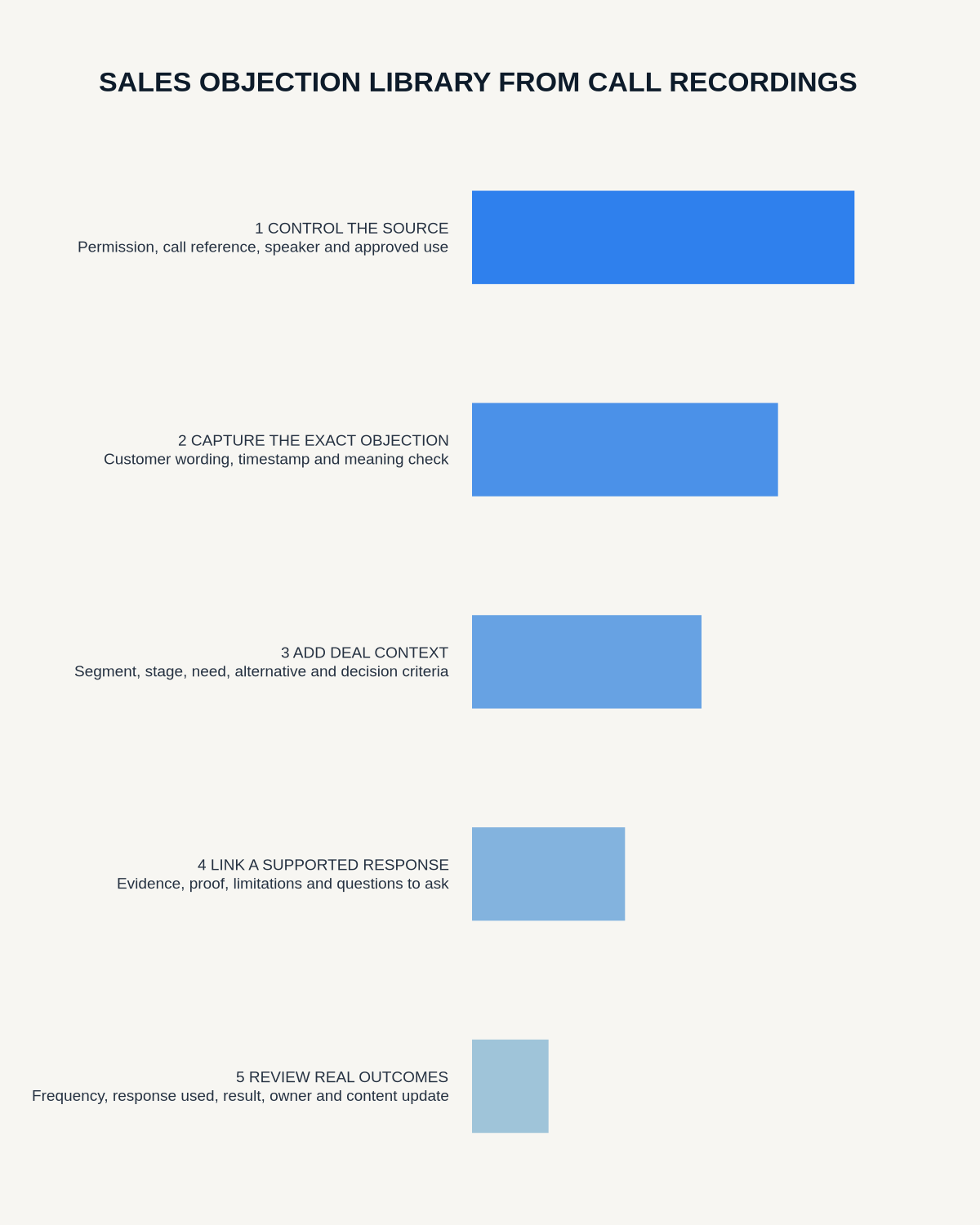
State which products, customer segments, markets and sales stages are covered. Use only authorised calls and approved accounts. Confirm whether quotations will be anonymised, paraphrased or used internally.
Classify the customer statement
- Question: information is missing.
- Objection: a specific reason not to proceed.
- Constraint: budget, timing, policy or authority prevents action.
- Risk: a feared negative outcome.
- Deferral: no current priority or decision.
- Polite refusal: the customer does not wish to continue.
Misclassifying a constraint as an objection encourages the wrong response.
Capture the complete objection record
- Customer segment and buying stage
- Exact or checked paraphrased wording
- Triggering offer or claim
- Underlying need, risk or evidence
- Decision authority and stakeholders
- Response provided
- Customer reaction and final status
- Evidence or product change required
Preserve voice-of-customer language
Check important phrases against the recording. Remove personal information and avoid rewriting a clear concern into sales jargon. Keep context so the quote is not used outside the situation in which it was expressed.
Separate response from proof
An approved talk track is not evidence. Link product claims, security statements, implementation commitments and commercial terms to current authorised sources. Remove obsolete responses after product or policy changes.
Measure whether the concern was resolved
Record whether the customer accepted the answer, required evidence, delayed, declined or raised a different concern. Do not mark an objection “handled” merely because the salesperson responded.
Use patterns for improvement
Review objections by segment, stage, source, frequency, severity and outcome. Repeated concerns may indicate weak positioning, missing evidence, product friction, pricing confusion or unsuitable targeting.
Protect fair selling
Do not use the library to pressure customers or hide material limitations. Preserve clear refusals and route complaints, vulnerability or regulated matters through the appropriate process.
Workflow choice matrix for How to Build a Sales Objection Library from Call Recordings
Choose the method that protects the source and reduces downstream correction. The table makes the non-hardware options explicit.
| Condition | Preferred route | Why |
|---|---|---|
| High-risk or mixed work | Governed hybrid | Separate capture, review, approval and retention rather than trusting one tool. |
| Recording is refused, prohibited or unnecessary | Manual notes / no recording | Respecting the boundary is the correct workflow, not a product failure. |
| In-person, mobile or unreliable-connectivity work | Dedicated recorder | Independent capture and a recoverable local source are usually more resilient. |
| Repeatable remote work with approved integrations | Cloud software | Automation and central collaboration may outweigh device independence. |
Frequently asked questions
Should every negative comment become an objection?
No. It may be a question, constraint, risk or refusal.
Can AI recommend the best rebuttal?
It can organise approved material, but responses must remain accurate, fair and appropriate to the customer.
How often should the library be reviewed?
After material product, price, policy or market changes and whenever recurring objections shift.
Useful resources
- ICO direct-marketing guidance
- AI Voice Recorder for Sales Calls
- How to Turn Recordings into CRM Notes
- How to Create a Customer FAQ
Final library checklist
- Statement classified correctly
- Customer language and context preserved
- Response linked to evidence
- Resolution status genuine
- Personal information minimised
- Obsolete content reviewed and removed
On this page
Related guides
See whether Halo fits this workflow
Review the NERALVO Halo specifications, included services, delivery information and current offer only after completing the guide.
Found an error or an out-of-date claim? Email support@neralvo.com with the article address and a supporting source.