The 60-second verdict
Quick answer: an AI voice recorder can help account managers produce clearer CRM notes when every recording is authorised, important facts are checked against the audio and only the concise business record—not the full transcript—is transferred into the CRM.
Best fit: Account Managers who need recoverable audio and human-verified notes in an authorised workflow. Use another method when: recording is prohibited, a participant declines or the approved process requires manual notes.
Evidence basis and limits
- Decision factors covered: Why account-management notes often fail; Choose the right account meetings to record; Capture the customer’s operating context.
- Evidence rule: Claims are weighted by consequence: capture failure, changed meaning, access and recovery matter more than polished wording.
- Boundary: Examples and workflow recommendations must be tested with representative recordings, the intended users and the actual approval process before rollout.
Account managers spend much of the working week in conversations: discovery calls, implementation check-ins, service reviews, commercial discussions and renewal planning. The difficulty is not hearing the customer. It is turning dozens of spoken details into accurate commitments, useful CRM notes and follow-up that arrives before trust is lost.
An AI voice recorder for account managers can support that process when calls and meetings are recorded with permission and handled under the organisation’s approved rules. It can help recover customer priorities, objections, promised actions and decision criteria. It should not become an excuse to record every interaction or copy unverified summaries directly into the CRM.
Why account-management notes often fail
Account managers have to listen, build rapport, ask commercial questions and think about the next move at the same time. Manual notes are usually compressed into fragments. Important context may be omitted because it appeared obvious during the call but is unclear two weeks later.
Common failures include:
- A customer request being recorded without the reason or business impact.
- A verbal commitment being remembered differently by sales, delivery and the customer.
- Renewal concerns being buried inside a general meeting summary.
- Several stakeholders expressing different priorities without those differences being labelled.
- Actions entering the CRM without an owner or deadline.
- Commercial figures being copied incorrectly.
Recording can reduce these gaps, but the value comes from a disciplined extraction process rather than the transcript alone.
Choose the right account meetings to record
Not every customer conversation needs audio. Record only when there is a clear business purpose and the participants have been informed appropriately.
Useful situations may include:
- New-customer discovery and handover meetings.
- Implementation or onboarding reviews.
- Quarterly or strategic business reviews.
- Renewal and expansion conversations.
- Complex service or delivery discussions.
- Multi-stakeholder requirement workshops.
- Approved customer research interviews.
A short scheduling call, casual check-in or conversation containing material that should not enter the recording workflow may be better handled with ordinary notes.
Capture the customer’s operating context
Good account notes explain more than what the customer asked for. They show how the customer operates and why the request matters.
Extract:
- Business goals and current priorities.
- Teams, locations and users affected.
- Existing process or system constraints.
- Success measures and reporting expectations.
- Decision makers, users, influencers and blockers.
- Budget timing and approval stages where appropriately discussed.
- Known risks, dependencies and competing initiatives.
Label information by source. “Finance has frozen all discretionary spending” is different from “the project lead expects finance to be cautious”. The first may be a stated fact; the second is a stakeholder’s interpretation.
Turn conversations into structured CRM notes
A transcript should not be pasted into the CRM. It is too long, may include irrelevant personal detail and can obscure the commercial signal. Create a concise, checked record with consistent fields.
Meeting purpose
State why the meeting happened and what outcome was expected.
Customer priorities
Record the outcomes the customer is trying to achieve, in the customer’s own language where useful.
Current position
Summarise progress, usage, delivery status, open issues and evidence.
Risks and objections
Separate an explicit objection from a possible concern inferred by the account manager. Include the impact and any evidence required.
Commitments
Record exactly what was promised, by whom, to whom and by when. Avoid upgrading exploratory language into a commitment.
Next step
Every meaningful meeting should end with a defined next event, owner and date.
Manual notes vs an AI-assisted account workflow
| Account task | Manual notes only | AI-assisted workflow | Human control still required |
|---|---|---|---|
| Customer priorities | Key wording may be shortened or missed | Searchable transcript preserves more context | Confirm what is current and material |
| Commitments | Actions can be split across notebooks and inboxes | Draft actions can be extracted into one review list | Verify owner, wording and due date |
| CRM update | Written later from memory | Structured notes can be drafted soon after the call | Remove irrelevant or sensitive content |
| Renewal risk | Signals depend on individual recollection | Repeated concerns can be easier to locate | Do not treat AI sentiment as proof |
Improve handover between sales and delivery
Customer frustration often begins when information collected during the sale does not reach implementation or service teams. A controlled recording and checked summary can support a more complete handover.
The handover should cover:
- The original problem and expected outcome.
- Scope sold and anything explicitly excluded.
- Key assumptions made during the sale.
- Stakeholder expectations and communication preferences.
- Critical dates and dependencies.
- Technical, operational or security requirements.
- Risks already raised.
- Unresolved questions requiring confirmation.
Do not treat a sales-call transcript as a contract. Formal scope, pricing and obligations must remain in the approved commercial documents.
Use voice evidence to prepare better business reviews
Quarterly business reviews often become backward-looking presentations full of activity statistics. Recorded customer conversations can help account managers reconnect those figures to the customer’s stated objectives.
Before the review, search prior notes for:
- Outcomes the customer expected.
- Problems they wanted removed.
- Measures they said would demonstrate value.
- Promises made by both organisations.
- Repeated service concerns.
- New priorities mentioned since the last review.
Build the agenda around progress, evidence, unresolved gaps and decisions. Do not use isolated quotations to create a misleading success story. Context and current confirmation matter.
Detect renewal risk without inventing sentiment
AI tools may label calls as positive or negative, but account managers should not rely on automated sentiment as a renewal forecast. A calm customer can still be preparing to leave, while a frustrated customer may remain strongly committed to the relationship.
Use observable indicators instead:
- Reduced engagement or attendance.
- Unresolved high-impact issues.
- Failure to achieve agreed outcomes.
- Loss of an internal sponsor.
- Budget uncertainty or procurement delays.
- Requests for data exports, contract terms or competitor comparisons.
- Explicit dissatisfaction or missing confidence.
Record what was said, what behaviour was observed and what evidence supports the risk rating. Keep assumptions visible.
Control promises and commercial statements
Account managers frequently discuss potential features, timelines, discounts and service responses. Spoken language can be conditional, but summaries often remove the condition.
Distinguish:
- Confirmed commitment: approved and owned.
- Proposed option: under consideration.
- Customer request: desired but not agreed.
- Working assumption: used for planning and still to be tested.
- Future possibility: not part of current scope.
Where a statement changes scope, price or contractual expectations, confirm it through the authorised commercial process.
Create action notes that teams can execute
After the meeting, convert discussion into a small action table. Each action needs one responsible owner, a specific deliverable, a due date and any dependency.
For example, “send information” is weak. “Amir to send the revised implementation timeline, including the data-migration dependency, by Thursday” is usable.
Separate customer-owned and supplier-owned actions. Highlight actions that block delivery, renewal or a decision. Then send the checked follow-up promptly rather than waiting for the transcript to become perfect.
For longer-term customer planning, the AI voice recorder guide for customer success teams explains how to structure onboarding, QBR and renewal-risk notes. When a discovery conversation needs to become a commercial document, see the guide to creating client proposals from discovery-call recordings.
Protect customer and commercial information
Account recordings may contain personal data, pricing, contract discussions, security information and internal customer plans. Use only approved tools and access controls. Confirm where the audio and transcript are processed, who can export them and how deletion works.
Minimise what enters the CRM. Store the concise business record, not unnecessary conversation. Follow the customer agreement, organisational policy and retention schedule. When a recording is no longer needed, remove it rather than keeping an indefinite archive.
How NERALVO Halo may support account managers
Check whether NERALVO Halo fits account managers work provides portable recording and transcription support for authorised customer meetings. A dedicated device can help account managers focus on the conversation and review key details afterwards without relying only on rushed handwritten notes.
Before deployment, test the recorder in typical meeting rooms and calls, confirm the approved data workflow and define how outputs will enter the CRM. The device should support the process, not become the system of record.
Cloud software, a dedicated recorder or manual notes?
For Account Managers, the right answer changes with the setting. This matrix deliberately gives each method a situation where it can be the strongest choice.
| Situation | Best starting point | Reason |
|---|---|---|
| scheduled remote client meetings | Cloud meeting software | Calendar automation and shared integrations are usually the strongest advantage. |
| in-person visits and travel | Dedicated recorder | Independent capture reduces reliance on an active phone or laptop. |
| a client declines or policy requires manual notes | Manual notes or an approved alternative | The boundary takes priority over convenience. |
| mixed CRM and field work | Governed hybrid | Use each method only in the setting it actually fits. |
Frequently asked questions
Can account managers record customer calls?
Only when the organisation’s rules and the customer’s permission allow it. Explain the purpose and use an approved recording and storage process.
Should the full transcript be stored in the CRM?
Usually a concise, checked summary is more useful and creates less unnecessary data. Store only what the organisation requires.
Can AI identify renewal risk automatically?
It can surface phrases and themes, but renewal risk should be based on verified commercial, relationship and delivery evidence.
How quickly should meeting notes be sent?
Send checked actions and commitments while they are still useful, ideally soon after the meeting. Accuracy matters more than an instant unreviewed summary.
Can recorded customer statements be treated as approval?
Only where the applicable governance and contract process recognises that form of approval. Important decisions should be confirmed through the authorised channel.
Make every customer conversation easier to act on
An AI voice recorder can help account managers preserve customer language, improve handovers and create clearer follow-up. The strongest workflow remains human-led: obtain permission, capture for a defined purpose, verify critical details and move the final actions into the systems the team already uses.
Related guides
- How to Choose an AI Voice Recorder: Complete Buyer’s Guide
- AI Voice Recorder for Management Consultants: Interviews, Workshops and Recommendations
- AI Voice Recorder for Recruitment Consultants: Client Briefs, Candidate Interviews and Placement Notes
- AI Voice Recorder for Corporate Development: Diligence Calls, Assumptions and Deal Decisions
Profession workflow
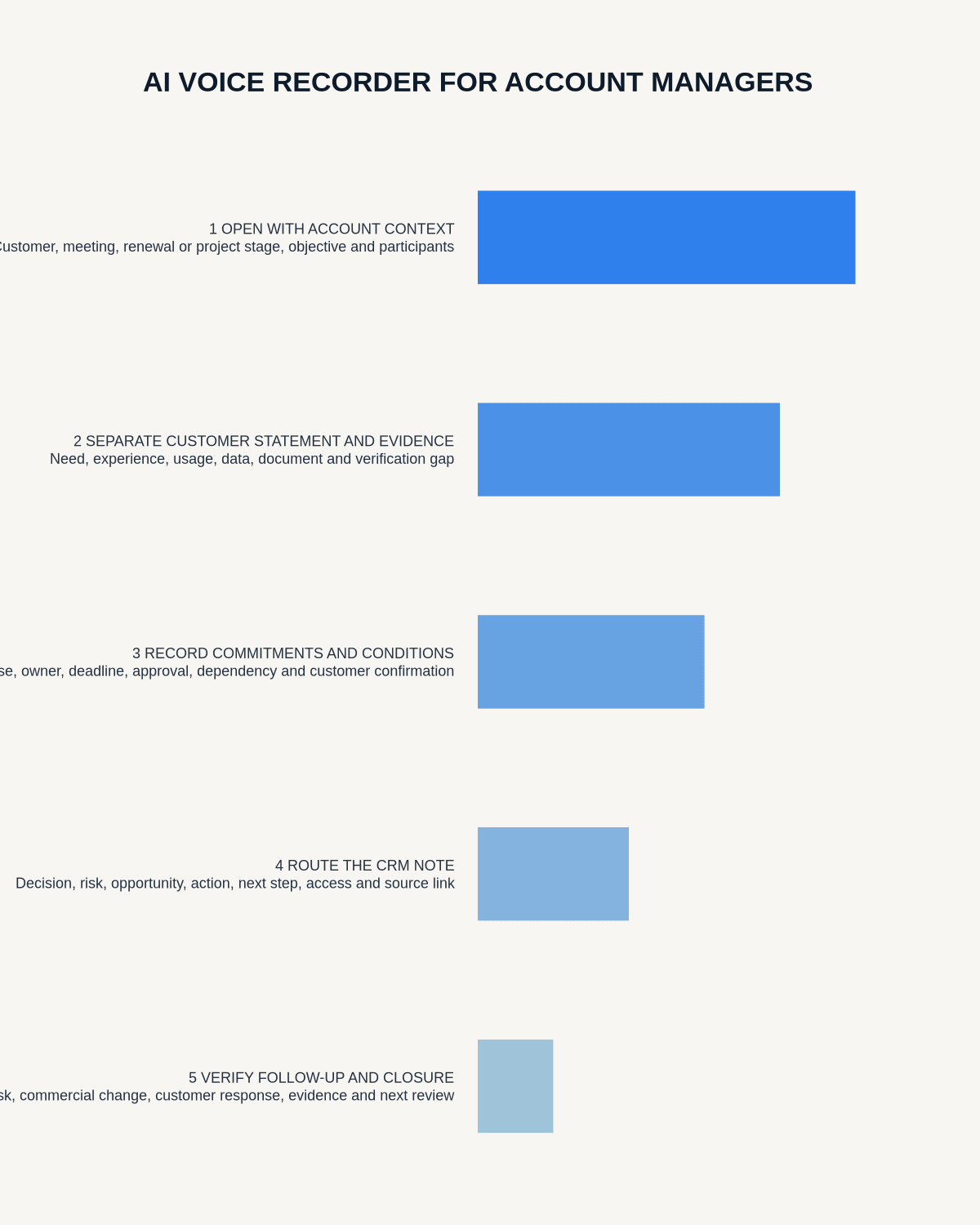
Visual map for AI Voice Recorder for Account Managers: Clearer Client Commitments and CRM Notes
- Prepare the approved useDefine purpose, safe position, permission and the required formal record.
- Capture context firstState the case, asset, person, location or event identifier before detail.
- Human-verify evidenceCheck technical terms, units, names, dates, decisions and uncertainty.
- Complete the formal recordTransfer only verified information and apply access and retention controls.
On this page
Related guides
See whether Halo fits this workflow
Review the NERALVO Halo specifications, included services, delivery information and current offer only after completing the guide.
Found an error or an out-of-date claim? Email support@neralvo.com with the article address and a supporting source.