
The 60-second verdict
Quick answer: family lawyers can use an AI voice recorder for authorised client conferences and private dictation, but the final attendance note must separate the client’s instructions, allegations, verified evidence, legal advice, urgent safeguarding issues and formal court or agreement status.
Best fit: Family Lawyers who need recoverable audio and human-verified notes in an authorised workflow. Use another method when: recording is prohibited, a participant declines or the approved process requires manual notes.
Evidence basis and limits
- Decision factors covered: Start with the current legal and practical objective; Use a structured client interview; Handle children’s information carefully.
- Evidence rule: A claim earns weight only when the source, date, configuration and limitation are clear enough for a reader to check.
- Boundary: Examples and workflow recommendations must be tested with representative recordings, the intended users and the actual approval process before rollout.
Family-law consultations often move between relationship history, children, housing, finance, risk and immediate procedural decisions. A fluent transcript can make an allegation appear proven or a possible option appear agreed. The reliable workflow preserves source and status.
Start with the current legal and practical objective
Record what the client needs now:
- urgent protection or safety advice;
- arrangements for children;
- separation or divorce process;
- housing or occupation concerns;
- financial information and interim support;
- negotiation, mediation or court preparation;
- document review or evidence preservation;
- a clear next procedural step.
This prevents the first meeting from becoming an unstructured life history with no decision path.
Build a source-labelled chronology
| Status | Meaning |
|---|---|
| Client first-hand account | What the client personally experienced, saw or heard |
| Reported information | What another person told the client |
| Allegation | A disputed claim requiring fair handling and evidence |
| Document-supported | Linked to a message, order, statement, report or other record |
| Agreed fact | Accepted or formally established |
| To verify | Material point requiring further evidence |
An AI summary must not merge allegation, interpretation and verified fact into one narrative.
Use a structured client interview
- People: parties, children, dependants and relevant professionals.
- Relationship: key dates, living arrangements and current communication.
- Recent trigger: event that led to the consultation.
- Children: current care, routines, schools, health and expressed concerns.
- Safety: immediate risk, coercion, threats, stalking or safeguarding information.
- Housing and finance: property, income, accounts, liabilities and urgent needs.
- Existing process: orders, agreements, mediation or previous advice.
- Evidence: documents, messages, witnesses and records available.
- Objective: outcome the client seeks and decisions needed now.
Handle children’s information carefully
Record the source of each statement about a child and avoid adult interpretation being presented as the child’s own view. Keep:
- direct observation;
- what the child reportedly said and to whom;
- school, health or professional information;
- parental interpretation;
- disputed account;
- evidence or assessment required.
Do not record more sensitive detail than the legal and safeguarding purpose requires.
Use an urgent-risk fast lane
Where information suggests immediate danger, domestic abuse, child safeguarding risk, unlawful removal, evidence destruction or another urgent issue, follow the firm’s approved emergency and safeguarding process immediately. Do not wait for transcription.
The factual record should show the concern, source, immediate advice, person notified, action taken and time.
Separate advice, option and client decision
| Record type | What it means |
|---|---|
| Client objective | What the client wants to achieve |
| Legal option | A possible route explained by the lawyer |
| Risk or consequence | Potential effect of the option |
| Advice | Professional recommendation based on current information |
| Client instruction | What the client authorises the firm to do |
| Formal outcome | Agreement, undertaking, order or completed filing |
An exploratory discussion is not a final instruction. Preserve conditions and information gaps.
Map financial evidence without treating estimates as facts
For each material item, record:
- asset, income, liability or expenditure;
- person or entity associated;
- client estimate and date;
- document reviewed;
- ownership or valuation issue;
- disclosure or expert evidence required;
- deadline and responsible person.
Figures spoken in a meeting must be checked against statements, valuations and formal disclosure.
Protect privilege and confidentiality
Before recording, define:
- the purpose and authorised participants;
- whether the setting permits recording;
- device, app and processing route;
- who can access audio and transcript;
- how third-party and children’s information is minimised;
- which document becomes the official attendance note;
- retention and deletion;
- how accidental capture is handled.
Do not use a personal consumer account for sensitive client advice or evidence unless the firm has expressly approved the complete workflow.
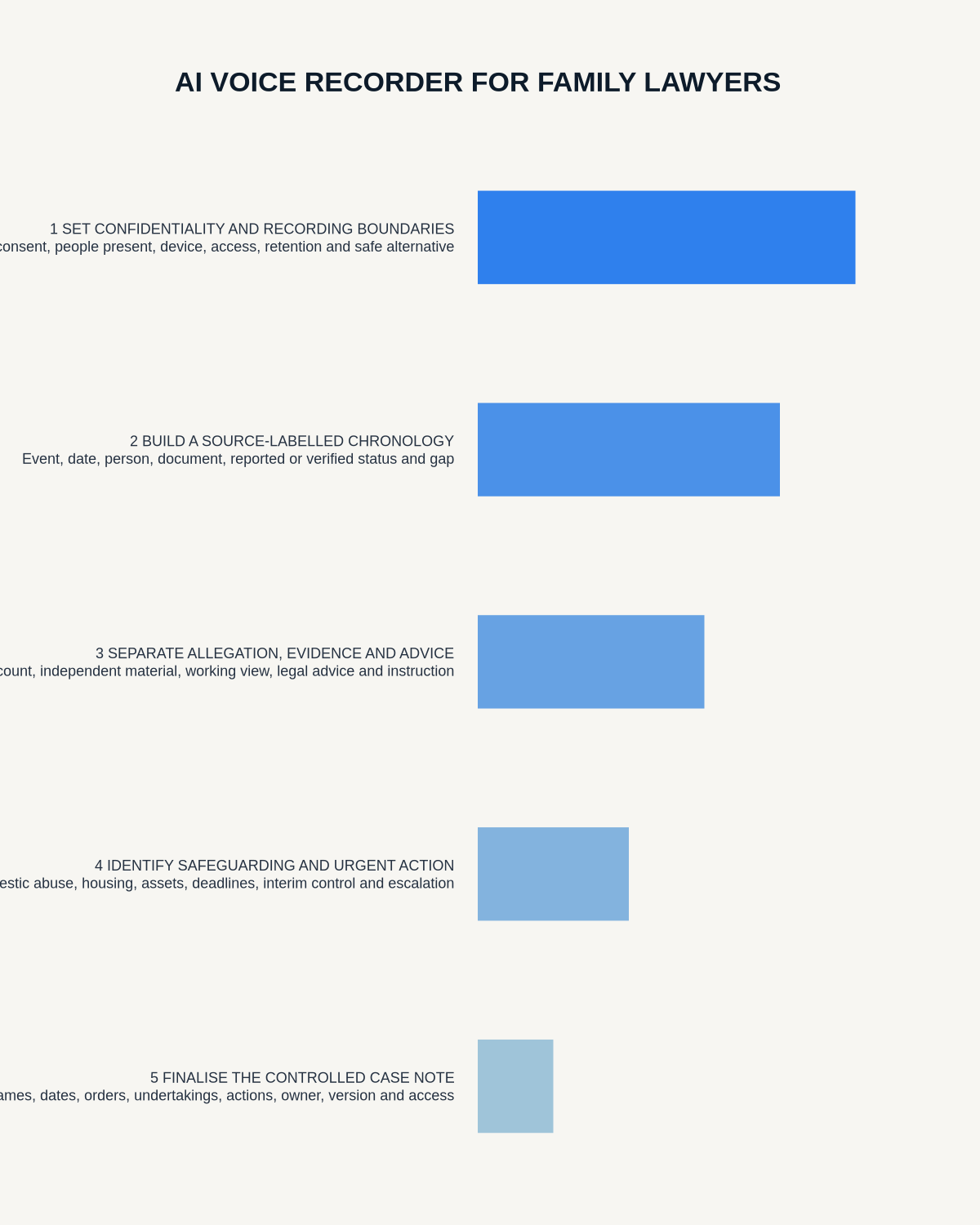
Use a conference-to-matter workflow
- Confirm authority, purpose and confidentiality.
- State the matter reference and immediate objective.
- Take the client’s uninterrupted account where appropriate.
- Build the source-labelled chronology.
- Separate children, risk, finance and procedural issues.
- Verify names, dates, figures and material quotations.
- Record advice, options and client instructions separately.
- Extract evidence requests, deadlines and urgent actions.
- Create the reviewed attendance note.
- Update the matter, diary and formal process.
How NERALVO Halo may support approved family-law work
Assess Halo against the family lawyers workflow matrix may support firm-approved client meetings and private post-conference dictation through NOTE mode, supported CALL capture, 64GB local storage and DOWAY transcription tools. Suitability depends on setting rules, privilege, confidentiality and the complete device-and-app data path.
Cloud software, a dedicated recorder or manual notes?
For Family Lawyers, the right answer changes with the setting. This matrix deliberately gives each method a situation where it can be the strongest choice.
| Situation | Best starting point | Reason |
|---|---|---|
| scheduled remote case meetings | Cloud meeting software | Auto-join and central collaboration can remove routine admin. |
| authorised interviews or field discussions | Dedicated recorder | Dedicated hardware suits movement, variable rooms and offline source capture. |
| privilege, procedure or an objection prevents recording | Manual notes or an approved alternative | A clear alternative respects policy and participant choice. |
| mixed casework | Governed hybrid | One governed process prevents gaps between desk and field work. |
Frequently asked questions
Can the transcript prove an allegation?
No. It records what was said and must be assessed with the available evidence.
Can AI decide the child’s best interests?
No. Legal and welfare decisions require the authorised professional and court processes.
Should every client conference be recorded?
No. Recording must be necessary, proportionate and approved.
Can spoken financial figures enter formal disclosure automatically?
No. Verify them against documents and the required disclosure process.
Final family-law note checklist
- Matter and objective are clear.
- Client account, allegation and evidence are separated.
- Children’s information is source-labelled and minimised.
- Urgent risk entered the correct process immediately.
- Advice, options and client instructions are distinct.
- Financial figures and ownership are verified.
- Actions, evidence requests and deadlines are owned.
- The reviewed attendance note is stored in the matter system.
Bottom line: an AI recorder can help preserve a complex family-law consultation, but the defensible record depends on careful source labels, urgent safeguarding, verified evidence and lawyer-approved instructions.
Related guides
On this page
Related guides
Check permission, retention and access before choosing hardware
Once the policy requirements in this guide are satisfied, compare Halo’s specifications, local storage, included services and current offer against your approved workflow.
Found an error or an out-of-date claim? Email support@neralvo.com with the article address and a supporting source.