
The 60-second verdict
Quick answer: estate planners can use an AI voice recorder to organise authorised client objectives, family relationships, asset evidence and unresolved instructions. The recording does not establish capacity, prove ownership or create a legally valid will, trust or power of attorney.
Best fit: Estate Planners who need recoverable audio and human-verified notes in an authorised workflow. Use another method when: recording is prohibited, a participant declines or the approved process requires manual notes.
Evidence basis and limits
- Decision factors covered: Start with outcomes before assets; Build a family and dependency map; Use an evidence-status label for every asset.
- Evidence rule: A claim earns weight only when the source, date, configuration and limitation are clear enough for a reader to check.
- Boundary: Examples and workflow recommendations must be tested with representative recordings, the intended users and the actual approval process before rollout.
Estate-planning meetings combine family relationships, asset ownership, future wishes, tax questions and difficult personal decisions. The transcript is only a working source. It does not prove ownership, establish capacity, create a valid legal instrument or replace current professional advice.
The strongest workflow creates three connected maps: the client’s objectives, the family and dependency structure, and the verified estate position.
Start with outcomes before assets
Ask what the client wants the plan to achieve:
- provide for particular people;
- protect a dependant or vulnerable beneficiary;
- maintain flexibility;
- support a spouse, partner or later generation;
- plan for business or property continuity;
- make charitable gifts;
- reduce family uncertainty;
- prepare for loss of capacity;
- coordinate existing documents and nominations.
This prevents the meeting from becoming a list of accounts before the adviser understands the purpose.
Build a family and dependency map
Record relationships carefully:
- spouse, civil partner or partner;
- children and stepchildren;
- previous relationships;
- dependants;
- people receiving regular support;
- estranged or disputed relationships;
- executors, attorneys, trustees or other proposed roles;
- potential conflicts between family members.
Names, dates and relationships should be checked against documents where they affect the plan. Keep uncertain or disputed information labelled rather than allowing a summary to present it as settled.
Use an evidence-status label for every asset
| Status | Meaning |
|---|---|
| Client estimate | Value or ownership described from memory |
| Document reviewed | Statement, title, policy or agreement has been seen |
| Third-party confirmation required | Provider, accountant, company or registry evidence is needed |
| Ownership uncertain | Legal or beneficial ownership needs clarification |
| Existing arrangement | Nomination, trust, will or contract may already control the asset |
| Outside current scope | Identified but not yet analysed in the meeting |
An AI transcript may repeat a client estimate as if it were a verified current value. The estate map should retain the evidence status.
Map ownership before discussing distribution
For each material asset or liability, record:
- asset type;
- legal owner;
- possible beneficial owner;
- joint or sole status;
- country or jurisdiction where relevant;
- estimated value and valuation date;
- debt or security;
- existing nomination, trust or contractual direction;
- document required.
Property, company interests, pensions, policies and digital assets may pass through different mechanisms. Do not assume every asset is controlled by the same document.
Separate wishes, instructions and decisions
- idea being explored;
- preference;
- instruction subject to advice;
- decision made;
- decision awaiting information;
- formal document drafted;
- formal document executed.
This stops a meeting summary from suggesting that an option discussed has already become the client’s final instruction.
Record reasons without over-collecting family detail
The client’s reasons may be important, particularly where gifts differ, people are excluded or conditions are considered. Capture enough context for professional advice and file quality, but avoid turning the recording into an unnecessary history of family conflict.
Where a decision may be challenged or misunderstood, record:
- the client’s stated objective;
- alternatives discussed;
- risks or consequences explained;
- information the client considered;
- decision and confidence;
- further advice or evidence required.
Capacity and vulnerability require the professional process
If communication, understanding, coercion, dependency or undue pressure becomes a concern, follow the firm’s approved process. A recorder cannot determine capacity or voluntariness.
Record observable facts rather than labels:
- who attended;
- who answered questions;
- whether the client could explain the plan in their own words;
- where confusion or inconsistency arose;
- what step was taken;
- which professional assessment or separate meeting may be required.
Do not wait for an AI summary before responding to a safeguarding or vulnerability concern.
Review existing documents rather than relying on memory
Ask for copies of relevant materials, which may include:
- current will or codicil;
- trust documents;
- powers of attorney;
- business agreements;
- property records;
- policy or pension nominations;
- marriage or partnership documents where relevant;
- previous tax or professional advice.
Record what the client believes exists, but mark it as unverified until the document is reviewed.
Create a decision-and-evidence list
After the meeting, extract:
- decision already made;
- decision awaiting advice;
- document required;
- valuation or professional input required;
- person responsible;
- deadline or review date;
- formal drafting step.
This is more useful than leaving unresolved points inside a long transcript.
Protect highly sensitive family and financial information
Before recording, define:
- the purpose;
- participant process;
- who may access the source audio;
- where transcription occurs;
- how exports enter the client file;
- whether parts of the meeting should not be recorded;
- retention and deletion;
- which note becomes the approved instruction record.
Raw audio should not be circulated where a concise reviewed note is sufficient.
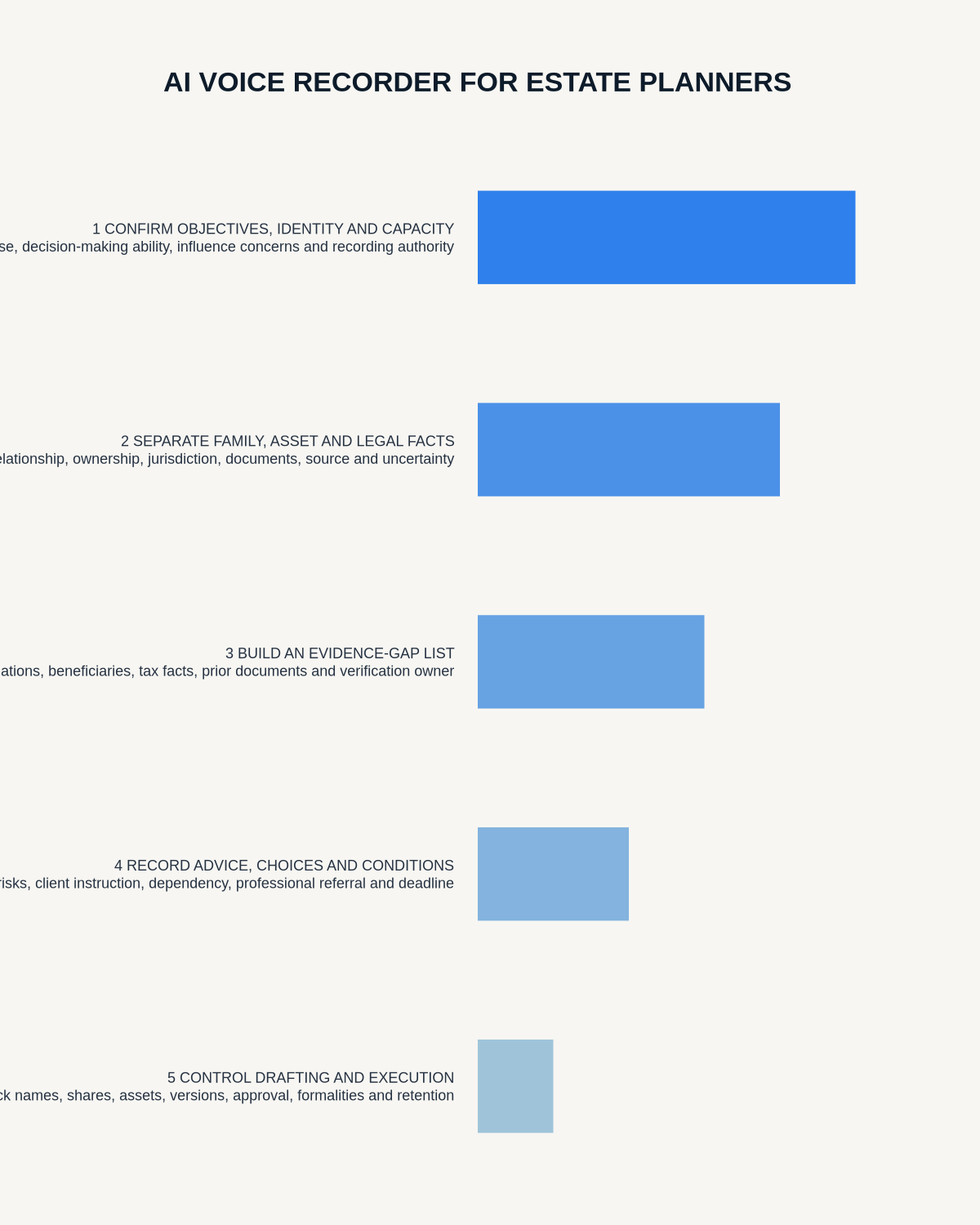
An instruction-to-plan workflow
- Confirm the approved recording and confidentiality process.
- Capture the client’s objectives.
- Build the family and dependency map.
- Build the asset and liability map with evidence status.
- Review existing documents and gaps.
- Separate options, preferences and final instructions.
- Record reasons, risks and decisions proportionately.
- Extract evidence, advice and drafting actions.
- Create the reviewed instruction note.
- Prepare and complete formal documents through the appropriate professional process.
How NERALVO Halo may support approved estate-planning work
Assess Halo against the estate planners workflow matrix provides portable NOTE recording, supported CALL capture, 64GB local storage and DOWAY transcription and structured-note tools. It may support approved client meetings, follow-up reviews and private dictation.
Professional firms should approve confidentiality, app processing, access, export and retention before use. Verify names, ownership, values, percentages and document status manually, and confirm current professional requirements before acting.
Cloud software, a dedicated recorder or manual notes?
For Estate Planners, the right answer changes with the setting. This matrix deliberately gives each method a situation where it can be the strongest choice.
| Situation | Best starting point | Reason |
|---|---|---|
| scheduled remote meetings | Cloud meeting software | Auto-join and central collaboration can remove routine admin. |
| in-person or mobile work | Dedicated recorder | Dedicated hardware suits movement, variable rooms and offline source capture. |
| recording is refused or prohibited | Manual notes or an approved alternative | A clear alternative respects policy and participant choice. |
| mixed online and offline work | Governed hybrid | One governed process prevents gaps between desk and field work. |
Frequently asked questions
Does a recording make instructions legally valid?
No. Formal validity depends on the applicable professional and legal process.
Can AI decide capacity?
No. Use the firm’s approved professional procedure.
Should every family detail be recorded?
No. Record only what is necessary for the planning purpose.
Can an estimated asset value be used as verified?
No. Preserve its evidence status and obtain the appropriate valuation or document.
Final instruction-note check
- Are client objectives clear?
- Are relationships and dependencies accurately mapped?
- Is each asset labelled by evidence status?
- Are ownership and distribution treated separately?
- Are preferences distinguished from final instructions?
- Were vulnerability or capacity concerns handled through the proper process?
- Are existing documents reviewed rather than assumed?
- Does every unresolved point have an owner and next step?
Bottom line: an AI voice recorder can help preserve complex family and financial instructions. The reliable plan still depends on verified ownership, careful professional judgement and formal documents completed through the correct process.
Related guides
On this page
Related guides
See whether Halo fits this workflow
Review the NERALVO Halo specifications, included services, delivery information and current offer only after completing the guide.
Found an error or an out-of-date claim? Email support@neralvo.com with the article address and a supporting source.