The 60-second verdict
Quick answer: financial advisers can use an AI voice recorder to capture the review delta—what has changed since the previous advice process—but the transcript cannot determine suitability, affordability, risk or recommendation. Client statements, documentary evidence, adviser analysis and regulated records must remain separate.
Best fit: Financial Advisers who need recoverable audio and human-verified notes in an authorised workflow. Use another method when: recording is prohibited, a participant declines or the approved process requires manual notes.
Evidence basis and limits
- Decision factors covered: Why the review delta is more useful than a full life retelling; The prior plan → client report → evidence → analysis → advice → confirmation workflow; Separate information states.
- Evidence rule: A claim earns weight only when the source, date, configuration and limitation are clear enough for a reader to check.
- Boundary: Examples and workflow recommendations must be tested with representative recordings, the intended users and the actual approval process before rollout.

Assess Halo against the financial advisers workflow matrix can support approved client meetings and post-call drafting. It is not a fact-find, risk-profiling, suitability or client-money system.
Why the review delta is more useful than a full life retelling
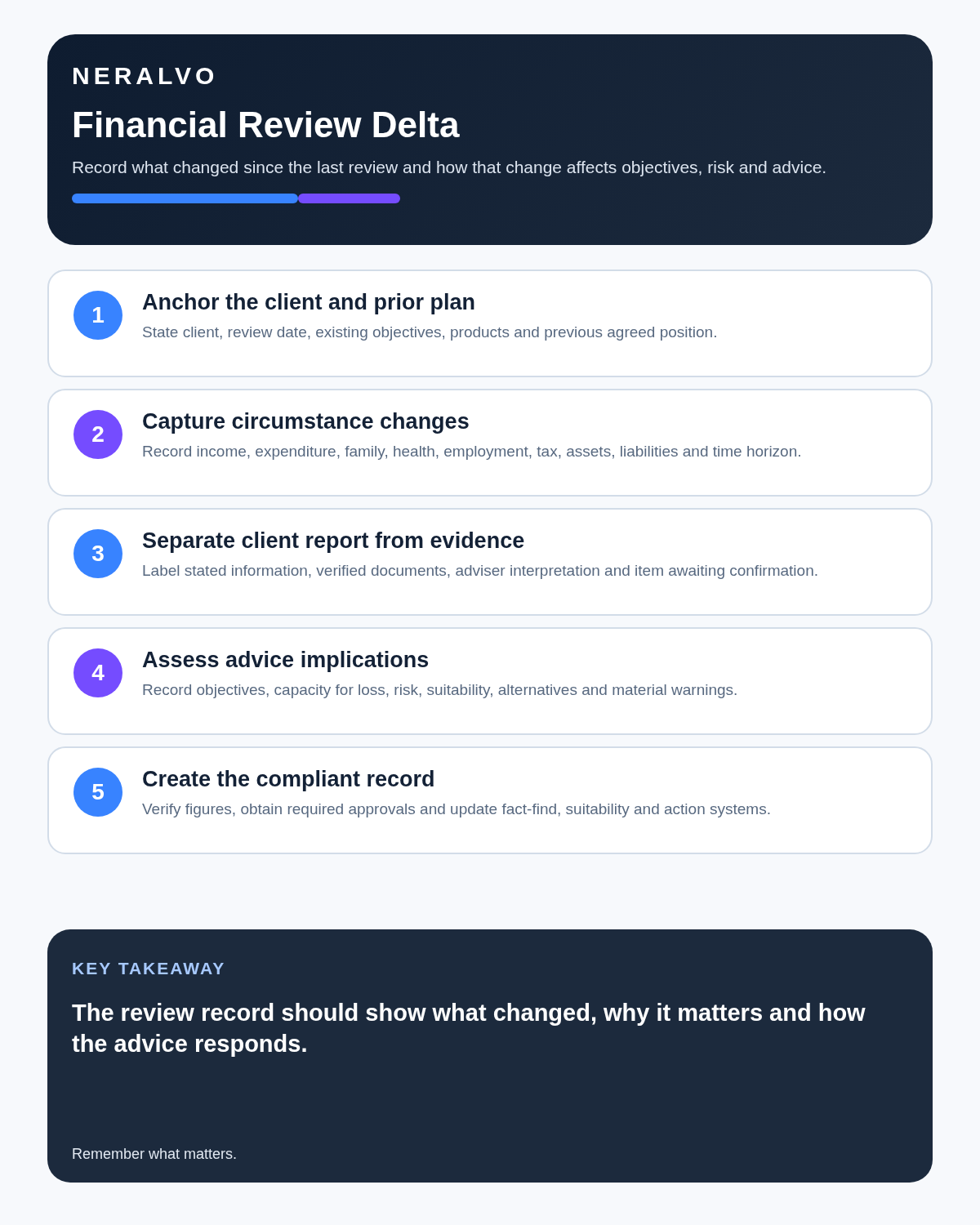
Repeating every unchanged fact hides the developments that may alter advice. The review should identify changes in household, income, expenditure, assets, liabilities, objectives, tax position, health where relevant, risk capacity, products and time horizon.
The prior plan → client report → evidence → analysis → advice → confirmation workflow
| Stage | Question | Output |
|---|---|---|
| Prior plan | What objectives, assumptions and recommendations were previously recorded? | Baseline |
| Client report | What does the client say has changed? | Attributed information |
| Evidence | Which documents or system records confirm material facts? | Verified fact-find |
| Analysis | How do changes affect needs, risk and options? | Professional reasoning |
| Advice | What recommendation follows and why? | Authorised advice |
| Confirmation | Does the client understand actions, risks and costs? | Completed record |
Use a review-delta checklist
- Personal, family and dependant changes.
- Employment, business and income changes.
- Expenditure and affordability changes.
- Assets, liabilities and emergency reserves.
- Objectives, priority and target dates.
- Knowledge, experience and decision support.
- Attitude to risk and capacity for loss.
- Existing products, benefits and guarantees.
- Tax, estate or protection questions.
- Health or vulnerability information where relevant and properly handled.
Separate information states
| Status | Meaning |
|---|---|
| Client reported | Statement requiring appropriate treatment |
| Estimated | Approximate figure not yet evidenced |
| Document verified | Supported by current evidence |
| Adviser calculation | Professional output with assumptions |
| Option discussed | Not yet recommended |
| Recommendation | Advice following the authorised process |
| Client instruction | Confirmed action or decision |
Do not allow a summary to turn an option into advice or a reported number into a verified fact.
Verify consequential figures
Check income, expenditure, pension values, debts, protection benefits, investment values, contributions, tax information, property values and dates against suitable sources. Record the source and date, not merely the number.
Keep risk discussion human-led
AI may organise the conversation but should not infer risk tolerance from tone or vocabulary. Record the client’s answers, examples, trade-offs, understanding and relevant capacity evidence. The authorised adviser remains responsible for interpretation.
Document advice with assumptions and limitations
- Client objective and priority.
- Material verified facts.
- Assumptions and missing evidence.
- Options considered.
- Recommended course and rationale.
- Risks, costs, tax and limitations.
- Why alternatives were not selected.
- Client questions and understanding.
- Instruction, cooling-off or further action.
Current suitability requirements
FCA COBS 9A requires firms within scope to obtain necessary information about the client’s financial situation, objectives, risk tolerance, ability to bear losses, knowledge and experience, and to take reasonable steps to ensure the information is reliable and kept current during an ongoing relationship. The exact duties depend on the service and product involved. Review the current FCA COBS 9A suitability requirements.
Protect vulnerable clients and power balance
Consider communication needs, capacity, support, language, hearing, distress and whether recording may inhibit disclosure. Explain the purpose and alternative. Record only information genuinely needed for the advice and regulatory process.
Protect financial and identity information
Do not record passwords, one-time codes, full account numbers, card data or unnecessary identity documents. Use approved accounts and matter access. Separate raw audio retention from the final regulated record.
How NERALVO Halo fits financial advice
NERALVO Halo includes NOTE mode, supported CALL mode, 64GB local storage, up to 35 hours of recording and Bluetooth sync with DOWAY. CALL mode is not universal, so test the exact phone, case and route. DOWAY provides transcripts, summaries, speaker-separated notes, templates, translations, mind maps and exports, with one year of DOWAY Max included. These features cannot automate suitability or regulatory compliance.
Cloud software, a dedicated recorder or manual notes?
For Financial Advisers, the right answer changes with the setting. This matrix deliberately gives each method a situation where it can be the strongest choice.
| Situation | Best starting point | Reason |
|---|---|---|
| scheduled remote client meetings | Cloud meeting software | Auto-join and central collaboration can remove routine admin. |
| in-person visits and travel | Dedicated recorder | Dedicated hardware suits movement, variable rooms and offline source capture. |
| a client declines or policy requires manual notes | Manual notes or an approved alternative | A clear alternative respects policy and participant choice. |
| mixed CRM and field work | Governed hybrid | One governed process prevents gaps between desk and field work. |
Frequently asked questions
Can AI complete the suitability assessment?
No. It can support drafting, but an authorised adviser must verify facts and exercise professional judgement.
Should client estimates be stored as facts?
No. Label them and obtain appropriate evidence where material.
Can sentiment analysis measure risk tolerance?
No. Risk assessment requires an appropriate human-led process and evidence.
Final financial-review checklist
- Previous objectives and plan identified.
- Review delta captured.
- Client reports separated from evidence.
- Figures and dates verified.
- Risk discussion human-led.
- Advice, options and instructions distinct.
- Sensitive data protected.
- Regulated systems and actions updated.
Bottom line: the strongest financial-advice voice note makes changed circumstances and evidence gaps visible while leaving suitability and recommendation with the authorised professional.
Related guides
On this page
Related guides
See whether Halo fits this workflow
Review the NERALVO Halo specifications, included services, delivery information and current offer only after completing the guide.
Found an error or an out-of-date claim? Email support@neralvo.com with the article address and a supporting source.