The 60-second verdict
A useful football debrief should connect what the coach noticed during the game to evidence on video and one clear change in the next training session. It should not become an emotional match report, an automated player rating or a substitute for welfare and safeguarding action.
Best fit: Football Coaches who need recoverable audio and human-verified notes in an authorised workflow. Use another method when: recording is prohibited, a participant declines or the approved process requires manual notes.
Evidence basis and limits
- Decision factors covered: The match note → video check → training action loop; Step 1: Capture a factual match note; Step 2: Check the observation against evidence.
- Evidence rule: Claims are weighted by consequence: capture failure, changed meaning, access and recovery matter more than polished wording.
- Boundary: Examples and workflow recommendations must be tested with representative recordings, the intended users and the actual approval process before rollout.
An AI voice recorder for football coaches can help preserve private post-match observations, permitted player reviews and staff decisions while context is fresh. It cannot analyse the match by itself, diagnose injury, assess concussion, safeguard a child or make a fair selection decision.
The match note → video check → training action loop
| Step | Question | Output |
|---|---|---|
| Match note | What did we notice, in which phase and at what moment? | A factual hypothesis with a minute or sequence |
| Video check | What does the evidence confirm, challenge or add? | A verified team, unit or player finding |
| Training action | What behaviour will we practise and how will we recognise improvement? | One focused coaching objective |
This loop prevents the first emotional impression from becoming the final judgement.
Step 1: Capture a factual match note
Create the note only after immediate coaching and player-welfare responsibilities are complete. Use a private setting and state:
- Match, opposition, competition and date.
- Score and game-state context.
- Minute, restart, transition or phase.
- Observable team or player behaviour.
- The coach’s current question—not a final conclusion.
- The clip, data point or staff view needed for verification.
“Right side exposed after our full-back advanced; check transitions at 34 and 39 minutes” is more useful than “the right-back had a bad game.” The first note creates a testable question; the second attaches blame before the structure has been reviewed.
Step 2: Check the observation against evidence
Review the relevant clip and separate the layers that shaped the outcome:
- Team organisation: pressing line, rest defence, distances and game model.
- Unit behaviour: communication, covering positions and timing.
- Role expectation: what the player had been asked to do.
- Individual action: technique, scan, decision or execution.
- Opponent action: movement or tactic that created the problem.
- Physical and welfare context: fatigue, injury concern or restricted availability.
Correct the transcript after the review. If the original interpretation was wrong, preserve the revised finding rather than forcing the evidence to fit the first impression.
Step 3: Convert the finding into one training action
A debrief becomes valuable only when it improves future behaviour. Define:
- The specific behaviour to practise.
- The game problem it should solve.
- The practice constraint or coaching cue.
- The players or unit involved.
- The evidence that will show improvement.
- The review date.
For example, a verified transition problem might become: “On loss in the right channel, nearest midfielder protects inside first while the full-back recovers; review spacing in the transition game on Thursday.” This is clearer than adding several generic defensive objectives to the session.
Keep player feedback observable and two-way
Player reviews should combine evidence with the player’s perspective. A useful conversation covers:
- The role and development goal.
- A specific clip or training moment.
- What the player saw and intended.
- A strength to retain.
- One development priority.
- Actions owned by the player, coach and support staff.
- When progress will be reviewed.
Replace broad labels such as “lazy,” “poor attitude” or “not brave enough” with observable behaviour. Recording should not pressure a player to agree; explain the purpose and provide an alternative note-taking method.
Use a separate welfare fast lane
Performance notes must not delay medical or safeguarding action. If concussion is suspected, England Football guidance says the player should be removed from play or training immediately and must not return that day. Follow the club’s medical and graduated-return process; an AI summary or player assurance cannot clear a return.
See England Football’s concussion guidance.
Where a child or adult at risk discloses a concern, follow the club and football safeguarding route immediately. Do not leave the information inside a general coaching transcript or share it in a staff group chat. The FA’s current safeguarding framework is available through its football safeguarding guidance.
Separate coaching, medical and safeguarding records
| Information | Correct destination |
|---|---|
| Technical and tactical feedback | Approved coaching or player-development record |
| Injury and return-to-play detail | Restricted medical process |
| Safeguarding concern | Authorised safeguarding route |
| Selection rationale | Accountable club decision record |
| Training actions | Current controlled session plan |
A single raw recording can contain all five categories. Share only the minimum verified information with each authorised audience.
Make selection evidence fair and traceable
AI may organise comments but should not score character, potential or commitment. A selection note should use relevant criteria, current evidence and accountable human judgement.
Before finalising a decision, check:
- Was the player assessed in the role being discussed?
- Did every player have a comparable opportunity?
- Are conclusions supported by current clips or data?
- Could injury, illness, communication need or limited exposure explain the evidence?
- Has a broad label replaced a specific behaviour?
- Who made the decision and how will it be communicated?
A 90-second post-match voice-note script
- Game state: identify the match, score context and phase.
- Observation: describe the behaviour without blame.
- Evidence request: name the minute, clip or data to review.
- Alternative explanation: state what else may have caused it.
- Welfare flag: move any medical or safeguarding matter to the correct process.
- Provisional action: state one possible training response, clearly marked as unverified.
After video review, update the official analysis and remove anything the evidence did not support.
How NERALVO Halo can support football coaching
Check whether NERALVO Halo fits football coaches work can support private post-match notes, permitted player reviews and staff meetings. It includes NOTE mode, supported CALL capture, 64GB local storage, up to 35 hours of recording and Bluetooth sync with DOWAY. DOWAY can create transcripts, summaries, speaker-separated notes, templates, translations, mind maps and exportable files, with one year of DOWAY Max included from activation.
Halo is not a match-analysis platform, medical device, emergency system or safeguarding service. Clubs remain responsible for approval, consent, supervision, access and record retention.
Football debrief quality check
- Was the note created after live responsibilities were complete?
- Does every important observation have a phase, minute or evidence reference?
- Were team, unit and individual factors separated?
- Was the first interpretation checked against video?
- Was player feedback specific and two-way?
- Were medical and safeguarding concerns moved immediately to restricted processes?
- Is selection based on fair, current evidence?
- Does the debrief create one testable training action?
- Has temporary audio been handled under club policy?
The strongest football note does not try to preserve every thought. It captures a testable match question, verifies it and turns it into a focused coaching action.
Cloud software, a dedicated recorder or manual notes?
For Football Coaches, the right answer changes with the setting. This matrix deliberately gives each method a situation where it can be the strongest choice.
| Situation | Best starting point | Reason |
|---|---|---|
| scheduled remote meetings | Cloud meeting software | Calendar automation and shared integrations are usually the strongest advantage. |
| in-person or mobile work | Dedicated recorder | Independent capture reduces reliance on an active phone or laptop. |
| recording is refused or prohibited | Manual notes or an approved alternative | The boundary takes priority over convenience. |
| mixed online and offline work | Governed hybrid | Use each method only in the setting it actually fits. |
Related AI voice recorder guides
See the guides for sports coaches, rugby coaches and personal trainers.
Related guides
Profession workflow
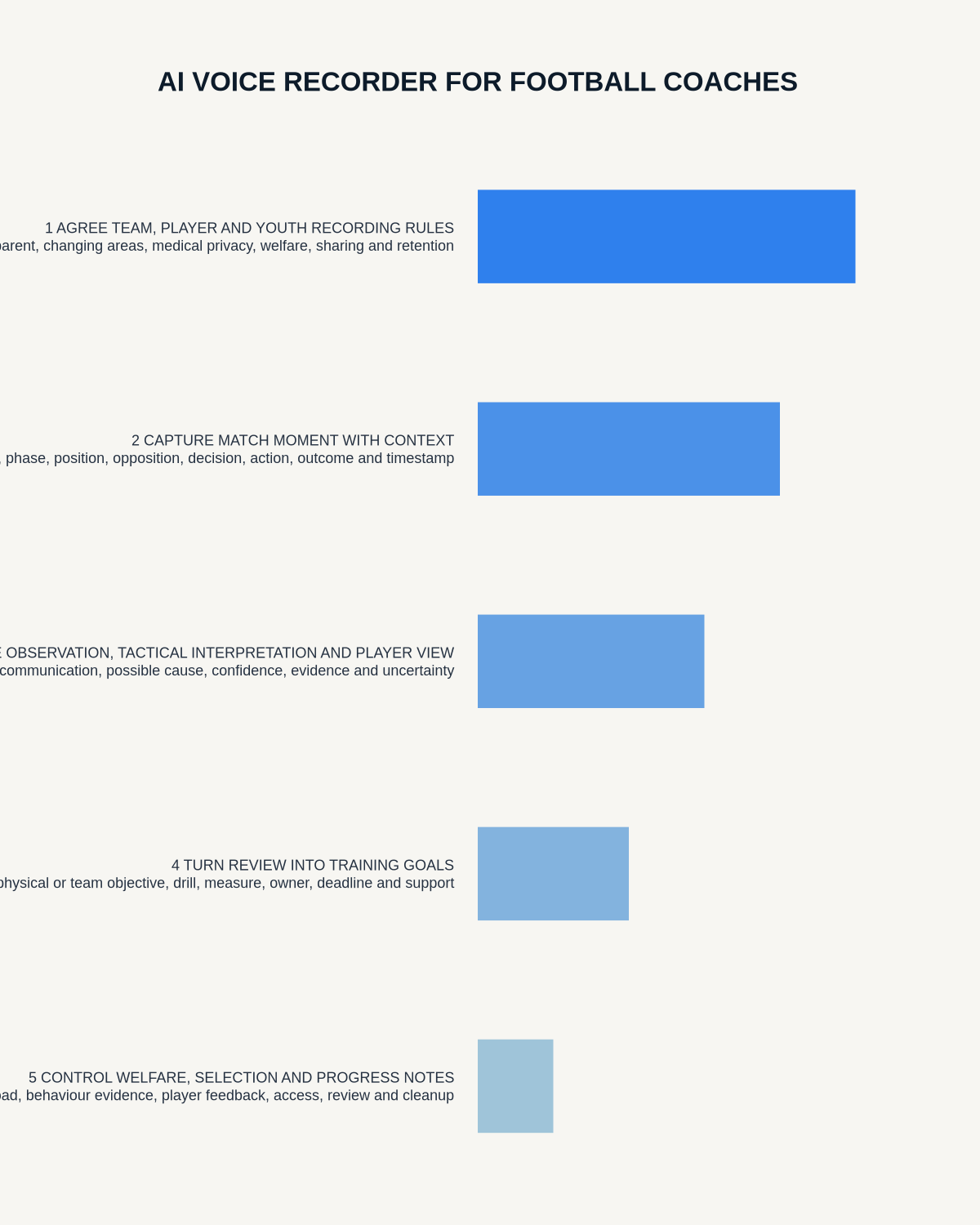
Visual map for AI Voice Recorder for Football Coaches: Match Debriefs, Player Reviews and Training Notes
- Prepare the approved useDefine purpose, safe position, permission and the required formal record.
- Capture context firstState the case, asset, person, location or event identifier before detail.
- Human-verify evidenceCheck technical terms, units, names, dates, decisions and uncertainty.
- Complete the formal recordTransfer only verified information and apply access and retention controls.
On this page
Related guides
See whether Halo fits this workflow
Review the NERALVO Halo specifications, included services, delivery information and current offer only after completing the guide.
Found an error or an out-of-date claim? Email support@neralvo.com with the article address and a supporting source.