The 60-second verdict
Home-care records must describe what happened during the visit, what changed, what the person wanted and what action the next worker or coordinator must take. A routine transcript can become intrusive inside a private home and still fail to capture the exact medicine, safeguarding or escalation detail that matters.
Best fit: Home Carers who need recoverable audio and human-verified notes in an authorised workflow. Use another method when: recording is prohibited, a participant declines or the approved process requires manual notes.
Evidence basis and limits
- Decision factors covered: Use a post-visit care snapshot; Use the least intrusive recording method; Create a change-from-baseline trigger.
- Evidence rule: A claim earns weight only when the source, date, configuration and limitation are clear enough for a reader to check.
- Boundary: Examples and workflow recommendations must be tested with representative recordings, the intended users and the actual approval process before rollout.
An AI voice recorder for home carers is usually most appropriate for a provider-approved private post-visit draft rather than continuous recording inside the home. It cannot assess the person, decide capacity, administer medicine or replace the care plan, MAR or eMAR, safeguarding record and authorised daily notes.
Use a post-visit care snapshot
| Snapshot area | What to record |
|---|---|
| Person and visit | Required identity, date, arrival, departure and worker |
| Presentation | Mood, communication, comfort and change from baseline |
| Care delivered | Tasks completed, declined, changed or not possible |
| Medicine support | Outcome verified against the MAR or eMAR |
| Observation | Direct factual information and attributed reports |
| Escalation | Concern, person contacted, advice and response |
| Next visit | Priority, owner and review point |
The note should show the person’s choices and abilities, not merely a list of tasks marked complete.
Separate every source of information
- Person reported: their words, symptoms, preference or concern.
- Family reported: information attributed to the relative or visitor.
- Carer observed: what the worker directly saw.
- Professional instruction: advice from a coordinator or clinician, with source and time.
- Action completed: what actually happened after the information was received.
An AI summary must not merge these sources into one unsupported conclusion.
Use the least intrusive recording method
Homes contain private conversations, letters, finances, photographs, security details and other household members. The default should be to complete the visit, deal with any immediate issue and create a short draft later from an approved private location.
Any direct recording needs a specific purpose, provider approval, appropriate information and safeguards for everyone who may be captured. One person’s agreement does not automatically cover relatives, visitors or other workers.
Create a change-from-baseline trigger
Record meaningful changes such as:
- new confusion, distress or unusual behaviour
- reduced food or fluid intake
- breathlessness, pain or dizziness
- mobility, fall or skin concern
- medicine refusal, omission or supply problem
- unsafe environment or loss of essential support
- family concern or safeguarding indicator
Do not rely on AI to decide whether a change is serious. Follow the care plan and escalation process immediately.
Keep medicine support inside the MAR boundary
Verify the person, medicine, dose, route, scheduled time and level of support against the authorised MAR or eMAR. Record the actual outcome: administered, prompted, refused, omitted, unavailable or another approved status.
A voice note cannot replace the MAR entry and must not imply a medicine was taken merely because it was prepared or offered.
Use a safeguarding fast lane
Concerns about abuse, neglect, self-neglect, coercion, financial exploitation, unexplained injury, deprivation or unsafe restraint must be acted on through the provider’s safeguarding route immediately.
Protect the person, contact the required manager or emergency service and create the restricted factual record. Do not leave the concern inside a routine transcript for later processing.
Build family updates around authority and purpose
Before sharing information, confirm what the person, care plan, lawful authority and provider policy permit. A close relative is not automatically entitled to every detail.
A checked family-update record should show what was shared, questions raised, commitments made, who owns follow-up and when the next update will occur.
Protect lone-worker safety
The recorder is not a lone-worker alarm or emergency device. Follow check-in, missed-visit, travel, dynamic risk and escalation procedures. If the environment becomes unsafe, leave or obtain support rather than continuing to record.
How NERALVO Halo may fit a governed home-care workflow
Assess Halo against the home carers workflow matrix provides 64GB local storage, up to 35 hours of recording and Bluetooth sync with DOWAY. DOWAY can create transcripts, summaries, templates, translations, mind maps and exports, with one year of DOWAY Max included from activation.
Halo is a consumer AI voice recorder. Home-care use would require provider assessment of the device, application, data flow, privacy, safeguarding, lone-worker implications and record process before use.
Daily-note release check
- Is the correct person and visit identified?
- Does the note preserve the person’s wishes and independence?
- Are reports separated from direct observations?
- Were meaningful changes escalated promptly?
- Is medicine support verified through the MAR or eMAR?
- Were safeguarding concerns moved to the restricted process?
- Was family information shared within authority?
- Has the checked note entered the authorised care system?
The strongest home-care note is timely, factual and proportionate. Recording can support a private draft after the visit, but dignity, safeguarding, medicine safety and the official care record remain controlling.
Cloud software, a dedicated recorder or manual notes?
For Home Carers, the right answer changes with the setting. This matrix deliberately gives each method a situation where it can be the strongest choice.
| Situation | Best starting point | Reason |
|---|---|---|
| scheduled remote consultations | Cloud meeting software | Auto-join and central collaboration can remove routine admin. |
| in-person consultations or ward handovers | Dedicated recorder | Dedicated hardware suits movement, variable rooms and offline source capture. |
| a patient declines or policy prohibits recording | Manual notes or an approved alternative | A clear alternative respects policy and participant choice. |
| mixed remote and clinical work | Governed hybrid | One governed process prevents gaps between desk and field work. |
Related care guides
See care-home action notes, nursing handovers and social-work case records.
Related guides
Profession workflow
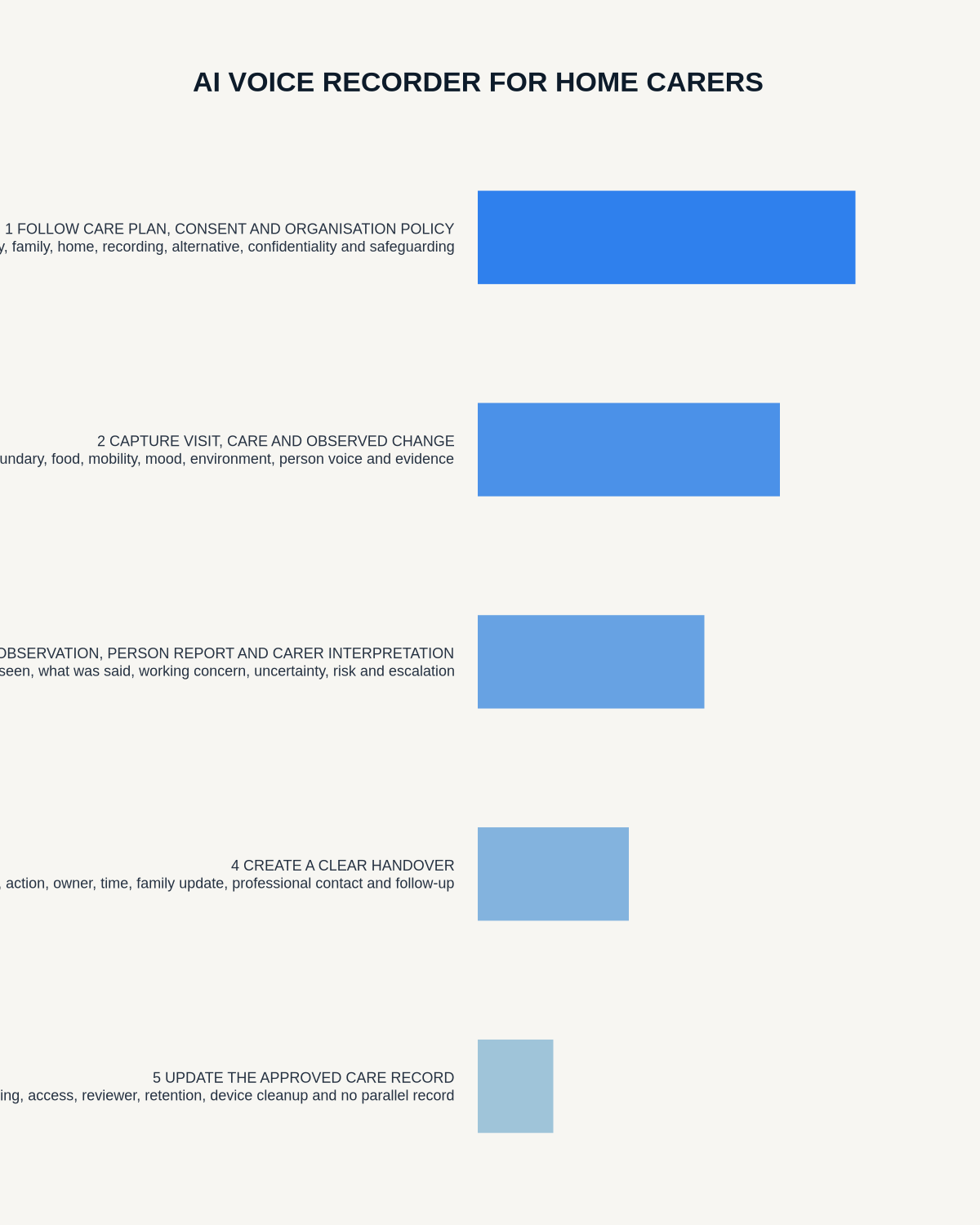
Visual map for AI Voice Recorder for Home Carers: Visit Notes, Family Updates and Shift Handover
- Prepare the approved useDefine purpose, safe position, permission and the required formal record.
- Capture context firstState the case, asset, person, location or event identifier before detail.
- Human-verify evidenceCheck technical terms, units, names, dates, decisions and uncertainty.
- Complete the formal recordTransfer only verified information and apply access and retention controls.
On this page
Related guides
See whether Halo fits this workflow
Review the NERALVO Halo specifications, included services, delivery information and current offer only after completing the guide.
Found an error or an out-of-date claim? Email support@neralvo.com with the article address and a supporting source.