The 60-second verdict
Quick answer: mediation should not be recorded by default. Full recording can undermine confidentiality, candour and the agreed process. Where recording is explicitly authorised, capture only what the mediation agreement permits and create a concise, verified outcome record rather than treating the transcript as the settlement.
Best fit: Mediators who need recoverable audio and human-verified notes in an authorised workflow. Use another method when: recording is prohibited, a participant declines or the approved process requires manual notes.
Evidence basis and limits
- Decision factors covered: Why recording can change mediation; The agreement → boundary → confidentiality → outcome → wording → closure workflow; Confirm recording rules before substantive discussion.
- Evidence rule: A claim earns weight only when the source, date, configuration and limitation are clear enough for a reader to check.
- Boundary: Examples and workflow recommendations must be tested with representative recordings, the intended users and the actual approval process before rollout.

Assess Halo against the mediators workflow matrix should be used in mediation only where the mediator’s professional process, agreement and participant choices explicitly allow it.
Why recording can change mediation
Participants may speak less openly when every word becomes permanent, searchable and potentially shareable. A transcript can also expose private caucus information, offers made for negotiation purposes and statements taken out of context.
The agreement → boundary → confidentiality → outcome → wording → closure workflow
| Stage | Question | Output |
|---|---|---|
| Agreement | Does the mediation process permit recording? | Explicit authority |
| Boundary | Which session or outcome may be captured? | Limited scope |
| Confidentiality | Who may access, use or disclose the record? | Controlled handling |
| Outcome | What is agreed, unresolved or conditional? | Accurate status |
| Wording | Do all parties understand the exact terms? | Read-back confirmation |
| Closure | What formal document and action follows? | Completed process |
Confirm recording rules before substantive discussion
The mediation agreement should address:
- Whether any recording is allowed.
- Which participants must agree.
- Private caucus restrictions.
- Confidentiality and privilege treatment.
- Who controls the device and account.
- AI processing and supplier access.
- Use, retention, deletion and dispute handling.
- The non-recorded alternative.
Do not introduce recording after a participant has disclosed sensitive information without revisiting informed choice.
Protect private sessions absolutely
A caucus should remain within the agreed confidentiality boundary. Do not allow a combined transcript, automatic workspace search or AI summary to reveal private-session content to another party.
Use an outcome-focused structure
- Parties and mediation reference.
- Date and mediator.
- Issues within scope.
- Points agreed.
- Points not agreed.
- Conditions and dependencies.
- Amounts, dates and practical actions.
- Whether terms are provisional, binding or subject to documentation.
- Who drafts, reviews and signs the formal record.
- Review or implementation route.
Separate negotiation from agreement
| Status | Meaning |
|---|---|
| Proposal | Option raised for discussion |
| Exploratory range | Negotiation position, not commitment |
| Provisional agreement | Subject to stated condition or approval |
| Agreed in principle | Core understanding awaiting formal wording |
| Formal agreement | Completed through the required process |
| Not agreed | Issue remains unresolved |
AI must not convert movement in negotiation into a concluded term.
Read back material terms
Check names, amounts, dates, payment schedule, confidentiality, actions, releases, dependencies, tax or legal review and what happens if a condition fails. Ask parties to confirm their understanding through the proper process.
Do not use AI to judge credibility or emotion
Do not use voice, sentiment, dominance, personality or deception analysis to assess a party’s credibility, reasonableness or intentions. Culture, disability, language, stress and communication style can all affect how somebody sounds. A mediator should clarify directly with the parties and apply the agreed neutral process rather than introducing an invisible machine judgement.
Do not let the transcript become the settlement document
The formal outcome should be drafted, reviewed and completed according to the mediation and legal framework. Raw audio contains far more than the terms and may introduce ambiguity.
Protect data after the mediation
Restrict access, disable public links, separate outcome documents from source audio, apply the agreed retention period and confirm deletion from device, app, exports and backups where required.
How NERALVO Halo fits mediation
NERALVO Halo includes NOTE mode, supported CALL mode, 64GB local storage, up to 35 hours of recording and Bluetooth sync with DOWAY. DOWAY provides transcripts, summaries, speaker-separated notes, templates, translations, mind maps and exports, with one year of DOWAY Max included. None of these features overrides the mediation agreement or professional obligations.
Cloud software, a dedicated recorder or manual notes?
For Mediators, the right answer changes with the setting. This matrix deliberately gives each method a situation where it can be the strongest choice.
| Situation | Best starting point | Reason |
|---|---|---|
| scheduled remote case meetings | Cloud meeting software | Auto-join and central collaboration can remove routine admin. |
| authorised interviews or field discussions | Dedicated recorder | Dedicated hardware suits movement, variable rooms and offline source capture. |
| privilege, procedure or an objection prevents recording | Manual notes or an approved alternative | A clear alternative respects policy and participant choice. |
| mixed casework | Governed hybrid | One governed process prevents gaps between desk and field work. |
Frequently asked questions
Should mediation sessions normally be recorded?
No. The starting point should be the agreed professional process, confidentiality and participant choice.
Can a transcript prove the final agreement?
It may support review where permitted, but the formal agreement and required signatures or approvals control.
Can private caucus notes enter a shared AI workspace?
No. Keep them within the agreed confidential boundary.
Final mediation checklist
- Agreement permits the exact recording.
- Participant choice and alternative respected.
- Caucus boundaries protected.
- Proposal separated from agreement.
- Material terms read back and verified.
- No automated credibility, emotion or deception inference used.
- Outcome status and authority clear.
- Formal documents completed.
- Source access and deletion controlled.
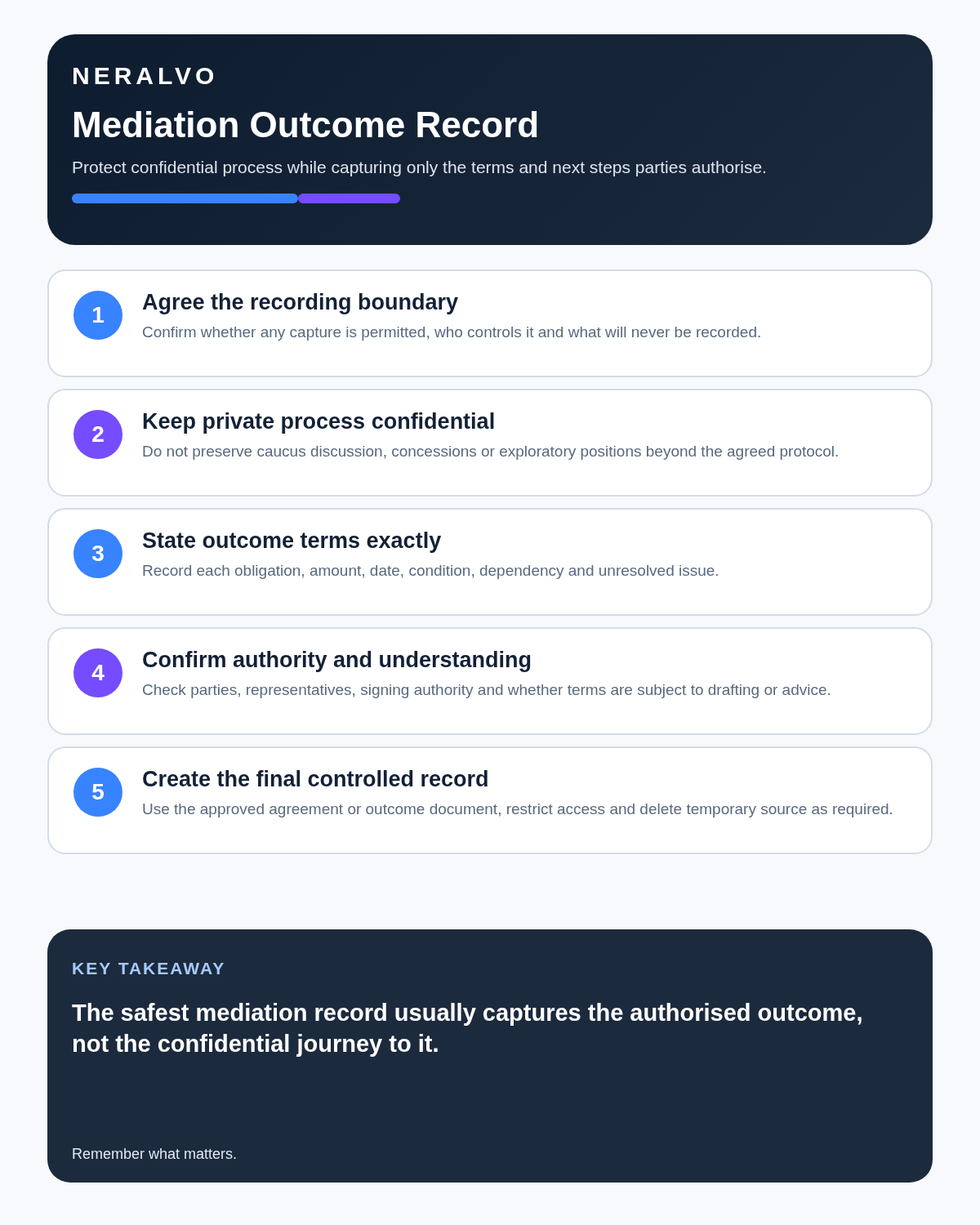
Bottom line: mediation recording should never weaken the confidentiality and trust that make settlement possible; capture only the authorised outcome needed to complete the process.
Related guides
See the guides for solicitors, barristers and HR managers.
On this page
Related guides
See whether Halo fits this workflow
Review the NERALVO Halo specifications, included services, delivery information and current offer only after completing the guide.
Found an error or an out-of-date claim? Email support@neralvo.com with the article address and a supporting source.