The 60-second verdict
Quick answer: songwriters can use an AI voice recorder as a portable catalogue inbox for lyric sparks, melodic sketches and collaboration notes, but every useful idea should be labelled, dated, linked to a song version and moved into the appropriate writing or production system.
Best fit: Songwriters who need recoverable audio and human-verified notes in an authorised workflow. Use another method when: recording is prohibited, a participant declines or the approved process requires manual notes.
Evidence basis and limits
- Decision factors covered: Use a three-layer song catalogue; Layer 1: sparks; Layer 2: sketches.
- Evidence rule: The decision is based on the complete capture-to-action workflow, not a single feature or marketing accuracy percentage.
- Boundary: Examples and workflow recommendations must be tested with representative recordings, the intended users and the actual approval process before rollout.

View Halo specifications for songwriters use can support rapid creative capture while authorship, split sheets, demo files and publishing records remain controlled elsewhere.
Use a three-layer song catalogue
Layer 1: sparks
Very short captures of a lyric phrase, rhythmic idea, title or melodic shape. Add enough spoken context to explain what made the fragment interesting.
Layer 2: sketches
A developed verse, chorus, bridge, intro or transition. Include tempo feel, harmonic context where known and the emotional job of the section.
Layer 3: session records
Agreed records of collaboration decisions, artist feedback, arrangement changes and next actions. These are working records, not substitutes for split sheets, contracts or official production files.
| Layer | Keep when | Process into |
|---|---|---|
| Spark | The fragment has a distinctive musical or lyrical idea | Idea bank |
| Sketch | The section can be tested in a song | Song folder or DAW session |
| Session record | It explains a decision, contribution or action | Session log and written follow-up |
Use an idea → intention → test → version workflow
- Idea: lyric, melody, rhythm, title or image.
- Intention: what emotion or story it should carry.
- Test: verse, chorus, contrast or performance experiment.
- Version: file name, date and revision status.
- Action: next writing session or collaborator task.
Record melody with musical context
Before or after singing a melody, state:
- Working title.
- Song section.
- Approximate tempo or feel.
- Key or starting chord if known.
- Where the phrase enters.
- The emotional movement it should create.
- Whether the lyric is fixed or placeholder.
Keep the earliest version before creating alternatives. The first take may preserve the instinct that later versions polish away.
Transcribe lyrics, not the music itself
AI transcription can make spoken lyric ideas searchable. Sung words, harmonies, melisma and invented phrases are more likely to be misheard. Correct the lyric text while memory is fresh and keep the audio attached to the version.
For every promising lyric, record its narrator, point of view, image or idea, rhyme family, surrounding line and whether it is original or inspired by a source requiring a rights check.
Separate fragments from finished work
- Raw fragment.
- Promising idea.
- Draft lyric.
- Song sketch.
- Demo version.
- Collaborative revision.
- Approved master lyric.
Protect authorship and collaboration
At the end of an agreed co-writing session, record the working title, participants, sections developed and unresolved questions, then trigger the real administrative step: confirm credits and splits in writing.
A recording may help reconstruct chronology but does not automatically decide authorship, ownership or percentages. Contributions may be lyrical, musical, structural or production-related and their treatment depends on the agreement and applicable rights.
Turn artist feedback into testable revisions
Feedback such as “make the chorus bigger” should become testable variables:
- Higher melodic register.
- Shorter pre-chorus.
- Stronger title repetition.
- Wider harmony.
- More rhythmic contrast.
- Clearer emotional payoff.
- Arrangement change rather than songwriting change.
Record the hypothesis, test one variable at a time and compare versions.
Use a practical spark-to-demo route
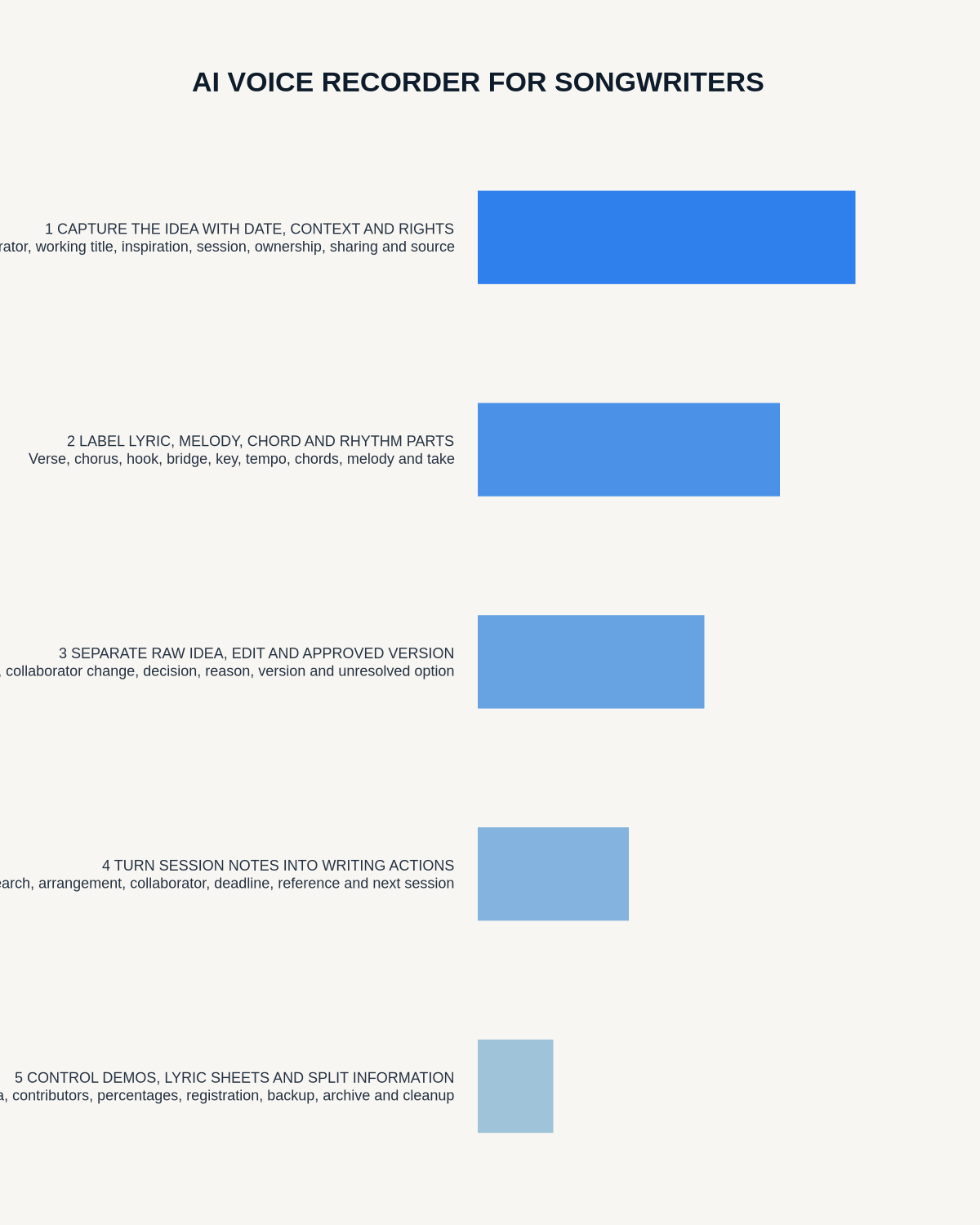
- Capture the first idea immediately.
- Add spoken musical context.
- Name the file with date, title, section and version.
- Transcribe spoken lyrics or session discussion where useful.
- Correct words, names and decisions.
- Move viable sketches into the central song folder.
- Develop harmony, structure and singability in appropriate music tools.
- Create a labelled demo.
- Confirm collaborator credits and splits separately.
- Archive source sketches deliberately and remove duplicates.
Use a weekly catalogue clean-up
- Delete accidental and empty files.
- Group recordings by song.
- Promote useful sparks into sketches.
- Mark songs waiting for collaborator action.
- Move production notes into the DAW or session checklist.
- Record unresolved sample, lyric or permission questions.
- Back up important source recordings securely.
This routine matters more than recording hundreds of ideas.
Use AI summaries carefully
AI can organise themes, session decisions and repeated phrases, but it should not silently rewrite lyrics into generic language or introduce protected lines from elsewhere. Preserve the writer’s voice and check originality.
How NERALVO Halo fits songwriting
Halo supports NOTE mode for lyric ideas, melody context, arrangement notes and agreed writing sessions; supported CALL capture for compatible calls where recording is lawful and disclosed; 64GB local storage; up to 35 hours of recording; and Bluetooth sync with DOWAY for transcripts, summaries, templates, translations, mind maps and exports. One year of DOWAY Max is included.
Halo can act as a portable catalogue inbox. A studio microphone, audio interface and DAW remain more suitable for critical demos, multitrack production and final audio.
Protect unreleased songs
Limit access to lyric sheets, demos and collaboration recordings. Avoid public links for unreleased work and agree before recording another writer or artist. Samples, interpolations and borrowed protected material may require clearance.
A timestamp can support a creative timeline, but it is not a complete rights-management system.
Cloud software, a dedicated recorder or manual notes?
For Songwriters, the right answer changes with the setting. This matrix deliberately gives each method a situation where it can be the strongest choice.
| Situation | Best starting point | Reason |
|---|---|---|
| scheduled remote meetings | Cloud meeting software | Native remote-meeting workflows can be more efficient here. |
| in-person or mobile work | Dedicated recorder | A separate battery and recoverable local source improve resilience. |
| recording is refused or prohibited | Manual notes or an approved alternative | Manual notes are the correct control when recording is unavailable. |
| mixed online and offline work | Governed hybrid | A hybrid can combine automation with reliable physical capture. |
Frequently asked questions
Does a recording prove authorship?
It can support chronology, but rights and credits require the appropriate written agreements and records.
Can AI transcribe a melody accurately?
No. Preserve the audio and use music tools for pitch, harmony and arrangement.
Should every fragment be kept?
No. Review and curate the catalogue regularly.
Final songwriting checklist
- Capture labelled and dated.
- Song, section and version clear.
- Musical and emotional context recorded.
- Original source or inspiration status clear.
- Collaborators attributed.
- Feedback converted into testable revisions.
- Credits and splits confirmed separately.
- Strong fragments moved into the song folder or DAW.
- Unreleased work protected.
- Weekly catalogue cleanup completed.
Bottom line: catch the idea quickly, preserve its musical purpose and move the strongest fragments into a deliberate, versioned songwriting process.
Related guides
On this page
Related guides
See whether Halo fits this workflow
Review the NERALVO Halo specifications, included services, delivery information and current offer only after completing the guide.
Found an error or an out-of-date claim? Email support@neralvo.com with the article address and a supporting source.