The 60-second verdict
Quick answer: an AI voice recorder can support authorised occupational-health consultations by preserving the employee’s account, job demands and possible adjustments. Source audio, the confidential clinical note and the employer-facing report must remain separate records for different audiences.
Best fit: Occupational Health Advisers who need recoverable audio and human-verified notes in an authorised workflow. Use another method when: recording is prohibited, a participant declines or the approved process requires manual notes.
Evidence basis and limits
- Decision factors covered: Use the three-record model; Set the boundary at the start; Assess function before collecting unnecessary diagnosis detail.
- Evidence rule: A claim earns weight only when the source, date, configuration and limitation are clear enough for a reader to check.
- Boundary: Examples and workflow recommendations must be tested with representative recordings, the intended users and the actual approval process before rollout.

Occupational health sits at a sensitive boundary. The employee may disclose health information so the adviser can understand function, while the employer usually needs only limited advice about capacity, restrictions, adjustments and review.
Use the three-record model
| Record | Purpose | Typical access |
|---|---|---|
| Source audio | Temporary source for accurate notes where approved | Restricted occupational-health team |
| Clinical note | Relevant history, assessment, reasoning and decisions | Authorised clinical service |
| Employer report | Proportionate work-function advice | Authorised employer recipients |
Set the boundary at the start
Confirm the referral question, requester, recording purpose, processing route, source-audio access, report boundary, factual-correction process and urgent-safety route. Recording and disclosure to the employer are separate decisions.
Assess function before collecting unnecessary diagnosis detail
Map core tasks, physical demands, concentration, communication, shifts, travel, exposures, attendance pattern, safety-critical duties and support already tried. Collect diagnosis or treatment detail only where relevant to the occupational question.
Use a function-impact-adjustment chain
- Functional effect: what work activity is difficult or unsafe?
- Context: when and under what conditions?
- Current coping: what is already being done?
- Possible adjustment: what change could reduce the barrier?
- Dependency: what approval, equipment or management action is required?
- Review point: when and how will effectiveness be assessed?
Record employee goals and concerns separately
Capture the preferred outcome, main concern, helpful and worsening factors, current coping, what the employer understands and information the employee is concerned about sharing. The adviser can then explain the professional opinion required and any difference from the employee’s preference.
Do not let transcription create clinical certainty
Verify medicine names, diagnoses, dosages, dates, absence periods, hours, exposures, job titles and any statement affecting safety or fitness advice. Preserve words such as possibly, intermittently and under investigation.
Separate account, evidence and opinion
The clinical note should distinguish employee account, referral information, documents reviewed, functional assessment, professional interpretation, advice, limitations and information-sharing decisions.
Draft the employer report using necessity
Include only what is needed to answer the referral: functional effect, likely duration where supportable, adjustments to consider, phased return or restrictions, monitoring triggers and limitations. Detailed diagnosis, family circumstances and unrelated treatment history may not be necessary.
Make adjustments specific and reviewable
Define duties, hours, frequency, duration, what should be avoided, workplace owner, equipment or process dependency, review date and signs that the arrangement is not working.
Act on urgent concerns immediately
Use clinical, safeguarding or emergency procedures without waiting for transcription. Record the concern, action, person contacted and time in the authorised clinical system.
Use a consultation-to-report workflow
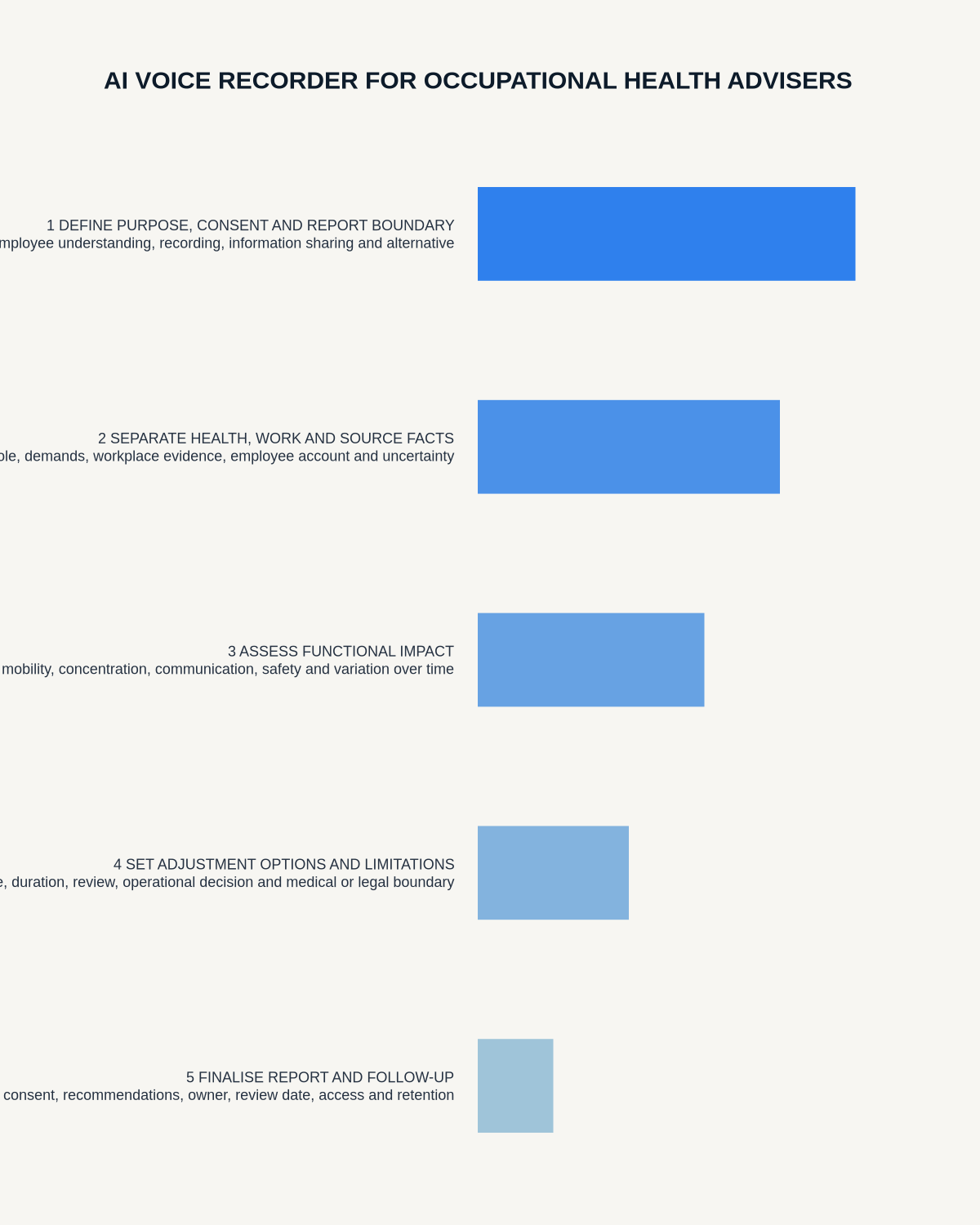
- Review the referral and approved recording process.
- Explain recording, confidentiality and report boundaries.
- Map job demands.
- Capture the employee account and goals.
- Assess functional effects and adjustments.
- Mark medical terms and figures for verification.
- Generate and review the transcript.
- Create the clinical note.
- Draft the separate employer report.
- Complete review, communication and retention steps.
Where NERALVO Halo fits
Assess Halo against the occupational health advisers workflow matrix can support approved consultations, case reviews and private drafting with NOTE mode, supported CALL capture, 64GB local storage and structured DOWAY notes. Occupational-health services should assess clinical governance, processing and deletion before use.
Cloud software, a dedicated recorder or manual notes?
For Occupational Health Advisers, the right answer changes with the setting. This matrix deliberately gives each method a situation where it can be the strongest choice.
| Situation | Best starting point | Reason |
|---|---|---|
| scheduled remote consultations | Cloud meeting software | Auto-join and central collaboration can remove routine admin. |
| in-person consultations or ward handovers | Dedicated recorder | Dedicated hardware suits movement, variable rooms and offline source capture. |
| a patient declines or policy prohibits recording | Manual notes or an approved alternative | A clear alternative respects policy and participant choice. |
| mixed remote and clinical work | Governed hybrid | One governed process prevents gaps between desk and field work. |
Frequently asked questions
Should the employer receive the transcript?
No. The employer should receive only the proportionate professionally approved report.
Can AI determine fitness for work?
No. The occupational-health professional remains responsible.
Should diagnosis always appear in the report?
No. Include only what is necessary to answer the referral.
Can the transcript replace the clinical note?
No. The clinical note must be reviewed and approved.
Can recording and disclosure be treated as one decision?
No. They should be explained and managed separately.
Authoritative guidance and related reading
- HSE occupational-health guidance
- ICO employment-practices guidance
- AI Voice Recorder for Personal Injury Solicitors
Final occupational-health checklist
- Referral question clear
- Recording and disclosure boundaries explained
- Collection limited to relevant health information
- Function, account and opinion separated
- Medical terms and dates checked
- Employer report proportionate
- Adjustments specific and reviewable
Related AI voice recorder guides
On this page
Related guides
See whether Halo fits this workflow
Review the NERALVO Halo specifications, included services, delivery information and current offer only after completing the guide.
Found an error or an out-of-date claim? Email support@neralvo.com with the article address and a supporting source.