The 60-second verdict
Quick answer: ombudsman investigators can use an AI voice recorder for authorised interviews and analytical notes, then convert the material into a source-linked allegation-response-evidence matrix. Jurisdiction, evidential weight, findings, remedies and the final determination must remain human-led and formally approved.
Best fit: Ombudsman Investigators who need recoverable audio and human-verified notes in an authorised workflow. Use another method when: recording is prohibited, a participant declines or the approved process requires manual notes.
Evidence basis and limits
- Decision factors covered: Confirm remit and scope; Use an authorised interview protocol; Build an allegation-response-evidence matrix.
- Evidence rule: The decision is based on the complete capture-to-action workflow, not a single feature or marketing accuracy percentage.
- Boundary: Examples and workflow recommendations must be tested with representative recordings, the intended users and the actual approval process before rollout.
A defensible ombudsman record shows not only what each party said, but how scope, evidence, fairness, contrary material and reasoning were controlled. AI can reduce administrative reconstruction without replacing impartial judgement.

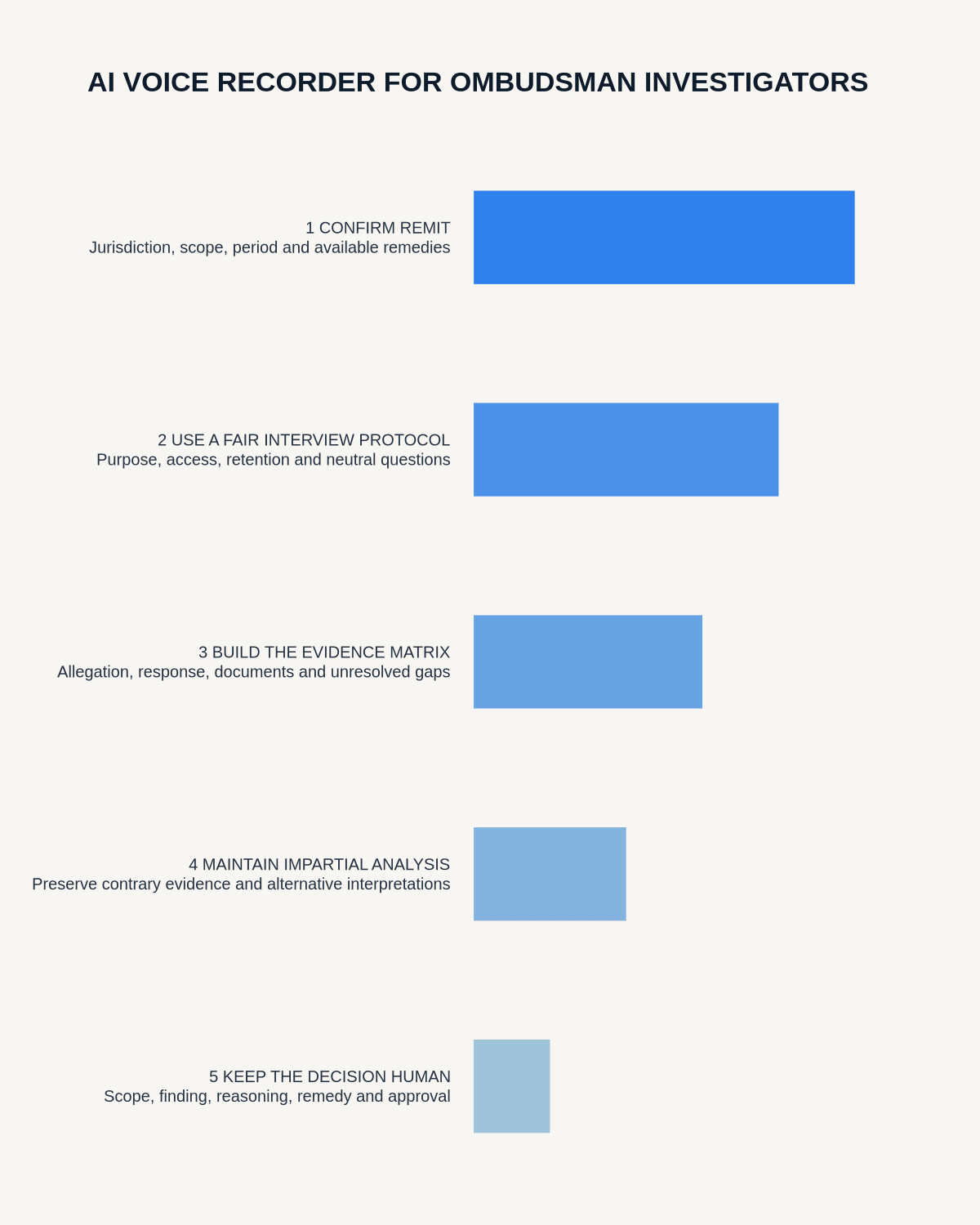
Confirm remit and scope
Record the complaint points accepted for investigation, matters outside jurisdiction, relevant period and remedies within the organisation’s powers. Document who approved any later scope change and inform the parties through the correct process.
Identify the applicable legislation, policy, standard or service commitment, including version and effective date.
Use an authorised interview protocol
Explain the recording purpose, access, retention and permitted use. Obtain the required agreement or authority and provide an alternative where necessary.
Begin with neutral, open questions before testing inconsistencies. Important statements should be checked against audio and, where appropriate, confirmed in writing.
Build an allegation-response-evidence matrix
For each complaint point, maintain separate fields for:
- the complainant’s allegation and account;
- the organisation’s response;
- documents, system records and independent evidence;
- evidence supporting or challenging each position;
- unresolved gaps;
- provisional finding and reason.
This prevents a strong narrative from being mistaken for stronger evidence.
Control chronology and provenance
Link every significant date and fact to its source. Distinguish contemporaneous records, system data, recollection and inference. Preserve conflicts rather than selecting the most convenient version.
For important documents, record provider, date received, author, version, relevant passage and any completeness concern.
Maintain impartial analysis
Separate a procedural failure from disagreement with an outcome. An organisation can reach an unfavourable decision fairly, or reach a reasonable outcome despite administrative weaknesses.
Actively record evidence that challenges the emerging view. Explain why alternative interpretations were accepted or rejected, applying the same evidence approach to both parties.
Draft findings and invite representations
Write a provisional finding for each complaint point using the evidence, applicable standard and reasoning. Identify uncertain facts.
Where the process allows, share provisional findings or relevant adverse material. Record each response and assess whether it changes chronology, evidence, findings or remedy.
Keep the decision human-led
The final determination should state scope, evidence considered, finding on each point, reasoning and any remedy or recommendation. Record the authorised decision-maker and approval date.
AI-generated text must not issue or approve a determination.
Link remedies to identified injustice
A remedy should address the service failure or injustice supported by the evidence. Record owner, deadline, implementation evidence and any follow-up. Do not add a remedy simply because it appears in a generated template.
Control access, disclosure and retention
Restrict recordings and transcripts to authorised case staff. Apply redaction and disclosure consistently. Retain material under the case schedule and remove unnecessary working copies.
Cloud software, a dedicated recorder or manual notes?
For Ombudsman Investigators, the right answer changes with the setting. This matrix deliberately gives each method a situation where it can be the strongest choice.
| Situation | Best starting point | Reason |
|---|---|---|
| scheduled remote case meetings | Cloud meeting software | Native remote-meeting workflows can be more efficient here. |
| authorised interviews or field discussions | Dedicated recorder | A separate battery and recoverable local source improve resilience. |
| privilege, procedure or an objection prevents recording | Manual notes or an approved alternative | Manual notes are the correct control when recording is unavailable. |
| mixed casework | Governed hybrid | A hybrid can combine automation with reliable physical capture. |
Frequently asked questions
Can AI decide whether a complaint is upheld?
No. It can organise material, but jurisdiction, evidential weight, findings and remedies require authorised human judgement.
Should conflicting accounts be merged?
No. Preserve them separately and explain how the conflict was tested.
What makes the record defensible?
Clear scope, source provenance, contrary evidence, representations, reasoning and named human approval.
Can source audio be shared with both parties?
Follow the organisation’s disclosure, redaction and access process rather than sharing automatically.
Useful resources
- Ombudsman Association
- AI Voice Recorder for Complaints Managers
- AI Voice Recorder for Compliance Officers
- View Halo specifications for ombudsman investigators use
Investigation checklist
- Jurisdiction and scope recorded
- Interview procedure followed
- Each fact traceable to a source
- Both parties’ accounts and contrary evidence visible
- Representations considered
- Findings linked to standard, evidence and reasoning
- Remedy linked to identified injustice
- Final decision human-approved
On this page
Related guides
See whether Halo fits this workflow
Review the NERALVO Halo specifications, included services, delivery information and current offer only after completing the guide.
Found an error or an out-of-date claim? Email support@neralvo.com with the article address and a supporting source.