
The 60-second verdict
Quick answer: oral history is not simply recording someone’s memories and generating a transcript. It is a planned relationship between interviewer, narrator, recording, consent, description and archive. AI can accelerate first-pass transcription and indexing, but meaning, rights and the archival record require careful human work.
Best fit: Oral Historians who need recoverable audio and human-verified notes in an authorised workflow. Use another method when: recording is prohibited, a participant declines or the approved process requires manual notes.
Evidence basis and limits
- Decision factors covered: Plan the archive before the interview; Consent is an ongoing process; Interview technique matters more than transcription speed.
- Evidence rule: A claim earns weight only when the source, date, configuration and limitation are clear enough for a reader to check.
- Boundary: Examples and workflow recommendations must be tested with representative recordings, the intended users and the actual approval process before rollout.
Plan the archive before the interview
- Purpose and research theme.
- Who will hold the recording.
- Intended access and audience.
- Restrictions or closure periods.
- Whether audio, transcript or both will be preserved.
- Preservation and access formats.
- File naming and metadata standards.
- How consent and future use will be documented.
Recording first and solving these questions later can create material that cannot be used responsibly.
Consent is an ongoing process
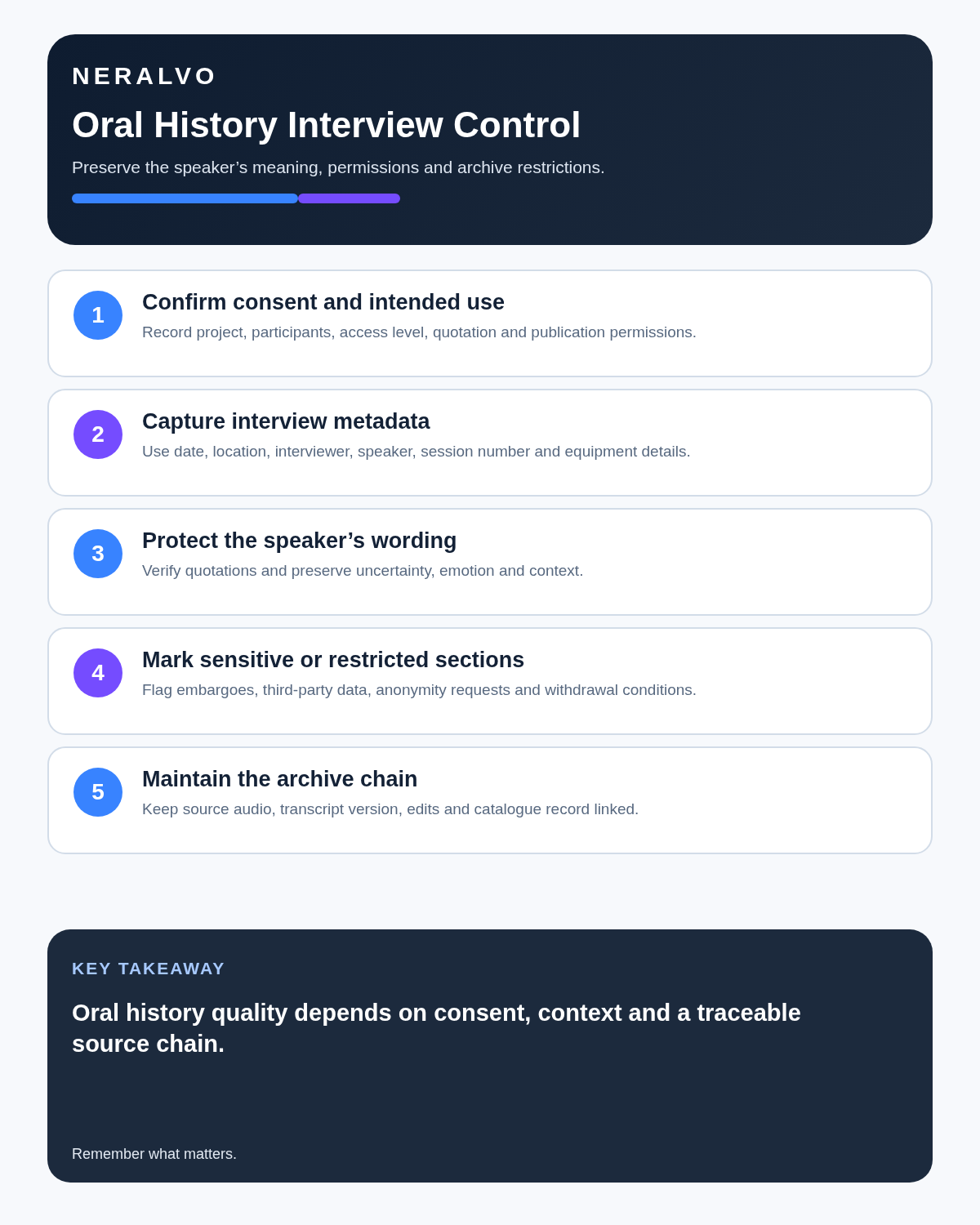
Explain the project, recording, storage, access and intended use in a form appropriate to the narrator. Confirm whether topics, names or passages require restriction. If the narrator changes their mind during or after the interview, follow the project’s agreed process and record the change clearly.
AI must not decide that consent covers an undisclosed use, publication format, translation or future project.
Interview technique matters more than transcription speed
Use open prompts, allow silence and avoid forcing memories into a predetermined narrative. Useful prompts include:
- “What do you remember about…?”
- “Can you describe the place?”
- “How did that change over time?”
- “Who else was involved?”
- “How did you understand it then?”
AI can organise themes afterwards. It should not replace attentive listening during the interview.
Interview record structure
| Record | Purpose |
|---|---|
| Master audio | Preserve the complete original interview |
| Access copy | Routine listening without altering the master |
| Transcript | Search, reading and quotation support |
| Interview log | Topics and timestamps |
| Consent record | Permitted use, changes and restrictions |
| Metadata | People, place, date, project and technical details |
AI transcription needs editorial rules
Before correction, decide how the project handles:
- Dialect and grammar.
- Pauses and false starts.
- Inaudible passages.
- Non-verbal sounds.
- Uncertain names.
- Interviewer speech.
- Redactions and restricted passages.
A transcript can be readable without erasing the narrator’s voice. Do not silently rewrite speech into a style the person did not use.
Verify names, places and dates
AI often mishears local place names, historical organisations and personal names. Create a verification list and, where appropriate, ask the narrator to confirm spelling. Mark uncertain dates, approximate periods and remembered sequences honestly rather than converting memory into false precision.
Interview logs are often more valuable than summaries
A timestamped topic log lets researchers navigate the audio without replacing it with a single interpretation. For example:
- 00:00 — introduction and childhood home.
- 12:40 — first employment.
- 28:15 — workplace dispute.
- 44:30 — community change.
- 61:10 — reflections.
AI can draft the log, but topics, speakers and timestamps require checking.
Archival file workflow
- Confirm the original recording is complete.
- Create the project-standard filename.
- Preserve the master according to archive procedure.
- Create an access copy if required.
- Generate the transcript and topic log.
- Check names, places, dates and sensitive passages.
- Attach consent, restrictions and metadata.
- Apply access controls and closure periods.
- Deposit or store through the project’s approved process.
Where NERALVO Halo fits
Assess Halo against the oral historians workflow matrix can provide compact local audio capture for interviews and field conversations, with 64GB storage, up to 35 hours of recording and DOWAY processing. Verify that exported audio quality, format and metadata meet the project’s preservation requirements.
Oral-history quality check
- Consent is documented, current and linked.
- The complete original audio is preserved.
- Master and access copies are distinguished.
- Names, places and dates are verified or marked uncertain.
- The transcript preserves the narrator’s meaning and voice.
- Restrictions and later consent changes are visible.
- Future users can navigate the recording.
Cloud software, a dedicated recorder or manual notes?
For Oral Historians, the right answer changes with the setting. This matrix deliberately gives each method a situation where it can be the strongest choice.
| Situation | Best starting point | Reason |
|---|---|---|
| scheduled remote meetings | Cloud meeting software | Auto-join and central collaboration can remove routine admin. |
| in-person or mobile work | Dedicated recorder | Dedicated hardware suits movement, variable rooms and offline source capture. |
| recording is refused or prohibited | Manual notes or an approved alternative | A clear alternative respects policy and participant choice. |
| mixed online and offline work | Governed hybrid | One governed process prevents gaps between desk and field work. |
Frequently asked questions
Can AI correct a narrator’s grammar?
Only under the project’s editorial policy and without changing meaning or erasing voice.
Can an interview be reused for a new project?
Only where the consent and archive terms cover that use or a new permission process is completed.
Should the transcript replace the audio?
No. The audio remains the primary source for voice, emphasis and uncertain wording.
Related guides
See the guides for genealogists, researchers and choosing an AI voice recorder.
Bottom line: AI is most valuable for first-pass transcription and topic indexing. The enduring oral-history record depends on continuing consent, archival file handling, careful editing and respect for the narrator’s voice.
On this page
Related guides
Check permission, retention and access before choosing hardware
Once the policy requirements in this guide are satisfied, compare Halo’s specifications, local storage, included services and current offer against your approved workflow.
Found an error or an out-of-date claim? Email support@neralvo.com with the article address and a supporting source.