The 60-second verdict
Family-history interviews contain names, nicknames, places and relationships that are easy to mishear and difficult to reconstruct later. An AI voice recorder can preserve the story and create a searchable first transcript, but oral memory must be separated from documentary evidence.
Best fit: Genealogists who need recoverable audio and human-verified notes in an authorised workflow. Use another method when: recording is prohibited, a participant declines or the approved process requires manual notes.
Evidence basis and limits
- Decision factors covered: Prepare a relationship map before recording; Ask for identity anchors; Separate memory from proof.
- Evidence rule: A claim earns weight only when the source, date, configuration and limitation are clear enough for a reader to check.
- Boundary: Examples and workflow recommendations must be tested with representative recordings, the intended users and the actual approval process before rollout.
Prepare a relationship map before recording
Bring a simple working tree with known names and dates. Use it to ask clear questions and to distinguish people with similar names.
At the start, confirm:
- narrator’s full name and relationship to the family
- date and place of interview
- who is present
- purpose and intended use
- any topics the narrator does not want recorded
Ask for identity anchors
For each person mentioned, capture:
- full name and spelling
- maiden or previous names
- nickname
- approximate birth and death dates
- place
- occupation
- relationship to the narrator
- document or photograph connected to the person
AI transcription often confuses uncommon surnames and place names, so spell them aloud.
Separate memory from proof
| Statement type | How to label it |
|---|---|
| Narrator witnessed event | First-hand recollection |
| Story told by a parent | Second-hand family account |
| Date read from certificate | Document-supported fact |
| Identity inferred from names | Working hypothesis |
| Conflicting family stories | Unresolved accounts |
A polished summary should not make all five look equally certain.
Use chronology prompts
- What is your earliest memory of the person?
- Where were they living then?
- Who else was in the household?
- What happened before and after the move?
- Which school, employer, regiment or church was involved?
- Do you know where the document or photograph came from?
Photographs and documents
When discussing an item, assign a temporary reference and describe it aloud:
“Photograph 7: three people outside 18 High Street, believed to be around 1952; narrator identifies the woman on the left as Alice Brown.”
Keep identification as attributed information until corroborated.
Transcript correction list
After transcription, search and verify:
- surnames and variants
- maiden names
- towns, parishes and counties
- occupations
- military units
- street names
- dates and ages
- relationship terms such as cousin, half-brother and step-sister
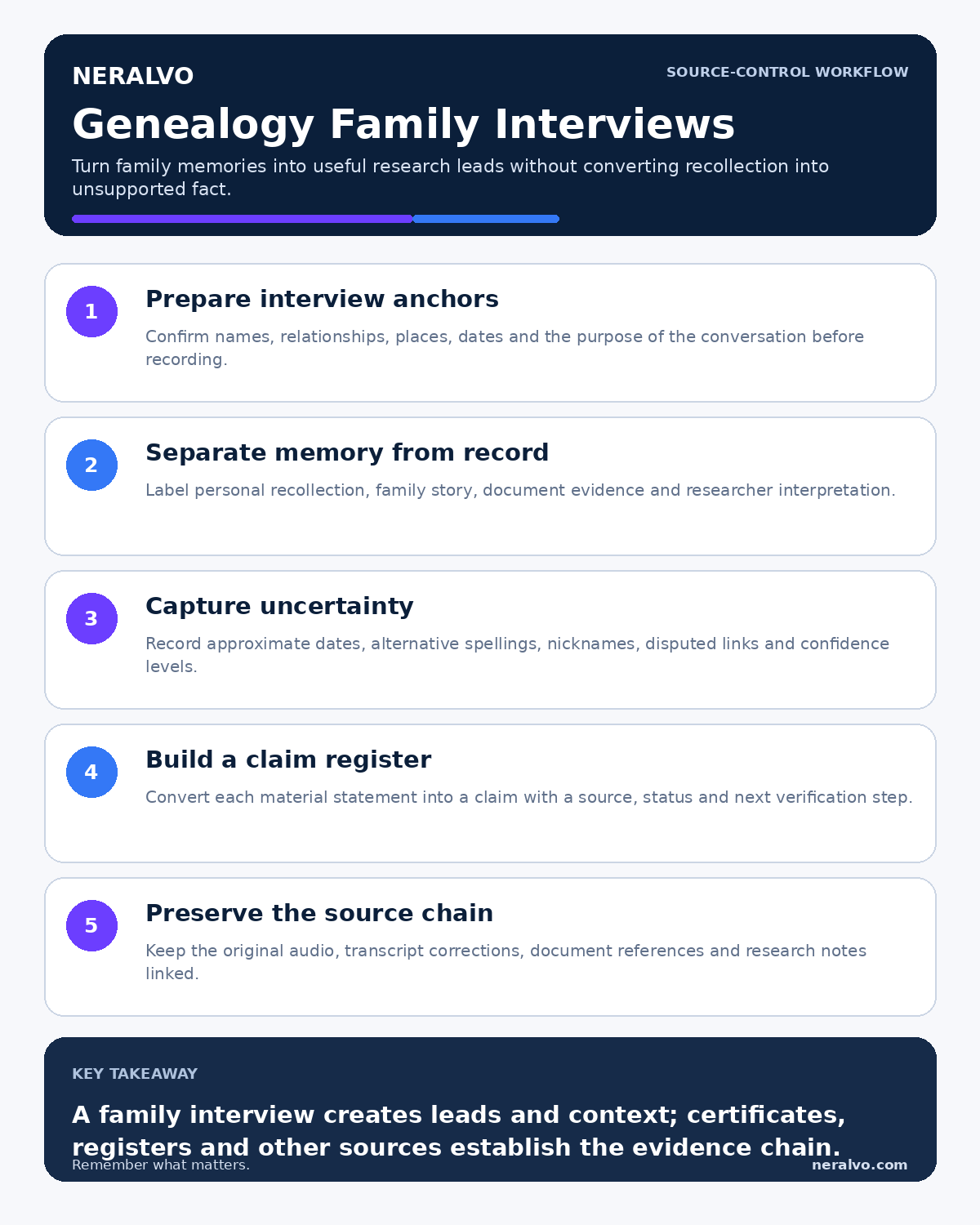
A practical interview workflow
- Explain the project and intended use.
- Record identity anchors.
- Follow one family branch or life period at a time.
- Spell names and places.
- Reference photographs and documents.
- Generate a transcript and name index.
- Mark first-hand, second-hand and documentary sources.
- Create a research-question list.
- Verify against certificates, registers and other records.
- Store consent, audio, transcript and evidence links together.
Do not correct memories into false certainty
If the narrator says “around 1948,” keep the approximation. If two relatives disagree, retain both accounts with attribution. The purpose of the interview is to preserve memory and generate leads, not to manufacture a clean tree.
Where NERALVO Halo fits
Assess Halo against the genealogists workflow matrix can capture family interviews and document-description sessions with local audio storage. Its current specification includes 64GB local storage, NOTE and CALL modes, up to 35 hours of recording and Bluetooth transfer to DOWAY.
DOWAY can create transcripts, summaries, speaker-separated notes, templates, translations and mind maps. For long-term family archives, verify export formats and create appropriate copies outside the app.
Genealogy-interview quality check
- Are names and spellings verified?
- Are relationships unambiguous?
- Is the source of each claim visible?
- Are approximate dates still approximate?
- Are photographs and documents referenced?
- Are conflicts and research questions preserved?
Bottom line
For genealogists, an AI recorder is a memory-preservation and indexing tool. Its best output is a searchable interview with a name list, source labels and research questions. Documentary proof still comes from the records.
Cloud software, a dedicated recorder or manual notes?
For Genealogists, the right answer changes with the setting. This matrix deliberately gives each method a situation where it can be the strongest choice.
| Situation | Best starting point | Reason |
|---|---|---|
| scheduled remote meetings | Cloud meeting software | Auto-join and central collaboration can remove routine admin. |
| in-person or mobile work | Dedicated recorder | Dedicated hardware suits movement, variable rooms and offline source capture. |
| recording is refused or prohibited | Manual notes or an approved alternative | A clear alternative respects policy and participant choice. |
| mixed online and offline work | Governed hybrid | One governed process prevents gaps between desk and field work. |
Related AI voice recorder guides
Profession workflow
Visual map for AI Voice Recorder for Genealogists: Better Family Interviews and Source Control
- Prepare the approved useDefine purpose, safe position, permission and the required formal record.
- Capture context firstState the case, asset, person, location or event identifier before detail.
- Human-verify evidenceCheck technical terms, units, names, dates, decisions and uncertainty.
- Complete the formal recordTransfer only verified information and apply access and retention controls.
On this page
Related guides
See whether Halo fits this workflow
Review the NERALVO Halo specifications, included services, delivery information and current offer only after completing the guide.
Found an error or an out-of-date claim? Email support@neralvo.com with the article address and a supporting source.