Reviewed and improved: 4 August 2026.
The 60-second verdict
Quick answer: build a reliable decision log from a meeting recording by confirming the exact approved outcome, who had authority, the evidence and rationale, any conditions or dissent, the implementation actions and the event that should trigger review.
Decision focus: use the method below only where it produces a recoverable source, a verifiable output and a clear next action. If one of those fails, change the workflow rather than trusting a polished summary.
A transcript preserves discussion. A decision log preserves the controlled choice and why it was reasonable at the time. An AI recorder can help locate decision-like wording, but it cannot determine whether a recommendation became an authorised decision.
Evidence basis and limits
- Decision factors covered: Why ordinary meeting notes lose decision context; Make the decision explicit before the meeting moves on; Use a complete decision-log template.
- Evidence rule: The decision is based on the complete capture-to-action workflow, not a single feature or marketing accuracy percentage.
- Boundary: Examples and workflow recommendations must be tested with representative recordings, the intended users and the actual approval process before rollout.
NERALVO sells the Halo AI voice recorder. This guide explains a general governance workflow and does not claim that AI can establish decision authority or approval status.
Why ordinary meeting notes lose decision context
Minutes often record only a phrase such as “Option B approved.” That omits the question, alternatives, evidence, limits and assumptions behind the choice. When circumstances change, the team cannot tell whether the decision still applies.
A useful decision log should answer:
- What exact question required a choice?
- Which options were genuinely considered?
- What evidence, assumptions and constraints mattered?
- Who had authority to approve the outcome?
- Was it final, temporary, conditional, deferred or subject to another approval?
- What work, cost, risk or document changed as a result?
- What date, threshold or event should trigger review?
Make the decision explicit before the meeting moves on
The chair or decision owner should read the outcome back in one complete sentence and ask for confirmation. This reduces the risk that an AI summary mistakes a strong opinion or recommendation for a final decision.
“Decision D-204: approve the pilot for 30 users, capped at £12,000, subject to security review. Owner: product director. Review after four weeks using activation and retention measures.”
Use a complete decision-log template
| Field | What to record |
|---|---|
| Decision ID | Unique project or governance reference |
| Date and forum | When and where the decision was made |
| Question | The exact issue requiring a choice |
| Options | Material alternatives considered |
| Evidence | Current data, advice, assumptions and constraints |
| Decision | The approved outcome in plain language |
| Authority | Person or body authorised to decide |
| Conditions | Approvals, limits or dependencies still outstanding |
| Dissent | Material objection or uncertainty affecting risk |
| Consequences | Plans, costs, risks and documents affected |
| Actions | Owner, deadline and required output |
| Review trigger | Date, threshold or changed assumption requiring reconsideration |
| Sources | Linked papers, recording, transcript and controlling documents |
Separate six commonly confused statuses
- Idea: a possibility only.
- Recommendation: advice submitted to a decision maker.
- Decision: an authorised choice.
- Conditional decision: approval dependent on a named event.
- Deferred: no decision has yet been made.
- Superseded: a later authorised decision replaces the earlier one.
Correct the source before extracting the decision
Replay the relevant section and verify speaker names, roles, figures, thresholds, dates, project and supplier names, voting outcomes and conditional wording such as “if,” “subject to” and “provided that.” Check whether the final wording changed after the first proposal.
Do not treat the first confident statement as the decision. The closing read-back, formal vote, written approval or required governance step may control the final status.
Confirm authority, not just influence
A senior or persuasive participant may support an option without having delegated authority to approve it. Check the organisation’s governance route, financial limits, quorum, required sign-off and whether a written instrument is needed.
Record concise rationale and material dissent
Capture the evidence and trade-off that explain the choice, not every comment. Preserve dissent, uncertainty or excluded evidence where it could affect implementation, risk or future review. AI should not smooth a contested discussion into false unanimity.
Link execution without duplicating it
- Correct the relevant transcript passage.
- Confirm the decision wording, authority and effective date.
- Record options, evidence, constraints and conditions.
- Identify consequences and review triggers.
- Create the approved decision-log entry.
- Update affected plans, designs, budgets, policies and risk registers.
- Create implementation actions with owners and deadlines.
- Notify affected stakeholders.
- Apply the retention rule to audio, transcripts and working drafts.
Protect confidential and personal information
Decision discussions may contain personal, commercially sensitive, security-related or legally privileged information. Record only through an approved and transparent process, restrict access and retain only what the purpose requires. The decision log should contain the minimum information needed to understand and implement the choice.
Decision quality and supersession toolkit
| Field | Control question |
|---|---|
| Decision question | What exact choice was required? |
| Evidence | Which current facts and assumptions supported it? |
| Authority | Who could approve within which limit? |
| Conditions | What must happen before implementation? |
| Consequence | What cost, risk or dependency follows? |
| Review | Which date or threshold reopens it? |
Supersession rule
Never overwrite the original decision. Add a new decision ID, link the earlier entry, state what changed and why, identify who approved the change and list the actions or documents affected.
Where NERALVO Halo fits
View Halo specifications against the evidence checklist provides NOTE recording, supported CALL capture, 64GB local storage, up to 35 hours of recording and Bluetooth sync with DOWAY. DOWAY can generate transcripts, summaries, templates, mind maps and exports. One year of DOWAY Max is included from activation.
Use verbal decision markers during approved meetings, verify the closing wording against the audio and papers, then enter only the controlled decision in the log. DOWAY can identify candidate decisions but cannot determine authority or legal status.
Decision-log audit checklist
- Decision wording verified against the final discussion
- Recommendation distinguished from approval
- Authority and delegated limit confirmed
- Evidence, assumptions and rationale recorded
- Conditions and dependencies remain visible
- Material dissent preserved
- Implementation has one accountable owner
- Actions and controlling documents linked
- Review or expiry trigger assigned
- Earlier decisions superseded transparently
Workflow choice matrix for How to Build a Decision Log from Meeting Recordings
Choose the method that protects the source and reduces downstream correction. The table makes the non-hardware options explicit.
| Condition | Preferred route | Why |
|---|---|---|
| High-risk or mixed work | Governed hybrid | Separate capture, review, approval and retention rather than trusting one tool. |
| Recording is refused, prohibited or unnecessary | Manual notes / no recording | Respecting the boundary is the correct workflow, not a product failure. |
| In-person, mobile or unreliable-connectivity work | Dedicated recorder | Independent capture and a recoverable local source are usually more resilient. |
| Repeatable remote work with approved integrations | Cloud software | Automation and central collaboration may outweigh device independence. |
Frequently asked questions
Should every meeting choice enter the log?
Log choices with ongoing strategic, operational, financial, technical, contractual or governance significance. Minor routine choices may remain in ordinary minutes.
Can AI identify decisions automatically?
It can suggest candidates, but a person must confirm the final wording, authority, conditions and status.
Should rejected options be included?
Include material alternatives and why they were rejected where that context prevents repeated debate or supports future review.
Can the transcript itself be the decision log?
Usually not. A concise structured record is easier to govern, search, implement and update.
What happens when a decision changes?
Create a new entry that references and supersedes the earlier decision. Do not erase the historical rationale.
Should the recording be kept indefinitely?
No. The approved log may require longer retention than the temporary source audio. Follow the defined purpose and organisational policy.
Useful resources
- Association for Project Management: decision-making
- ISO 31000 risk-management overview
- How to Turn a Recording into Accurate Meeting Minutes with AI
- How to Create an Issue Log from Meeting Recordings
Bottom line: a meeting recording helps recover what was discussed. Explicit authority, verified wording, controlled rationale, owned execution and transparent supersession turn it into a dependable decision record.
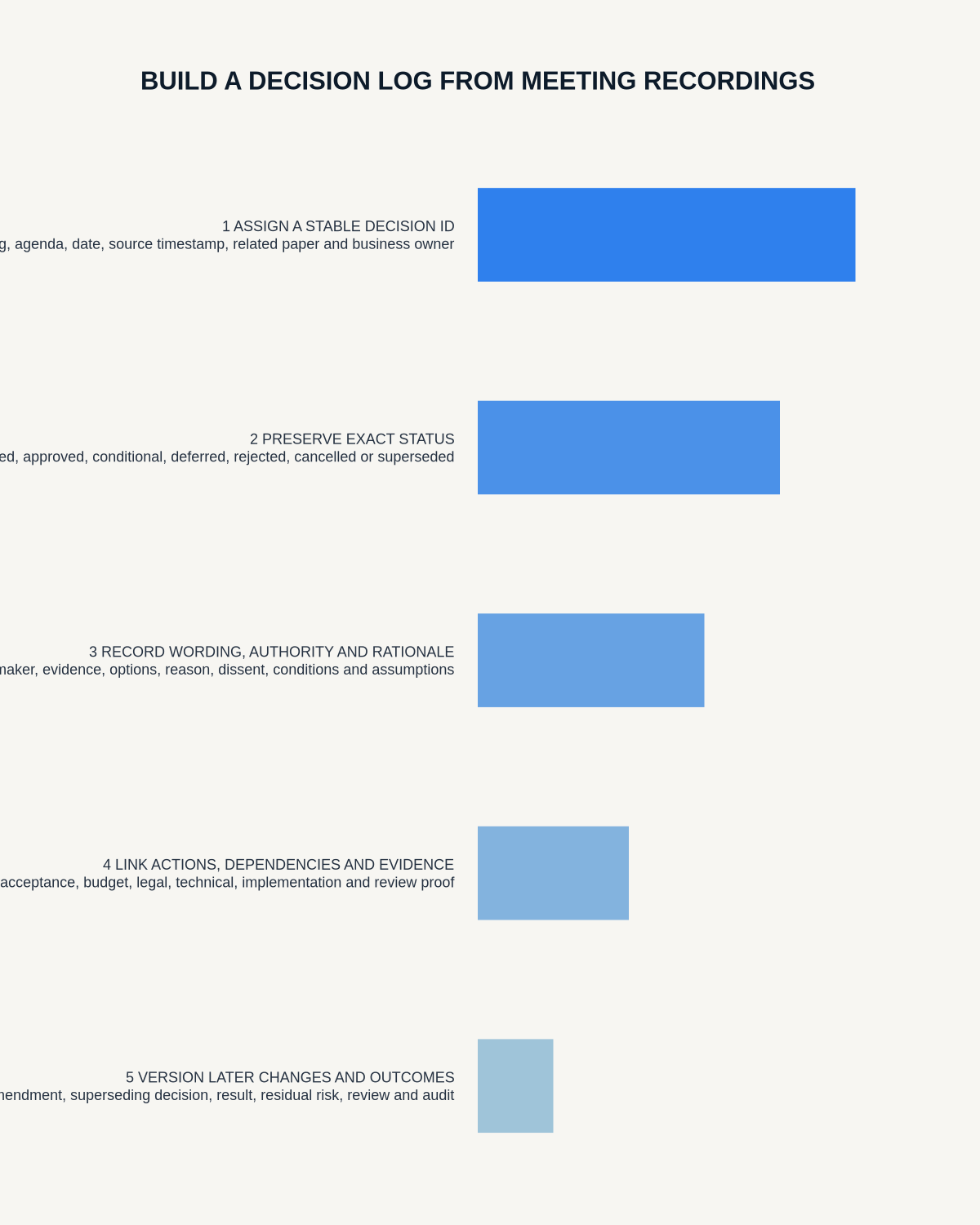
Workflow map
Visual map for How to Build a Decision Log from Meeting Recordings
- Define the decisionState the question, required output and acceptance rule.
- Capture the sourceUse the approved route and preserve context, identity and limitations.
- Verify material detailsReplay or check names, numbers, negatives, decisions and actions.
- Move into the real recordAssign an owner, retain evidence and apply the deletion rule.
On this page
Related guides
See whether Halo fits this workflow
Review the NERALVO Halo specifications, included services, delivery information and current offer only after completing the guide.
Found an error or an out-of-date claim? Email support@neralvo.com with the article address and a supporting source.