An AI voice recorder is worth buying when spoken information creates more administrative work than the device and app cost. It is not worth buying when recordings will rarely be reviewed, the phone already handles the job reliably or the user has no clear process for turning audio into actions.

The 60-second verdict
The answer is different for a solicitor producing client notes, a student revising lectures and someone who records one personal memo each month. The useful calculation is not “How advanced is the recorder?” It is “How much usable work does it remove?”
Best fit: buyers willing to test the complete capture-to-export workflow. Avoid: choosing from price, advertised accuracy or AI features without checking allowance, correction effort and exit options.
Evidence basis and limits
- Decision factors covered: A simple return-on-time calculation; When an AI voice recorder is usually worth it; You regularly lose detail while taking notes.
- Evidence rule: A claim earns weight only when the source, date, configuration and limitation are clear enough for a reader to check.
- Boundary: Examples and workflow recommendations must be tested with representative recordings, the intended users and the actual approval process before rollout.
A simple return-on-time calculation
Estimate four numbers:
- How many meetings, calls or spoken notes do you process each month?
- How many minutes do you currently spend writing or reconstructing each one?
- How much time would recording, transcription and review realistically save?
- What is one hour of your time worth?
Example: 20 meetings per month × 15 minutes saved = 300 minutes, or five hours. If that time is worth £25 per hour, the monthly time value is £125. A device that genuinely creates that saving can repay itself quickly.
Do not count time saved until you have measured correction and filing. A transcript that takes 20 minutes to clean may not improve on a 15-minute manual note.
When an AI voice recorder is usually worth it
You regularly lose detail while taking notes
Fast conversations force the listener to choose between participating and typing. Recording preserves the source so names, figures and commitments can be checked afterwards.
You repeat the same administrative task
Value rises when the output is predictable: a client attendance note, meeting summary, interview transcript, lecture outline or post-visit report. Repeated workflows are easier to template and measure.
Your phone is already overloaded
A separate recorder can keep capture independent from calls, messages, low battery and app interruptions.
The original wording may matter
Interviews, research, customer objections and detailed instructions benefit from a replayable source. Human review is still required before important text is treated as final.
You can use the output elsewhere
The recorder is more valuable when transcripts and summaries move into a CRM, project system, client file, revision plan or task list.
When it is probably not worth it
- You record only occasionally and a phone voice memo already works.
- You dislike reviewing transcripts and will leave files unprocessed.
- The conversations are too sensitive for the available workflow or policy.
- Your meetings are already captured reliably by an approved platform.
- You need live captions rather than post-meeting notes.
- The product locks exports behind a plan you do not intend to keep.
Value by type of user
| User | Potential value | Main test |
|---|---|---|
| Solicitor or adviser | Faster draft attendance notes and clearer recall | Can critical facts be checked and stored appropriately? |
| Sales professional | Better objection, requirement and next-step capture | Does the output reach the CRM? |
| Student | Review of dense explanations and lecture summaries | Does recording improve revision rather than create backlog? |
| Researcher or journalist | Searchable interviews and verified quotations | Are source audio and transcripts exportable? |
| Manager | Action lists and decision records | Does review take less time than manual minutes? |
| Occasional personal user | Quick ideas and reminders | Would a free phone app already be enough? |
The hidden costs
Include more than the device price:
- AI transcription or subscription charges.
- Time spent correcting names, numbers and speakers.
- Charging and file-management effort.
- Replacement if the device is lost or damaged.
- Staff training for a team rollout.
- Possible duplication with existing meeting software.
Also check what happens when an included app period ends. A recorder can still be worthwhile with recurring fees, but the ongoing cost should be visible before purchase.
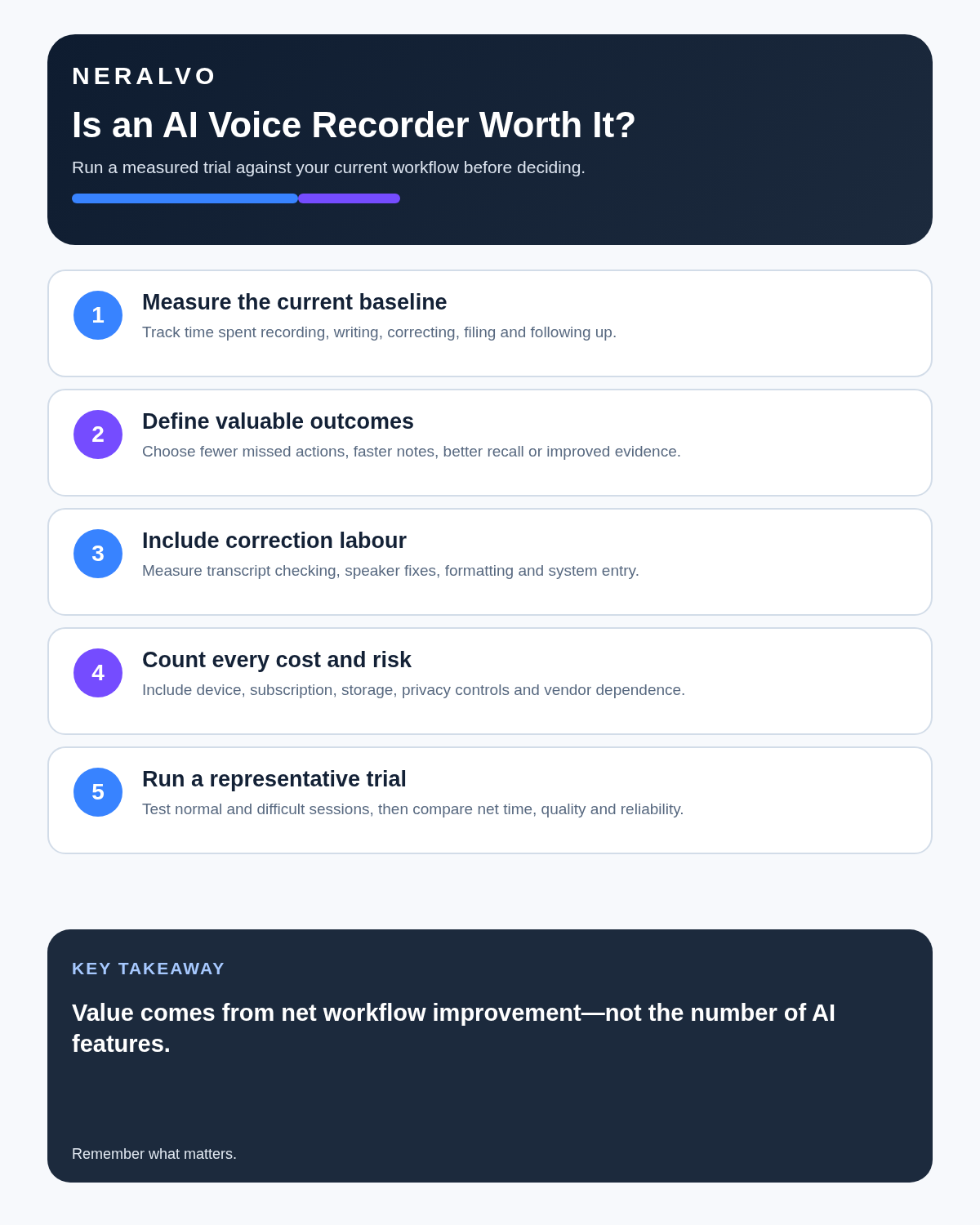
A seven-day worth-it test
Use the device in ordinary work for one week. Record at least five different situations rather than repeating one easy demonstration.
- Measure the length of each session.
- Record the time needed to transfer and process it.
- Record correction time.
- Note whether any critical detail was wrong or missing.
- Note the final destination of the output.
- Compare the total with the time your old method required.
The device passes only when the final usable record is faster or better—not merely when transcription appears quickly.
Questions that prevent a bad purchase
- Can recording continue without the phone or internet?
- Can original audio and transcripts be exported?
- What AI allowance is included and for how long?
- Does call recording work with the exact phone and apps used?
- Can recordings be named, searched and deleted easily?
- Can the device cover the longest normal session?
- Who will review and approve important outputs?
Where NERALVO Halo fits
Check Halo against the full-workflow buying test is aimed at users who want a compact dedicated recorder rather than relying only on a phone or meeting platform. Its current specification includes 64GB local storage, NOTE and CALL modes, up to 35 hours of recording and Bluetooth transfer to DOWAY.
DOWAY can create transcripts, summaries, speaker-separated notes, templates, translations and mind maps. The current package includes one year of DOWAY Max from activation. Verify current allowances and what remains available after that period.
CALL mode compatibility can vary by phone, operating system and call route, so test the exact setup before relying on it.
Workflow choice matrix for Is an AI Voice Recorder Worth It? A Real Cost-and-Time Test
Choose the method that protects the source and reduces downstream correction. The table makes the non-hardware options explicit.
| Condition | Preferred route | Why |
|---|---|---|
| High-risk or mixed work | Governed hybrid | Separate capture, review, approval and retention rather than trusting one tool. |
| Recording is refused, prohibited or unnecessary | Manual notes / no recording | Respecting the boundary is the correct workflow, not a product failure. |
| In-person, mobile or unreliable-connectivity work | Dedicated recorder | Independent capture and a recoverable local source are usually more resilient. |
| Repeatable remote work with approved integrations | Cloud software | Automation and central collaboration may outweigh device independence. |
Frequently asked questions
Will an AI recorder replace manual review?
No. It can produce a first draft and searchable source, but important names, figures, actions and decisions still need checking.
Is it worth it for one meeting a week?
Possibly, if the meeting is long and the follow-up burden is high. Measure time saved rather than meeting count alone.
Is a dedicated recorder better than a phone app?
It can be when independent battery, local storage, physical controls and deliberate placement matter. For occasional low-risk use, a phone app may be sufficient.
What is the strongest sign it is worth buying?
The output repeatedly reaches a useful destination while reducing total administration time.
Related buying guides
Compare a dedicated recorder with a phone app, review the hardware vs subscription cost model, and check the full NERALVO Halo buyer’s guide before deciding.
Source check: value should include governance cost as well as time saved. If recordings contain personal data, the ICO’s data-minimisation guidance says organisations should identify the minimum information needed for the purpose and hold no more than necessary. Read the official ICO data-minimisation guidance.
Bottom line
An AI voice recorder is worth it when it repeatedly converts spoken information into checked, usable work faster than your current method. Calculate value from complete outputs, correction time and recurring costs. Run a real one-week test before deciding.
On this page
Related guides
See whether Halo fits this workflow
Review the NERALVO Halo specifications, included services, delivery information and current offer only after completing the guide.
Found an error or an out-of-date claim? Email support@neralvo.com with the article address and a supporting source.