The 60-second verdict
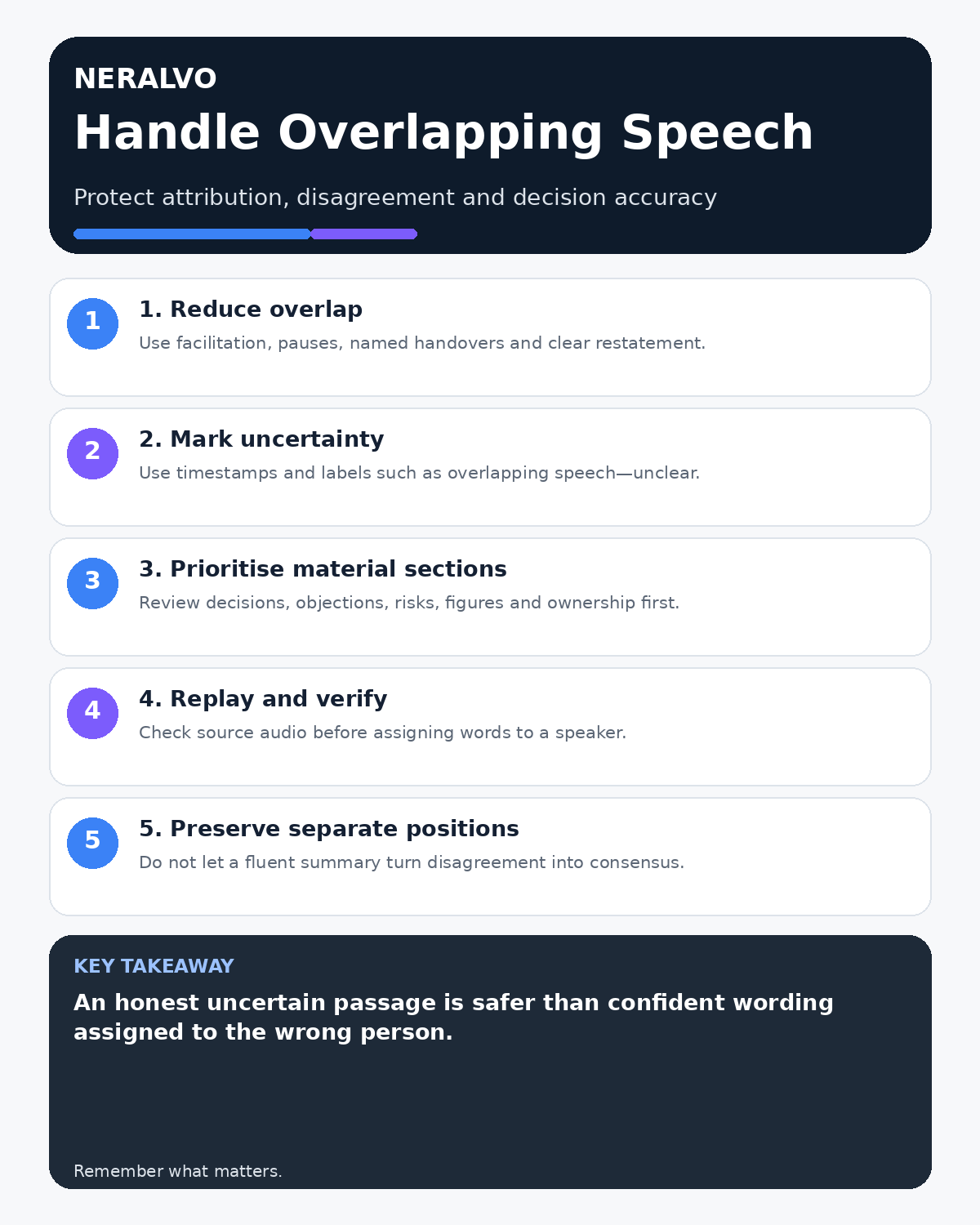
Quick answer: handle overlapping speech in AI transcripts by reducing overlap during the meeting, marking unclear sections honestly, replaying material passages against the source audio and preserving separate positions when interruption or simultaneous speech changes meaning.
Decision focus: use the method below only where it produces a recoverable source, a verifiable output and a clear next action. If one of those fails, change the workflow rather than trusting a polished summary.
Evidence basis and limits
- Decision factors covered: Reduce overlap before transcription; Recognise common overlap failures; Mark uncertainty instead of guessing.
- Evidence rule: A claim earns weight only when the source, date, configuration and limitation are clear enough for a reader to check.
- Boundary: Examples and workflow recommendations must be tested with representative recordings, the intended users and the actual approval process before rollout.
Overlapping speech is dangerous because an AI transcript can look fluent while merging two speakers, assigning words to the wrong person or converting disagreement into consensus.

Reduce overlap before transcription
- Use a chair or facilitator for larger discussions.
- Pause briefly after questions.
- Use names when handing over the floor.
- Ask interrupted speakers to complete their point.
- Repeat figures, conditions and actions clearly.
- Read back material decisions after rapid exchanges.
Better turn-taking improves both the meeting and the transcript.
Recognise common overlap failures
- One speaker disappears entirely.
- Two statements are merged into one sentence.
- A response is assigned to the wrong person.
- An objection becomes apparent agreement.
- A condition or negative word is lost.
- A summary invents consensus.
Mark uncertainty instead of guessing
Use a consistent label such as [overlapping speech—unclear], [speaker unclear] or [simultaneous responses], with a timestamp where useful. If attribution cannot be supported, leave the passage unattributed.
An honest gap is safer than confident invented wording.
Prioritise material sections
Review overlap carefully when it affects decisions, objections, admissions, complaints, safety, safeguarding, figures, dates, conditions, actions or ownership. Casual agreement noises and filler speech usually need less effort.
Use a targeted overlap log
| Field | Record |
|---|---|
| Timestamp | Start and end of the unclear section |
| Draft | Original machine wording |
| Possible speakers | Names or roles considered |
| Audio finding | Supported, unclear or contradictory evidence |
| Approved text | Final wording and reviewer |
Preserve interruption and dissent
Where one person interrupts another, preserve the unfinished statement if it materially affects meaning. Where simultaneous support and objection occur, record both supported positions rather than writing “the group agreed.”
Check downstream summaries and actions
Correcting the transcript is not enough. Review generated summaries, minutes, action lists and CRM notes for changed ownership, missing dissent or unsupported consensus.
Improve recurring problem conditions
Track where overlap occurs: large workshops, remote calls, poor room acoustics, weak chairing or emotionally charged topics. Use the evidence to improve meeting design, microphone placement and facilitation.
Workflow choice matrix for How to Handle Overlapping Speech in AI Transcripts
Choose the method that protects the source and reduces downstream correction. The table makes the non-hardware options explicit.
| Condition | Preferred route | Why |
|---|---|---|
| Repeatable remote work with approved integrations | Cloud software | Automation and central collaboration may outweigh device independence. |
| In-person, mobile or unreliable-connectivity work | Dedicated recorder | Independent capture and a recoverable local source are usually more resilient. |
| Recording is refused, prohibited or unnecessary | Manual notes / no recording | Respecting the boundary is the correct workflow, not a product failure. |
| High-risk or mixed work | Governed hybrid | Separate capture, review, approval and retention rather than trusting one tool. |
Frequently asked questions
Should unclear overlap be deleted?
Not when it may be material. Preserve the timestamp and mark the uncertainty.
Can AI reliably identify both speakers?
Sometimes, but material attribution must be checked against the audio.
How can remote meetings reduce overlap?
Use named handovers, visible hand-raising, short pauses and explicit read-back of decisions and actions.
Useful resources
- Association for Project Management meeting guidance
- How to Correct Names and Technical Terms
- How to Compare Transcript Versions
- Apply this guide before assessing NERALVO Halo
Final overlap checklist
- Material overlap identified
- Uncertainty marked honestly
- Speaker attribution supported
- Interruption and dissent preserved
- Summaries and actions rechecked
- Recurring causes addressed
On this page
Related guides
See whether Halo fits this workflow
Review the NERALVO Halo specifications, included services, delivery information and current offer only after completing the guide.
Found an error or an out-of-date claim? Email support@neralvo.com with the article address and a supporting source.