The 60-second verdict
Quick answer: recording in healthcare settings requires organisational clinical governance, a defined care or training purpose, appropriate patient information and choice, secure health-data handling, verification of every clinically material detail and a clear boundary between source audio and the authorised patient record.
Use this guide when: the recording purpose, authority, participants, access and retention can be defined. Pause when: any of those controls is unclear.
Evidence basis and limits
- Decision factors covered: Clinical recording is an organisational decision; Assign clinical-safety ownership; Complete the data-protection assessment.
- Evidence rule: Claims are weighted by consequence: capture failure, changed meaning, access and recovery matter more than polished wording.
- Boundary: This is practical information, not legal advice. Verify current ICO guidance, sector rules, contracts and organisational policy for the real use case.

Healthcare conversations can contain symptoms, diagnoses, medicines, allergies, safeguarding information, family history and highly personal details. AI transcription may reduce clerical pressure, but a missing negative, incorrect dose or misunderstood clinical context can create direct patient-safety risk.
This guide explains governance questions around recording consultations, handovers and clinical discussions in England. It is general information, not medical, legal, clinical-safety or information-governance advice. Healthcare organisations should follow current NHS, regulator, professional and local policies.
Clinical recording is an organisational decision
NHS England’s guidance on AI-enabled ambient scribing describes adoption as an organisational process requiring governance, clinical-safety assessment, data-protection controls, supplier due diligence, training and ongoing monitoring.
See the official NHS England guidance on AI-enabled ambient scribing.
Individual staff should not introduce a personal recorder or unapproved AI account into clinical care.
Assign clinical-safety ownership
Before deployment, identify a Clinical Safety Officer and document hazards such as:
- Incorrect or omitted symptoms.
- Wrong patient or speaker attribution.
- Incorrect medicines, doses or allergies.
- Loss of uncertainty or clinical nuance.
- Delayed or unavailable output.
- Integration failure.
- Automation bias.
- Data leakage or unauthorised access.
NHS guidance refers to clinical-safety documentation including a safety case, hazard log and monitoring framework under DCB0160. Suppliers may also need evidence under DCB0129.
Complete the data-protection assessment
Clinical audio and transcripts usually contain health data, which is special-category personal information. The organisation should identify the Article 6 lawful basis, Article 9 condition, controller and processor roles, transparency arrangements, supplier contract, international transfers, access controls, retention and rights handling.
Complete a DPIA where required before routine deployment. Cover the whole flow from microphone to electronic patient record, including app accounts, cloud processing, support access, exports and backups.
Use an approved supplier and deployment route
Assess:
- Product purpose and intended use.
- Clinical-safety evidence.
- Information-security certification and testing.
- Subprocessors and data locations.
- Whether content trains models.
- Incident and vulnerability reporting.
- Data deletion and contract exit.
- Integration with the electronic patient record.
- Accessibility, equality and language performance.
- Monitoring and audit information.
A consumer subscription should not be treated as equivalent to an approved healthcare contract.
Inform the patient clearly
Patients should understand:
- That recording or ambient capture is taking place.
- The purpose.
- Whether AI creates a transcript or draft note.
- Who can access the data.
- Where the approved record will be stored.
- Whether raw audio is retained.
- What happens if they decline.
The General Medical Council states that professionals making or using recordings should respect privacy and dignity, provide appropriate information, use appropriate consent or other valid authority, avoid pressure and store recordings securely. See the GMC principles for visual and audio recordings of patients.
Provide a non-recorded route
Patients should not be disadvantaged for declining optional recording. Define an alternative, such as conventional clinical note-taking or an approved accessibility process. Consider capacity, interpreters, communication needs, distress and the presence of relatives or carers.
Keep records separate
| Record | Status |
|---|---|
| Source audio | Temporary restricted material where approved |
| Machine transcript | Unverified working draft |
| Clinical note | Contemporaneous authoritative patient record |
| Patient communication | Approved letter, plan or instruction |
| Incident or safeguarding record | Completed through the required pathway |
Minimise capture
- Begin only when the relevant consultation starts.
- Pause during authentication, payment or unrelated discussion.
- Avoid recording other patients or corridor conversations.
- Stop when the formal clinical purpose ends.
- Do not leave devices recording unattended.
- Use only the outputs required for the clinical workflow.
Verify every clinically material detail
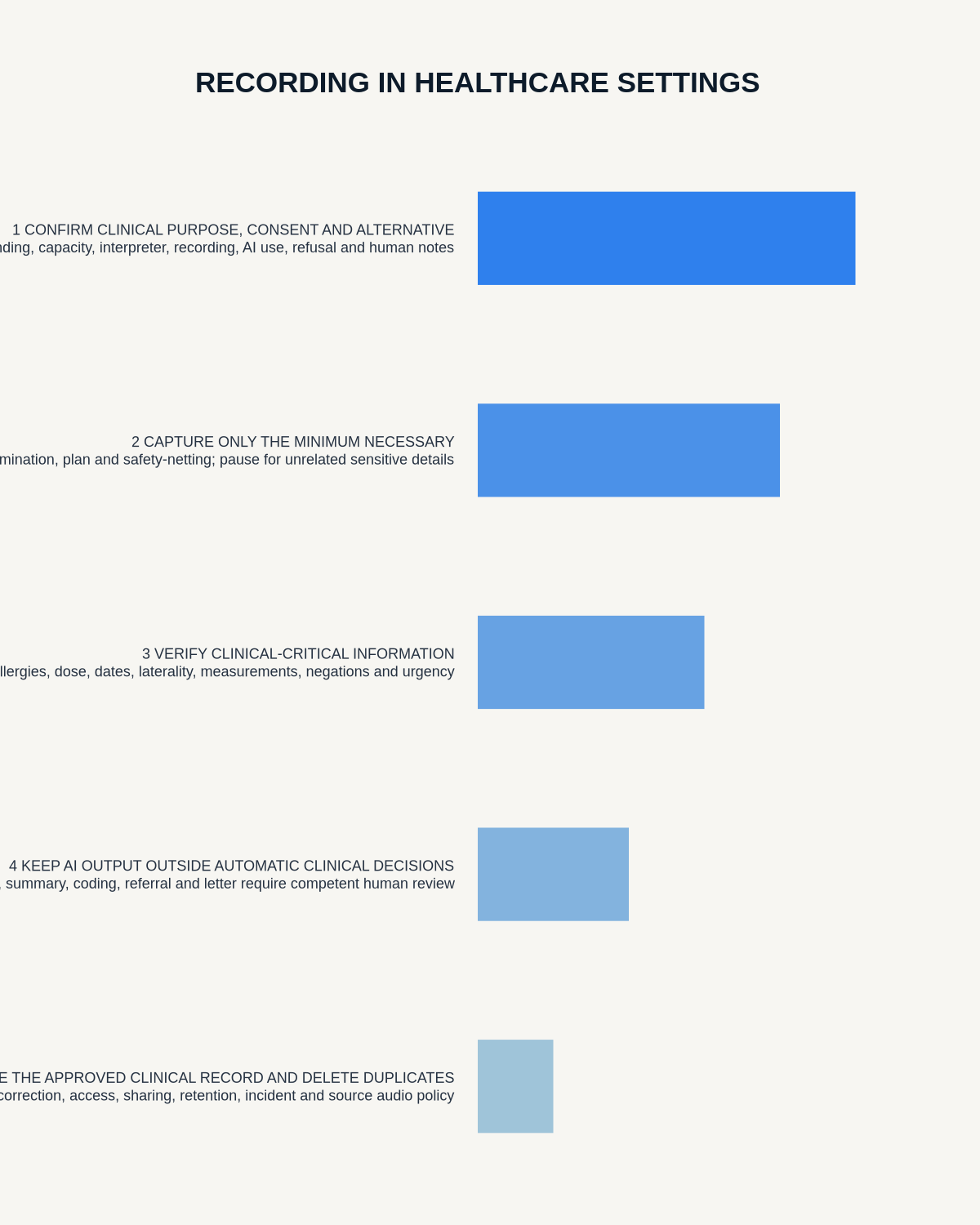
An authorised clinician should review and approve the output before it enters the patient record. Check:
- Patient identity.
- Symptoms and duration.
- Positive and negative findings.
- Medicines, formulations and doses.
- Allergies and adverse reactions.
- Dates, measurements and test results.
- Differential diagnoses and uncertainty.
- Advice, safety-netting and follow-up.
- What the patient said versus the clinician’s assessment.
AI should not diagnose, prescribe or alter a care plan merely because a transcript appears polished.
Keep the clinician in control
The system should support documentation, not replace clinical judgement. Staff need training in known limitations, verification, safe failure, incident reporting and automation bias.
Where output is incomplete or implausible, return to the original consultation information and normal clinical process rather than editing a guessed narrative.
Integrate with the authorised patient record
The reviewed note should enter the correct electronic patient record through an approved route. Avoid copy-and-paste workflows that lose author, time, version or provenance. Define whether the audio, draft transcript or only the final note is retained.
Monitor performance after deployment
Review:
- Error and omission rates.
- Performance across accents, languages and communication needs.
- Patient complaints and opt-out rates.
- Clinical incidents and near misses.
- Downtime and integration failures.
- Unauthorised access or data leakage.
- Staff workarounds.
- Supplier changes and model updates.
A product that was acceptable at launch may require reassessment after a material update.
Handle safeguarding and urgent care immediately
Do not wait for transcription before responding to acute deterioration, abuse, neglect, self-harm risk or another urgent concern. Clinical and safeguarding action takes priority over documentation.
Retention should be purpose-based
Raw audio can contain substantially more information than the final clinical note. Decide whether it needs to exist after verification. Apply separate schedules to audio, draft text, approved notes, exports and backups, subject to clinical, legal and local requirements.
Patient-created recordings
Patients may ask to record consultations or arrive with their own device. Organisations should have a clear, respectful policy addressing privacy of staff and third parties, safeguarding, covert recording, data sharing and how patient recordings may be incorporated into care.
Where NERALVO Halo fits—and does not fit
Review NERALVO Halo against these controls includes NOTE mode, supported CALL mode, 64GB local storage, up to 35 hours of recording and Bluetooth connection to DOWAY. DOWAY supports transcripts, summaries, templates, translation, mind maps and exports, with one year of DOWAY Max included.
Those features do not constitute clinical approval. A healthcare organisation would need to assess the complete Halo and DOWAY workflow against clinical-safety, data-protection, cybersecurity, procurement, records-management and professional requirements. Individual staff should not improvise with patient information.
Workflow choice matrix for Recording in Healthcare
Apply the strongest control before choosing a device. The table makes the non-hardware options explicit.
| Condition | Preferred route | Why |
|---|---|---|
| Repeatable remote work with approved integrations | Cloud software | Automation and central collaboration may outweigh device independence. |
| In-person, mobile or unreliable-connectivity work | Dedicated recorder | Independent capture and a recoverable local source are usually more resilient. |
| Recording is refused, prohibited or unnecessary | Manual notes / no recording | Respecting the boundary is the correct workflow, not a product failure. |
| High-risk or mixed work | Governed hybrid | Separate capture, review, approval and retention rather than trusting one tool. |
Frequently asked questions
Can AI-generated notes go directly into the patient record?
They should be reviewed and approved by an authorised clinician under the organisation’s clinical-safety process before use.
Is a patient’s agreement enough to use any recording app?
No. Consent or another authority does not replace organisational approval, clinical safety, supplier assessment, security and professional duties.
Can a general AI recorder be used for ward handovers?
Only after formal assessment and approval. Handover errors can affect immediate care and the environment may capture several patients and staff.
Should raw clinical audio be kept permanently?
Not by default. Retention must be justified by purpose and policy, with legal and clinical advice where required.
Healthcare deployment checklist
- Clinical purpose and intended use defined.
- Executive and clinical owner assigned.
- Clinical Safety Officer involved.
- Safety case and hazard log completed.
- DPIA and lawful processing documented.
- Approved supplier and contract confirmed.
- Patient information and non-recorded option prepared.
- Staff trained in limitations and verification.
- Electronic patient-record integration tested.
- Incident, downtime and fallback process ready.
- Accuracy and equality monitoring established.
- Retention and deletion approved.
Bottom line: clinical recording is safe only when the organisation controls the technology, the clinician controls the final note and patients retain dignity, transparency and a meaningful alternative.
Related guides
On this page
Related guides
Check permission, retention and access before choosing hardware
Once the policy requirements in this guide are satisfied, compare Halo’s specifications, local storage, included services and current offer against your approved workflow.
Found an error or an out-of-date claim? Email support@neralvo.com with the article address and a supporting source.