The 60-second verdict
Quick answer: recording in legal settings requires explicit authority, separate protection of confidentiality and privilege, strict matter and supplier controls, accurate attribution, secure processing and a lawyer-reviewed attendance note or authorised transcript.
Use this guide when: the recording purpose, authority, participants, access and retention can be defined. Pause when: any of those controls is unclear.
Evidence basis and limits
- Decision factors covered: Confidentiality and privilege are different; Apply a necessity and proportionality test; Check whether the setting permits recording.
- Evidence rule: Claims are weighted by consequence: capture failure, changed meaning, access and recovery matter more than polished wording.
- Boundary: This is practical information, not legal advice. Verify current ICO guidance, sector rules, contracts and organisational policy for the real use case.

Legal conversations may contain privileged advice, client instructions, litigation strategy, personal data, criminal allegations, undertakings and third-party confidential information. A convenient recording can create serious professional risk when the device, AI supplier, account or export route has not been approved.
This guide discusses recording in legal settings in England and Wales at a high level. It is general information, not legal or regulatory advice. Professionals should follow their regulator, firm policies, court or tribunal rules, client terms and current law.
Confidentiality and privilege are different
The professional duty of confidentiality applies broadly to the affairs of current and former clients. Legal professional privilege is a separate legal protection that depends on the nature, purpose and circumstances of the communication.
A recording does not create privilege merely because a lawyer was present. Conversely, careless disclosure to an AI supplier, personal account or unauthorised recipient may create confidentiality and privilege risks.
See the SRA Code of Conduct and SRA confidentiality guidance.
Apply a necessity and proportionality test
Ask what the recording achieves that contemporaneous written notes cannot. Recording may be justified for an approved accessibility need, a complex client instruction, an authorised interview or another defined purpose. It should not become the default for every meeting.
Consider:
- Sensitivity and privilege.
- Client expectations.
- Third-party information.
- Court, tribunal or police restrictions.
- Regulatory and contractual duties.
- Whether a formal record already exists.
- Whether written notes are less intrusive.
Check whether the setting permits recording
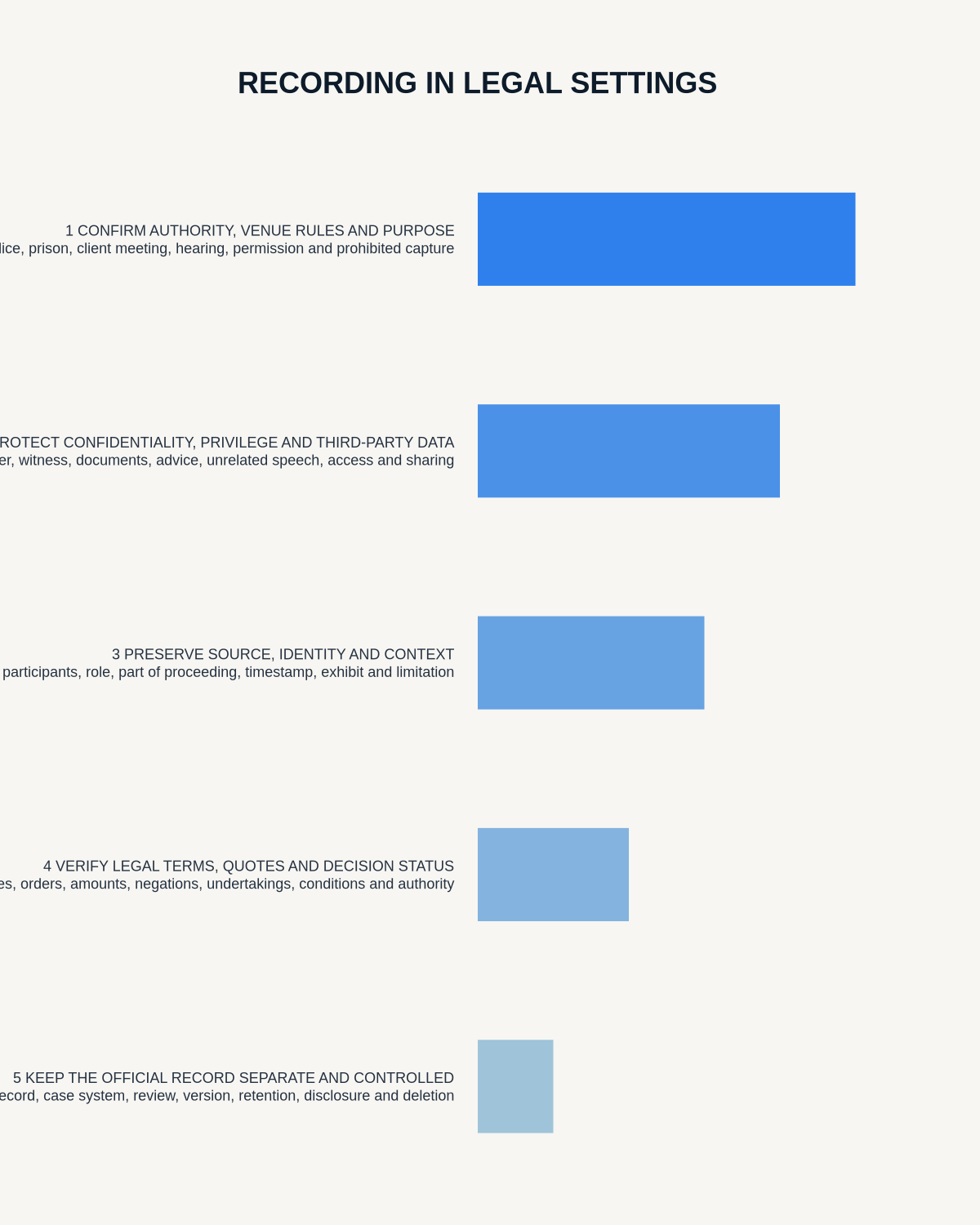
Client meetings, internal case conferences, police interviews, court hearings, tribunals, mediations, arbitrations, prisons and regulatory interviews have different rules. Do not assume that attendance gives permission to record.
Obtain specific authority and advice where the process is governed by a judge, tribunal, mediator, regulator, public body or facility.
Explain the process to the client
Where recording is proposed, explain:
- The precise purpose.
- Whether AI transcription or summarisation is used.
- The supplier and general processing route.
- Who can access audio and text.
- Whether third parties may be captured.
- Which final document controls.
- How long each record is retained.
- The non-recorded alternative.
Do not conceal the recorder or rely on its small size.
Assess the supplier as a confidentiality risk
Review:
- Contractual confidentiality.
- Processor and subprocessor terms.
- Data locations and international transfers.
- Whether content trains models.
- Human support access.
- Security and authentication.
- Incident notification.
- Deletion and account closure.
- Ability to separate matters and users.
- Audit and export controls.
A consumer account may give the supplier rights or operational access inconsistent with professional duties.
Use approved firm accounts and matter controls
Do not place client audio in personal cloud storage, private email, consumer messaging or an unmanaged device. Use individual accounts, matter-based permissions, multifactor authentication and approved storage.
Separate raw audio, draft transcript and final attendance note. Make it obvious which record is authoritative.
Use a matter anchor
State the matter reference, date, purpose, people present and recording status without speaking unnecessary identifiers. Keep each matter’s files separated.
Verify legal meaning, not just words
AI may transcribe a sentence accurately but misunderstand its legal status. Review:
- Client instructions.
- Advice and warnings.
- Offers and conditional proposals.
- Admissions and allegations.
- Undertakings.
- Deadlines and limitation dates.
- Names, addresses and amounts.
- Whether a statement was privileged, without prejudice or open.
- Who said what.
- Uncertainty and disputed facts.
Do not allow AI to infer that exploratory language formed a binding agreement or undertaking.
Keep human professional judgement mandatory
An authorised legal professional should review the source and approve the final record. AI cannot decide credibility, privilege, materiality, legal effect, professional compliance or whether disclosure is required.
The Bar Standards Board’s AI guidance emphasises risk evaluation, technology awareness, data governance, transparency, client confidentiality and protection of sensitive information. See the BSB AI guidance announcement.
Do not upload other parties’ documents casually
A transcript may quote witness statements, medical records, opponent correspondence, expert reports or court documents. Assess confidentiality, disclosure restrictions, copyright, protective orders and purpose before processing them through AI.
Protect without-prejudice and settlement discussions
Record status explicitly and keep internal strategy separate from any shared summary. Do not assume that a recording determines admissibility or privilege. Obtain legal advice for the specific dispute.
Manage legal holds and retention
Raw audio may ordinarily be deleted after an approved attendance note is verified, but disputes, complaints, investigations, disclosure obligations or legal holds can change the position. Check before deletion and document exceptions.
Apply the firm’s schedule to the matter record while removing duplicate downloads, app copies and uncontrolled exports.
Handle subject-access and disclosure requests
Audio and transcripts may contain personal data relating to several people. A request may require identification, search, privilege review, third-party redaction and application of exemptions. Do not assume audio is outside the process because review is inconvenient.
Use a structured legal attendance-note workflow
- Open with matter reference, date, participants and purpose.
- State that recording has been authorised.
- Capture the client’s instructions and factual account.
- Mark advice, questions and uncertainty separately.
- Read back material dates, figures and commitments.
- Generate a draft transcript and matter-specific note.
- Verify against audio and relevant documents.
- Approve the attendance note in the case-management system.
- Apply the audio-retention and deletion rule.
Using NERALVO Halo in legal work
Review NERALVO Halo against these controls provides NOTE mode, supported CALL mode, 64GB local storage, up to 35 hours of recording and Bluetooth connection to DOWAY. DOWAY can generate transcripts, summaries, templates, translations, mind maps and exports, with one year of DOWAY Max included.
A firm considering Halo should assess the complete recorder, DOWAY account, paired phone, processing and export workflow against confidentiality, privilege, data protection, professional indemnity, client-care, cybersecurity and records-management requirements. Individual staff should not introduce it to client matters without approval.
Workflow choice matrix for Recording in Legal Settings
Apply the strongest control before choosing a device. The table makes the non-hardware options explicit.
| Condition | Preferred route | Why |
|---|---|---|
| Repeatable remote work with approved integrations | Cloud software | Automation and central collaboration may outweigh device independence. |
| In-person, mobile or unreliable-connectivity work | Dedicated recorder | Independent capture and a recoverable local source are usually more resilient. |
| Recording is refused, prohibited or unnecessary | Manual notes / no recording | Respecting the boundary is the correct workflow, not a product failure. |
| High-risk or mixed work | Governed hybrid | Separate capture, review, approval and retention rather than trusting one tool. |
Frequently asked questions
Does a recording automatically prove what was agreed?
No. Legal effect depends on context, authority, intention, formalities and applicable law. A transcript can also omit tone and surrounding documents.
Does recording create legal professional privilege?
No. Privilege depends on the purpose and nature of the communication, not the presence of a recorder.
Can AI draft an attendance note?
It can assist with a draft, but an authorised legal professional should verify facts, advice, instructions and legal significance before filing it.
Should every client call be recorded?
No. Consider sensitivity, proportionality, policy and whether a contemporaneous written note is sufficient.
Can a solicitor use a personal AI account if the client agrees?
Client agreement does not remove regulatory, confidentiality, security, data-protection, insurance and firm-governance duties.
Legal-recording checklist
- Setting permits recording.
- Purpose and necessity documented.
- Client and participant transparency completed.
- Non-recorded alternative available.
- Confidentiality and privilege assessed separately.
- Firm account and supplier approved.
- Matter access restricted.
- Third-party and court information controlled.
- Material facts and legal status human-verified.
- Authoritative attendance note identified.
- Legal hold checked before deletion.
- Rights, complaints and breach processes ready.
Bottom line: responsible legal recording depends on authorised technology, confidential processing, preserved privilege, human professional judgement and a controlled final matter record.
Related guides
On this page
Related guides
Check permission, retention and access before choosing hardware
Once the policy requirements in this guide are satisfied, compare Halo’s specifications, local storage, included services and current offer against your approved workflow.
Found an error or an out-of-date claim? Email support@neralvo.com with the article address and a supporting source.