The 60-second verdict
Speaker identification is useful only when it assigns the right words to the right person. AI can separate voices into labels such as Speaker 1 and Speaker 2, but overlapping speech, similar voices and poor audio can cause confident-looking attribution errors.
Decision focus: use the method below only where it produces a recoverable source, a verifiable output and a clear next action. If one of those fails, change the workflow rather than trusting a polished summary.
Evidence basis and limits
- Decision factors covered: What speaker identification can and cannot do; Why attribution errors matter; The conditions that improve results.
- Evidence rule: The decision is based on the complete capture-to-action workflow, not a single feature or marketing accuracy percentage.
- Boundary: Examples and workflow recommendations must be tested with representative recordings, the intended users and the actual approval process before rollout.
This feature is often called speaker diarisation. It answers “when did the speaker change?” rather than automatically knowing everyone’s identity. Names normally need to be added or confirmed by a human.
What speaker identification can and cannot do
| Capability | Usually possible | Needs caution |
|---|---|---|
| Detect voice changes | Yes, in clear turn-taking | Short interjections can be missed |
| Label speakers separately | Often | Labels may merge or split incorrectly |
| Know a person’s real name | Sometimes after user input or voice profiles | Do not assume identity from the label alone |
| Handle overlapping speech | Partially | Words and ownership may be confused |
| Track similar voices | Sometimes | Family members or similar accents may be merged |
| Assign actions correctly | Only when attribution is correct | Always verify important commitments |
Why attribution errors matter
A transcription error changes the words. A speaker-identification error changes who appears to have said them. That can be more serious.
Examples include:
- A project risk attributed to the client instead of the consultant.
- A suggested deadline presented as the manager’s commitment.
- A quotation assigned to the wrong interview participant.
- A clinical or legal instruction attached to the wrong person.
- An action created for the person who mentioned it rather than the person who accepted it.
The conditions that improve results
- Place the recorder where every participant is audible.
- Encourage one person to speak at a time.
- Ask participants to state their name at the beginning where appropriate.
- Reduce room echo and background noise.
- Avoid moving or covering the recorder.
- Use a complete source recording rather than a clipped or compressed fragment.
A six-speaker test
Do not judge diarisation using a two-person quiet-room sample if your real meetings contain six people.
- Use the normal meeting room and seating arrangement.
- Ask each participant to say their name and a unique sentence.
- Include short replies such as “yes,” “agreed” and “I’ll take that.”
- Include one controlled overlap.
- Move the discussion between near and far speakers.
- Generate the transcript and rename the speaker labels.
- Check every decision and action against the audio.
Record how many speaker turns are correct, not merely how many words are correct.
Speaker splitting versus speaker merging
Splitting occurs when one person is labelled as two or more speakers. This can happen when their volume, position or tone changes.
Merging occurs when two people are treated as one speaker. This is more dangerous for decisions and actions because separate viewpoints become indistinguishable.
Both errors should be included in testing.
How to review a speaker-labelled transcript
- Rename generic labels only after checking the opening voices.
- Search for commitments such as “I will,” “we agreed” and “by Friday.”
- Replay those sections and verify the speaker.
- Check short interjections near decisions.
- Mark uncertain attribution rather than guessing.
- Remove unnecessary speaker identity from the final note when it is not needed.
When names are unnecessary
Not every summary needs a person attached to every sentence. A project note may require only decisions and action owners. A lecture transcript may need “Lecturer” and “Student” rather than personal names.
Reducing unnecessary identity can make the record clearer and more proportionate.
When speaker identification should not be trusted alone
Human verification is essential when the record affects legal rights or obligations, formal governance, safety instructions, regulated decisions, financial commitments or published quotations.
AI labels can speed review, but they should not become proof of identity.
What to compare between products
- Maximum practical number of speakers.
- Handling of short replies and interruptions.
- Ease of renaming speakers.
- Whether corrected labels remain consistent.
- Timestamp accuracy.
- Export of speaker labels into DOCX, TXT, PDF or other formats.
- Ability to replay a passage directly from the transcript.
Where NERALVO Halo fits
View Halo specifications against the evidence checklist captures audio that can be processed in DOWAY, including speaker-separated notes alongside transcripts, summaries, templates, translations and mind maps.
The current device specification includes 64GB local storage, NOTE and CALL modes, up to 35 hours of recording and Bluetooth transfer. Speaker separation still depends on source audio, room conditions and the way participants speak.
CALL mode compatibility varies by phone, operating system and call route. Test the exact setup and verify speaker attribution before using the output as an important record.
Workflow choice matrix for Speaker Identification in AI Transcription
Choose the method that protects the source and reduces downstream correction. The table makes the non-hardware options explicit.
| Condition | Preferred route | Why |
|---|---|---|
| High-risk or mixed work | Governed hybrid | Separate capture, review, approval and retention rather than trusting one tool. |
| Recording is refused, prohibited or unnecessary | Manual notes / no recording | Respecting the boundary is the correct workflow, not a product failure. |
| In-person, mobile or unreliable-connectivity work | Dedicated recorder | Independent capture and a recoverable local source are usually more resilient. |
| Repeatable remote work with approved integrations | Cloud software | Automation and central collaboration may outweigh device independence. |
Frequently asked questions
Does AI know each speaker’s name?
Not necessarily. It may separate voices into generic labels that a user then names and verifies.
How many speakers can AI identify?
There is no reliable universal number. Performance depends on audio quality, turn-taking, voice similarity and the specific system.
Why does one person appear as two speakers?
Changes in volume, position, microphone quality or speaking style can cause the system to split one voice.
Can speaker labels be used for action items?
Yes, but the owner should be checked against the audio before the action is assigned.
Related guides
Bottom line
Speaker identification is a review aid, not automatic proof of identity. Test it with the number of speakers, room and interruptions you actually face. Verify decisions, quotations and actions against the source audio before relying on attribution.
Workflow map
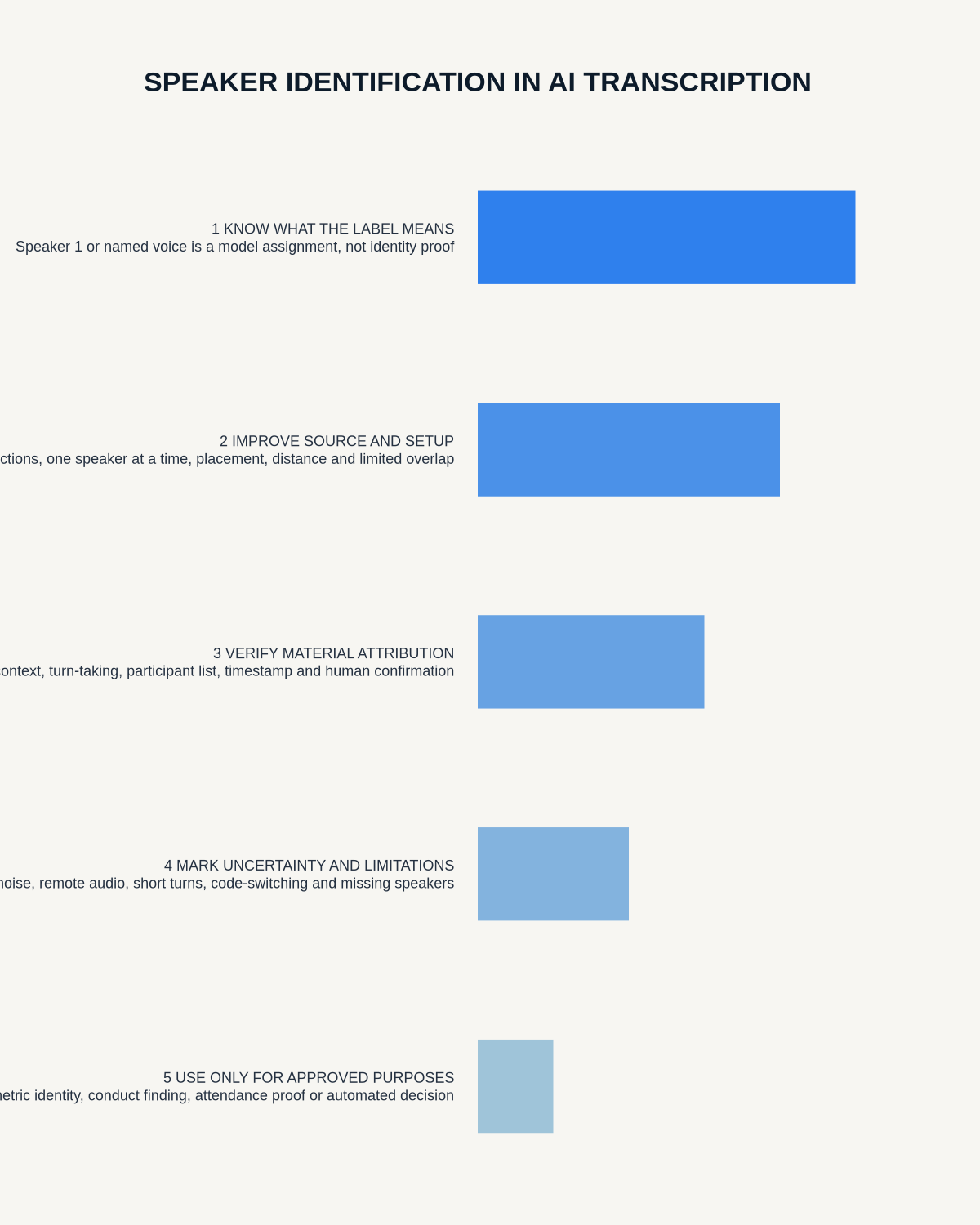
Visual map for Speaker Identification in AI Transcription: What It Can and Cannot Prove
- Define the decisionState the question, required output and acceptance rule.
- Capture the sourceUse the approved route and preserve context, identity and limitations.
- Verify material detailsReplay or check names, numbers, negatives, decisions and actions.
- Move into the real recordAssign an owner, retain evidence and apply the deletion rule.
On this page
Related guides
See whether Halo fits this workflow
Review the NERALVO Halo specifications, included services, delivery information and current offer only after completing the guide.
Found an error or an out-of-date claim? Email support@neralvo.com with the article address and a supporting source.