Reviewed and strengthened: 5 August 2026.
The 60-second verdict
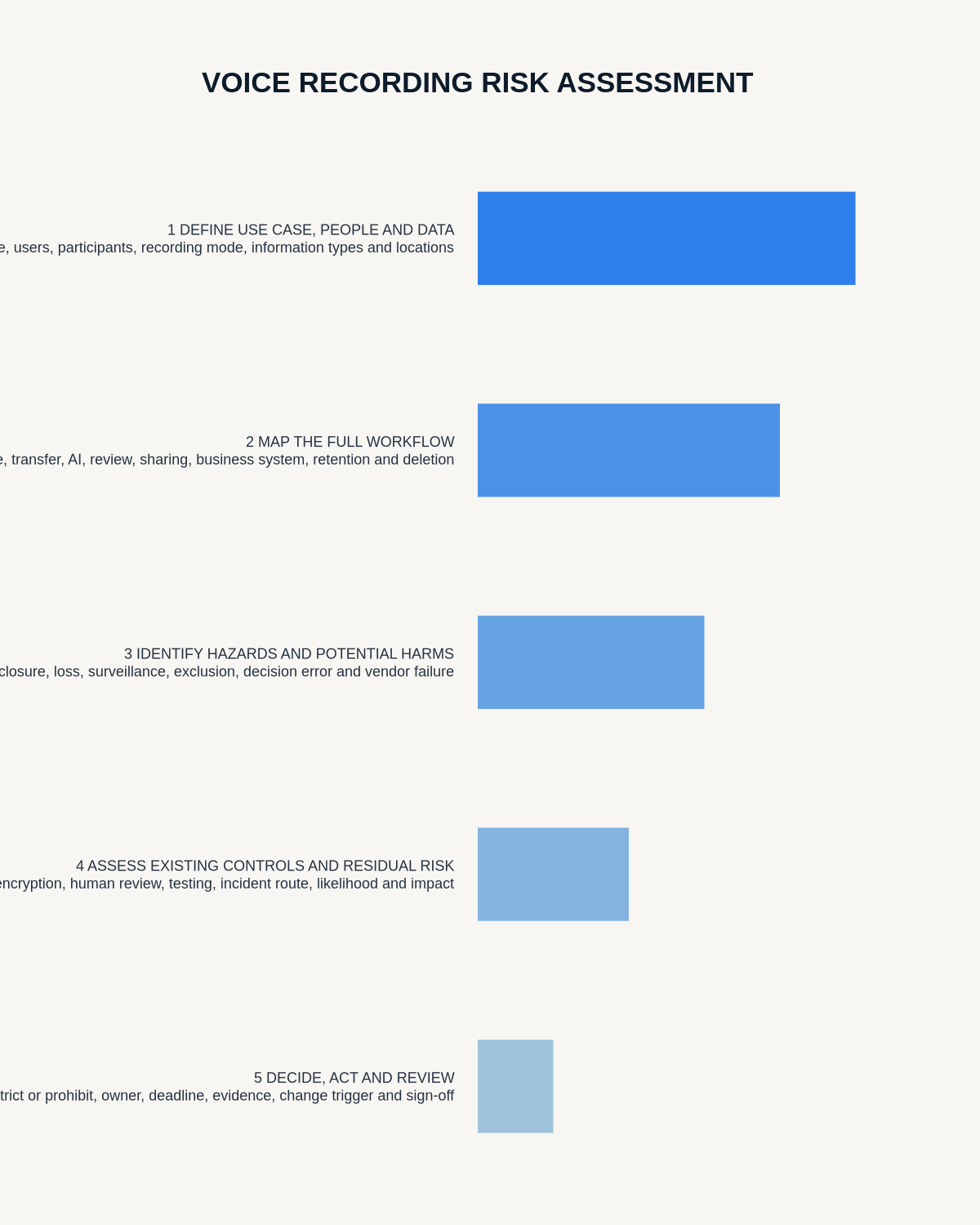
Quick answer: a voice-recording risk assessment should show why recording is necessary, identify everyone and every data category affected, map the full device-to-app-to-AI-to-export route, describe credible harms, score inherent and residual risk, assign evidence-backed controls and owners, and define approval, escalation and reassessment triggers.
Decision focus: use the method below only where it produces a recoverable source, a verifiable output and a clear next action. If one of those fails, change the workflow rather than trusting a polished summary.

Quick verdict: do not approve recording merely because the device is convenient or encrypted. Approval should depend on a necessary purpose, fair treatment of participants, controlled data flows, reliable human verification, workable deletion and acceptable residual risk.
Evidence basis and limits
- Decision factors covered: What the assessment should produce; Risk assessment, DPIA and specialist review are not interchangeable; Step 1: define the activity precisely.
- Evidence rule: A claim earns weight only when the source, date, configuration and limitation are clear enough for a reader to check.
- Boundary: Examples and workflow recommendations must be tested with representative recordings, the intended users and the actual approval process before rollout.
This article provides general information, not legal, security or data-protection advice. Higher-risk processing may require a formal data protection impact assessment, specialist security review, equality assessment, safeguarding review, clinical-safety process or sector-specific approval.
What the assessment should produce
The final record should identify:
- The specific activity and accountable business owner.
- The necessity and less-intrusive alternatives considered.
- The people, data and systems involved.
- The complete data flow and supplier chain.
- Credible hazards and possible harms.
- Inherent risk before controls.
- Controls, owners, deadlines and supporting evidence.
- Residual risk after controls.
- Specialist reviews and unresolved issues.
- The approval decision, conditions, review date and reassessment triggers.
Risk assessment, DPIA and specialist review are not interchangeable
| Review | Primary purpose | When it may be needed |
|---|---|---|
| Operational risk assessment | Identify practical harms, controls and ownership. | Before any routine organisational deployment. |
| Data protection impact assessment | Assess higher risks to people’s rights and freedoms. | Where the proposed processing is likely to create higher privacy risk. |
| Security review | Test technical, account, supplier and incident controls. | For confidential, sensitive or business-critical workflows. |
| Safeguarding, equality or clinical review | Address vulnerable people, discriminatory effects or safety consequences. | Where the context, participants or decisions require specialist governance. |
One review should reference the others rather than assuming that a single form covers every concern.
Step 1: define the activity precisely
Describe who records, who may be captured, the purpose, device, app, AI service, frequency, expected recording length, storage locations, access roles, exports, retention, deletion and whether a non-recorded route is available.
A useful activity statement is specific: “Record weekly project meetings to create draft actions that the chair verifies and transfers to the approved project system; delete raw audio after approval and the correction period.” “Use AI to improve productivity” is too broad to assess.
Step 2: test necessity and proportionality
| Question | Evidence expected |
|---|---|
| What specific problem does recording solve? | A defined accuracy, accessibility, audit or productivity need. |
| Could a less intrusive method work? | Comparison with written notes, approved minutes, structured forms or selective capture. |
| Is the whole conversation required? | A plan to start late, stop early or exclude private sections. |
| Is AI transcription or summarisation necessary? | A reason tied to the workflow rather than convenience alone. |
| Can people reasonably refuse? | A practical alternative without unfair disadvantage where appropriate. |
| Can less data be retained? | Separate periods for raw audio, draft transcript and approved record. |
Step 3: map people and data
Identify employees, customers, clients, patients, students, research participants, family members, bystanders and third parties mentioned in conversation. Include people who may not know they were discussed.
List likely information:
- Names, voices and contact details.
- Commercial, legal or employment information.
- Health or other sensitive information.
- Allegations, opinions and disciplinary matters.
- Children’s or vulnerable people’s data.
- Speaker labels, timestamps, location and device metadata.
- AI-generated summaries, action lists, sentiment or other inferences.
Step 4: map the complete data flow
- Audio is captured on the recorder, phone or conferencing system.
- The source file may remain on local hardware.
- Audio transfers to a phone, app or supplier platform.
- A speech-to-text model creates a transcript.
- Additional AI systems may generate summaries, translations, templates, speaker labels or action lists.
- Support or engineering personnel may access content.
- Users edit, export, email, download or upload outputs into other systems.
- Logs, analytics, caches and backups may retain additional copies.
- Content is deleted, returned or migrated when its purpose ends.
For every stage, record the system, supplier, processing location, access roles, security, retention, deletion method and accountable owner. A secure device does not protect copies exported to personal email or uncontrolled drives.
Step 5: identify hazards and credible harms
| Hazard | Possible harm | Typical control |
|---|---|---|
| No meaningful notice | Unfairness, distress, loss of trust or unlawful processing. | Clear pre-recording explanation and an alternative route where required. |
| Excessive capture | Private or irrelevant information is retained. | Record only the necessary section and pause for excluded discussion. |
| Lost device | Unauthorised access to local audio. | Inventory, device controls, rapid reporting and tested response. |
| Account compromise or support misuse | Audio and transcripts are disclosed or altered. | Strong authentication, least privilege, logged time-limited support access. |
| Transcript error | Wrong name, amount, instruction, decision or deadline is treated as fact. | Mandatory verification against audio for critical details. |
| Misleading AI summary or inference | Context is omitted or a person is characterised unfairly. | Treat output as a draft, prohibit unsupported inferences and require accountable review. |
| Uncontrolled sharing | Confidential material reaches the wrong recipient. | Approved systems, role-based access and export restrictions. |
| Over-retention | Larger breach impact and outdated material remains discoverable. | Purpose-based deletion, owner, trigger and evidence. |
| Supplier, model or location change | The approved processing chain changes without reassessment. | Change monitoring, contractual notice and approval gate. |
| Service outage or supplier exit | Records become unavailable or locked into the platform. | Source retention, usable exports, continuity plan and tested exit. |
Step 6: score inherent and residual risk
Score likelihood and impact before controls, then repeat after controls. Define the scales and evidence consistently. One simple method multiplies likelihood and impact from 1 to 5:
- 1–4: low—routine controls and ownership.
- 5–9: moderate—documented treatment and review required.
- 10–15: high—specialist review and stronger evidence required.
- 16–25: very high—do not proceed until reduced and formally accepted.
The score supports judgement; it does not override a clear legal, safeguarding, clinical, ethical or professional concern. Define which roles may accept each level of residual risk.
Step 7: turn controls into evidence
| Control | Owner | Evidence |
|---|---|---|
| Approved and prohibited uses | Business owner | Published procedure and training record. |
| Notice or consent process | Process owner | Current script, form or meeting workflow. |
| Critical-detail verification | Record approver | Checklist and sampled audit. |
| Restricted access and exports | System administrator | Configuration screenshots, logs or test results. |
| Retention and deletion | Records owner | Schedule, deletion report and backup handling. |
| Supplier governance | Contract owner | DPA, subprocessor list, security evidence and review date. |
A control is not complete merely because it appears in the assessment. It needs a responsible owner, implementation date and evidence that it works.
Step 8: run a controlled pilot and define stop criteria
Use non-sensitive or controlled data first. Test quiet and noisy rooms, multiple speakers, distance, accents, specialist terms, names, numbers, interrupted sync, full storage, exports, deletion and account offboarding.
Define failures that stop approval, such as:
- Loss of the source recording without a safe recovery route.
- Repeated critical errors that reviewers cannot efficiently identify.
- Unauthorised users retaining access after offboarding.
- No usable way to delete individual recordings.
- Unknown processing locations or model-training use.
- Exports that cannot be opened without the supplier.
- A required accessibility workflow that target users cannot complete.
Step 9: approve, reject or approve with conditions
Record one clear outcome:
- Approved: mandatory controls are complete and residual risk is acceptable.
- Approved with conditions: limited launch is permitted with named actions, deadlines and restrictions.
- Rejected: necessity is weak, required evidence is absent or residual risk remains unacceptable.
Record the approver, date, permitted use, prohibited use, conditions, residual risks, review date and trigger events.
Step 10: prepare for incidents and serious errors
The workflow should explain how users report lost devices, accidental recordings, wrong recipients, account compromise, inaccurate transcripts and supplier incidents. Preserve appropriate evidence, contain access, assess affected copies, notify accountable teams and document corrective action. A serious accuracy failure can require the same disciplined response as a security problem when it affects decisions or records.
Reassessment triggers
- A new purpose, department or participant group.
- Use involving more sensitive data or vulnerable people.
- A new supplier, model, subprocessor or processing country.
- A change to AI training, analytics or support access.
- A major firmware, app or account-control change.
- A material retention or deletion change.
- A security incident, complaint or serious transcript error.
- Repeated pilot or audit failures.
- Relevant legal, contractual or professional guidance changes.
Assessing NERALVO Halo
Apply this guide before assessing NERALVO Halo provides 64GB local storage, up to 35 hours of recording, NOTE mode, supported CALL mode, Bluetooth synchronisation with DOWAY, and AI transcription, summaries, templates, translation, mind maps and exports. One year of DOWAY Max access is included.
The assessment should cover lawful and permitted capture, local storage, transfer, DOWAY processing, account and support access, human verification, exports, retention, deletion and supplier exit. Halo is a productivity tool, not a substitute for professional judgement, authorised record systems or organisational approval.
Workflow choice matrix for Voice Recording Risk Assessment
Choose the method that protects the source and reduces downstream correction. The table makes the non-hardware options explicit.
| Condition | Preferred route | Why |
|---|---|---|
| High-risk or mixed work | Governed hybrid | Separate capture, review, approval and retention rather than trusting one tool. |
| Recording is refused, prohibited or unnecessary | Manual notes / no recording | Respecting the boundary is the correct workflow, not a product failure. |
| In-person, mobile or unreliable-connectivity work | Dedicated recorder | Independent capture and a recoverable local source are usually more resilient. |
| Repeatable remote work with approved integrations | Cloud software | Automation and central collaboration may outweigh device independence. |
Frequently asked questions
Can one assessment cover every department?
Only where purpose, participants, data, systems, decisions and risks are genuinely similar. HR, healthcare, legal, research and routine project meetings often require distinct treatment.
Is supplier certification enough?
No. Supplier assurance can support the assessment, but purpose, configuration, access, accuracy, fairness, sharing, retention and user behaviour must also be assessed.
Does participant agreement remove the need for risk controls?
No. Notice or consent does not correct weak security, excessive retention, inaccurate outputs or unfair use.
When should recording be rejected?
Reject or pause it when the purpose is weak, a less intrusive method works, people cannot be treated fairly, mandatory evidence is absent, a critical pilot test fails or residual risk remains unacceptable.
Related guides
- AI Voice Recorder Privacy Checklist: 30 Questions Before You Record
- Voice Recording Retention Policy: A Practical Template Guide
- AI Recorder Supplier Due Diligence: A Buyer’s Checklist
- Data Processing Agreements for AI Transcription: What to Review
Final sign-off checklist
- The purpose is specific, necessary and proportionate.
- Less-intrusive alternatives were considered.
- People and data categories are mapped.
- The complete device-to-AI data flow is documented.
- Accuracy, security, fairness, sharing, retention and continuity risks are assessed.
- Controls have owners, deadlines and evidence.
- Mandatory pilot and approval gates have passed.
- Required specialist reviews are complete.
- Residual risk is accepted by the correct authority.
- Permitted and prohibited uses are recorded.
- Incident and supplier-exit routes are workable.
- A review date and reassessment triggers are recorded.
Bottom line: a strong voice-recording risk assessment makes the decision, evidence, ownership and remaining risk visible before recording begins.
On this page
Related guides
See whether Halo fits this workflow
Review the NERALVO Halo specifications, included services, delivery information and current offer only after completing the guide.
Found an error or an out-of-date claim? Email support@neralvo.com with the article address and a supporting source.