Reviewed and updated: 21 July 2026.
The 60-second verdict
An AI voice recorder for multi-speaker discussions must capture every relevant voice and preserve who said what. General transcript fluency is not enough when the output will become meeting notes, research evidence or assigned actions.
Decision focus: use the method below only where it produces a recoverable source, a verifiable output and a clear next action. If one of those fails, change the workflow rather than trusting a polished summary.
Quick verdict: simulate the real room, review raw audio before the transcript, score speaker-turn accuracy and verify every material decision, quotation and action against the source before choosing a device.
Evidence basis and limits
- Decision factors covered: Map the discussion; Build a controlled speaker test; Measure speaker-attribution quality.
- Evidence rule: Claims are weighted by consequence: capture failure, changed meaning, access and recovery matter more than polished wording.
- Boundary: Examples and workflow recommendations must be tested with representative recordings, the intended users and the actual approval process before rollout.
Map the discussion
- Maximum number of speakers
- Table shape and room size
- Speaker distance
- Quiet participants
- Similar voices
- Overlapping speech
- Remote participants
- Movement and side conversations
- Meeting length
- Required output and attribution
Test the hardest ordinary arrangement, not two people beside the device.
Build a controlled speaker test
- Seat participants in normal positions.
- Ask each person to state their name and role.
- Include short interjections and longer turns.
- Use names, numbers and specialist terms.
- Include one deliberate overlap.
- Include a quiet speaker.
- Reassign one action during the meeting.
- Correct one statement later.
- Review the complete source audio.
- Compare the transcript and speaker labels with an answer key.
Score source audio first
Check:
- Every speaker is intelligible
- Distant voices are not lost
- Overlapping speech remains understandable enough to review
- The beginning and end are complete
- Movement does not create severe handling noise
- Remote audio is captured where relevant
Speaker AI cannot identify a voice that was not captured clearly.
Measure speaker-attribution quality
| Test | Pass condition | Failure |
|---|---|---|
| Speaker turns | Most turns assigned consistently | One person split repeatedly |
| Similar voices | Separate labels remain usable | Two people merged |
| Short replies | “Yes” and “I agree” attributed correctly | Commitment attached to wrong speaker |
| Overlap | Uncertainty remains visible | System invents one clean speaker turn |
| Corrections | Later correction replaces earlier claim | Obsolete statement remains in summary |
| Actions | Final owner is correct | Original owner retained after reassignment |
Test speaker correction
Users should be able to:
- Rename generic speakers
- Merge split labels
- Separate wrongly merged voices where possible
- Correct individual turns
- Preserve changes across the transcript
- Export speaker names
- Replay the source from a timestamp
Speaker separation that is difficult to repair creates substantial review time.
Use placement deliberately
Place the recorder:
- Centrally where practical
- Away from laptop fans, cups and paper handling
- On a stable surface
- Within the tested speaker-distance range
- Where microphones are unobstructed
- Away from a single dominant speaker where balanced capture is required
For long or difficult tables, a single compact recorder may not be sufficient. Test alternative placement or an approved room system.
Handle overlapping speech
AI systems struggle when two people speak simultaneously. Meeting practices can improve both human understanding and transcription:
- One speaker at a time for decisions
- Repeat actions and deadlines clearly
- State the final owner
- Pause after interruptions
- Read back material agreements
- Mark uncertain sections for review
Test quiet and distant speakers
Ask the quietest participant to state:
- A surname
- A number
- A negative statement
- An action
- A deadline
Verify these in the raw audio and transcript. Average speaker performance can hide a serious accessibility gap.
Test hybrid discussions separately
Remote participants may be captured through room speakers or another audio route. Check echo, volume balance, remote attribution, local-versus-remote overlap and whether headset use removes one side from the room recording.
A recorder that performs well in a purely in-person room may fail in a hybrid setup.
Verify decisions and actions
Before exporting:
- Confirm the final decision wording.
- Identify who made or approved it.
- Verify each action.
- Confirm the final owner.
- Confirm the deadline or leave it unassigned.
- Preserve conditions and dependencies.
- Remove rejected or cancelled tasks.
Measure review time
Record:
- Time to rename speakers
- Time to repair merged or split labels
- Time to verify quotations
- Time to correct actions
- Time to create and export the final note
A recorder with attractive speaker labels may not save time if most turns require correction.
Review privacy and proportionality
Multi-speaker recording captures several people and may include bystanders, side conversations and unrelated personal information. Define notice, approved purpose, participant handling, access, retention, deletion and the non-recorded alternative before use.
Calculate total cost
Include device, AI plan, correction time, room accessories, training, support, security review and the cost of attribution errors.
Where NERALVO Halo fits
Check whether NERALVO Halo fits this workflow provides NOTE mode, 64GB local storage, up to 35 hours of recording and Bluetooth synchronisation with DOWAY. DOWAY supports transcripts, speaker-separated notes, summaries, templates, translations, mind maps and exports, with one year of DOWAY Max included.
Buyers should test Halo with their real speaker count, table, quiet participants and overlap. Speaker-separated output still requires human verification.
Multi-speaker buying checklist
- Real room and speaker count mapped
- Controlled speaker test completed
- Raw audio checked first
- Speaker-turn accuracy measured
- Similar voices tested
- Short replies tested
- Overlap tested
- Quiet speakers tested
- Hybrid route tested
- Speaker correction completed
- Actions and quotations verified
- Review time measured
- Privacy and total cost assessed
Workflow choice matrix for Multi-Speaker AI Voice Recorders
Choose the method that protects the source and reduces downstream correction. The table makes the non-hardware options explicit.
| Condition | Preferred route | Why |
|---|---|---|
| Repeatable remote work with approved integrations | Cloud software | Automation and central collaboration may outweigh device independence. |
| In-person, mobile or unreliable-connectivity work | Dedicated recorder | Independent capture and a recoverable local source are usually more resilient. |
| Recording is refused, prohibited or unnecessary | Manual notes / no recording | Respecting the boundary is the correct workflow, not a product failure. |
| High-risk or mixed work | Governed hybrid | Separate capture, review, approval and retention rather than trusting one tool. |
Frequently asked questions
How many speakers can an AI recorder identify?
There is no reliable universal number. Room acoustics, distance, voice similarity and overlap matter.
Can speaker labels be trusted automatically?
No. Important quotations, decisions and actions require source verification.
What is the biggest speaker-separation failure?
Merging two people can make a statement or commitment appear to come from the wrong person.
Does central placement solve every problem?
No. It improves balance but cannot fully overcome large rooms, echo or simultaneous speech.
Choose balanced source capture first
The strongest multi-speaker workflow captures everyone clearly, makes attribution easy to correct and preserves source evidence for material statements.
Related guides
Workflow map
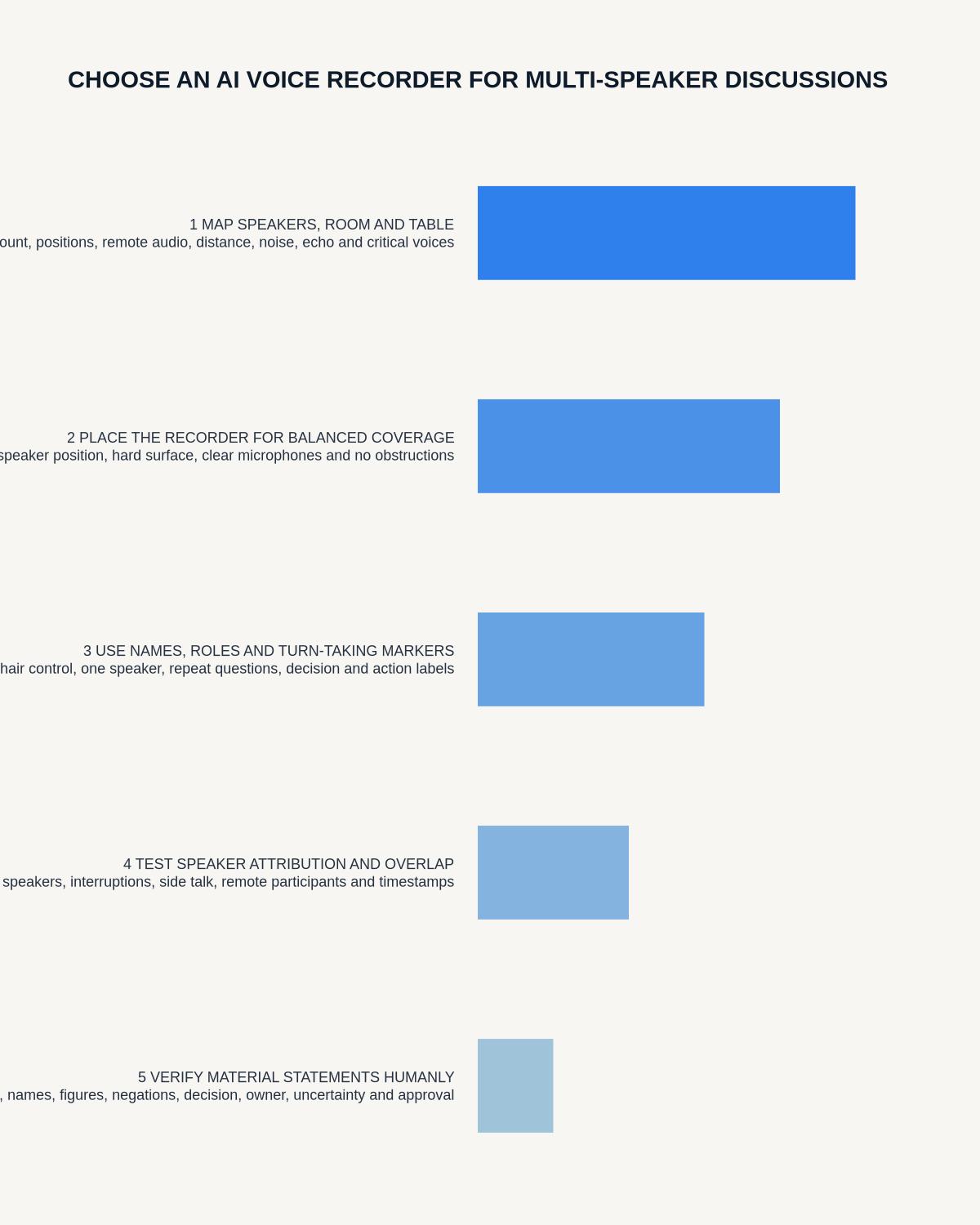
Visual map for Multi-Speaker AI Voice Recorders: How to Test Attribution and Overlap
- Define the decisionState the question, required output and acceptance rule.
- Capture the sourceUse the approved route and preserve context, identity and limitations.
- Verify material detailsReplay or check names, numbers, negatives, decisions and actions.
- Move into the real recordAssign an owner, retain evidence and apply the deletion rule.
On this page
Related guides
See whether Halo fits this workflow
Review the NERALVO Halo specifications, included services, delivery information and current offer only after completing the guide.
Found an error or an out-of-date claim? Email support@neralvo.com with the article address and a supporting source.