The 60-second verdict
Quick answer: use AI recording in corporate development only when transaction rules expressly permit it, restrict access to the authorised deal team and label every statement by source and verification status before it influences valuation, risk, structure or a deal decision.
Best fit: Corporate Development who need recoverable audio and human-verified notes in an authorised workflow. Use another method when: recording is prohibited, a participant declines or the approved process requires manual notes.
Evidence basis and limits
- Decision factors covered: Decide whether the meeting should be recorded; Capture management commentary carefully; Manual notes vs an AI-assisted diligence workflow.
- Evidence rule: The decision is based on the complete capture-to-action workflow, not a single feature or marketing accuracy percentage.
- Boundary: Examples and workflow recommendations must be tested with representative recordings, the intended users and the actual approval process before rollout.
Corporate-development conversations can change the investment case before the information reaches a formal paper. Management calls, adviser briefings and internal workshops may reveal new assumptions, contradictions, dependencies and integration risks. The same sensitivity that makes recording useful also makes careless capture dangerous.
Decide whether the meeting should be recorded
Before capture, confirm:
- all required parties have authorised it;
- the device, application, storage and transcription route are approved;
- information barriers and deal-team access restrictions remain intact;
- recording does not breach confidentiality terms, process rules or adviser requirements;
- participants know when recording starts and stops;
- retention, deletion and legal-hold requirements are understood.
Use controlled written notes whenever any point is unclear.
Use a source-labelled diligence record
| Field | What to record |
|---|---|
| Question | What the team needed to understand |
| Response | What was stated |
| Source | Speaker, document or dataset |
| Evidence status | Verified, partly supported or unverified |
| Caveat | Qualification, exception or limitation |
| Implication | Possible effect on value, risk, structure or integration |
| Follow-up | Evidence required, owner and deadline |
A fluent management answer is not a verified fact.
Capture management commentary carefully
Record explanations concerning:
- revenue, margin, cash conversion and forecast changes;
- customer and supplier concentration;
- key-person and operational dependencies;
- market position and competitive advantage;
- systems, controls and resilience;
- differences between executive accounts;
- information promised after the meeting.
Do not use automated tone, emotion or truthfulness judgements. Test the underlying claim through documents, data, references and specialist diligence.
Manual notes vs an AI-assisted diligence workflow
| Transaction task | Manual risk | AI-assisted value | Human control |
|---|---|---|---|
| Management call | Nuance and caveats may be compressed | Authorised discussion can be searched and revisited | Check speaker, context and permission |
| Assumption tracking | Assumptions disappear into slide comments | Statements can be extracted into a review list | Label source, confidence and validation owner |
| Diligence follow-up | Questions sit across separate workstreams | Open issues can be grouped and routed | Use the formal request and issue process |
| Decision paper | Evidence is reconstructed late | Source references are easier to recover | Investment judgement and approval remain human |
Maintain an assumption register
For every material assumption, record:
- assumption statement;
- source and date;
- evidence currently available;
- value sensitivity or risk impact;
- owner responsible for testing it;
- current status and conclusion;
- trigger that would change the model or recommendation.
After each meeting, identify which assumptions became stronger, weaker or invalid.
Create a controlled issue log
For each issue, capture:
- clear description;
- workstream and owner;
- source reference;
- potential financial, operational, legal or strategic impact;
- evidence required;
- mitigation or deal response;
- decision deadline;
- current status.
Separate a confirmed problem from a diligence gap. Missing evidence does not always prove the control or capability is absent, but the gap may still affect confidence and timing.
Preserve challenge and minority views
Investment discussions can converge too quickly around the preferred story. Record:
- evidence that contradicts the thesis;
- synergies that depend on untested behaviour;
- conditions that could make the deal unattractive;
- low-probability, high-impact risks;
- material questions the team still cannot answer;
- unresolved dissent at each decision gate.
Do not let repeated optimism become artificial consensus.
Link deal decisions to evidence
Each decision log should identify:
- transaction stage and decision requested;
- decision authority;
- evidence considered;
- conditions and limitations;
- dissent or unresolved risk;
- next gate;
- actions, owners and deadlines.
Approval to proceed may remain conditional on valuation, financing or confirmatory diligence. Those conditions must travel with the decision.
Bring integration into early discussions
Capture:
- critical people and retention risks;
- customer continuity requirements;
- systems and data dependencies;
- operational controls that cannot be interrupted;
- brand, culture and decision-right differences;
- Day One and first-100-day actions;
- synergy owners and measurement methods.
Keep integration ideas separate from approved commitments.
Verify transaction-critical details
Check:
- enterprise and equity values;
- debt, cash and working-capital references;
- revenue, EBITDA, margin and growth figures;
- customer and supplier concentrations;
- forecast periods, currencies and exchange-rate assumptions;
- legal entity and adviser names;
- conditional wording such as “subject to,” “indicative” and “not yet approved.”
Never use a transcript as the final source for model inputs where verified documents exist.
Apply transaction-grade information controls
Deal recordings may contain inside information, personal data, pricing, strategy and privileged discussion. Restrict access to the authorised team, control exports and local copies, avoid unapproved general-purpose services and remove temporary audio and transcripts according to the transaction process.
Diligence-call workflow
- Confirm transaction-grade permission and approved tools.
- State the opportunity, meeting purpose and participants.
- Capture questions, responses, sources and caveats.
- Generate the transcript in the restricted environment.
- Correct names, figures, conditions and speaker attribution.
- Update the assumption and issue registers.
- Preserve contradictory evidence and dissent.
- Link decisions to evidence, conditions and authority.
- Transfer approved outputs into the transaction record.
- Delete or retain temporary material under deal rules.
How NERALVO Halo may support corporate development
View Halo specifications for corporate development use may support authorised internal workshops, adviser briefings and diligence discussions through NOTE mode, supported CALL capture, 64GB local storage and DOWAY transcription tools. Approval of the complete data path matters more than convenience.
Cloud software, a dedicated recorder or manual notes?
For Corporate Development, the right answer changes with the setting. This matrix deliberately gives each method a situation where it can be the strongest choice.
| Situation | Best starting point | Reason |
|---|---|---|
| scheduled remote meetings | Cloud meeting software | Native remote-meeting workflows can be more efficient here. |
| in-person or mobile work | Dedicated recorder | A separate battery and recoverable local source improve resilience. |
| recording is refused or prohibited | Manual notes or an approved alternative | Manual notes are the correct control when recording is unavailable. |
| mixed online and offline work | Governed hybrid | A hybrid can combine automation with reliable physical capture. |
Frequently asked questions
Can management presentations be recorded?
Only where all required parties, confidentiality terms and transaction rules allow it.
Can AI identify whether management is truthful?
No. Test claims through documents, data, references, consistency and specialist diligence.
Should raw transcripts enter the data room?
Not automatically. Follow the transaction’s document-control, privilege, confidentiality and retention rules.
How should an unverified claim affect valuation?
Keep it as an explicit assumption or diligence gap with sensitivity, owner and validation requirement.
How long should recordings be retained?
Use the deal’s legal, contractual and organisational requirements. Do not keep sensitive working audio indefinitely without a defined need.
Final deal-record check
- Recording was explicitly authorised.
- Sources and evidence status are visible.
- Assumptions are tracked and tested.
- Contrary views and unresolved risks are preserved.
- Decisions remain linked to conditions.
- Integration dependencies are captured early.
- Critical figures are verified from authoritative records.
- Transaction access and retention are controlled.
Bottom line: AI voice recording can improve diligence memory and issue tracking, but investment quality still depends on source-labelled evidence, challenge, human verification and transaction-grade security.
Related guides
Profession workflow
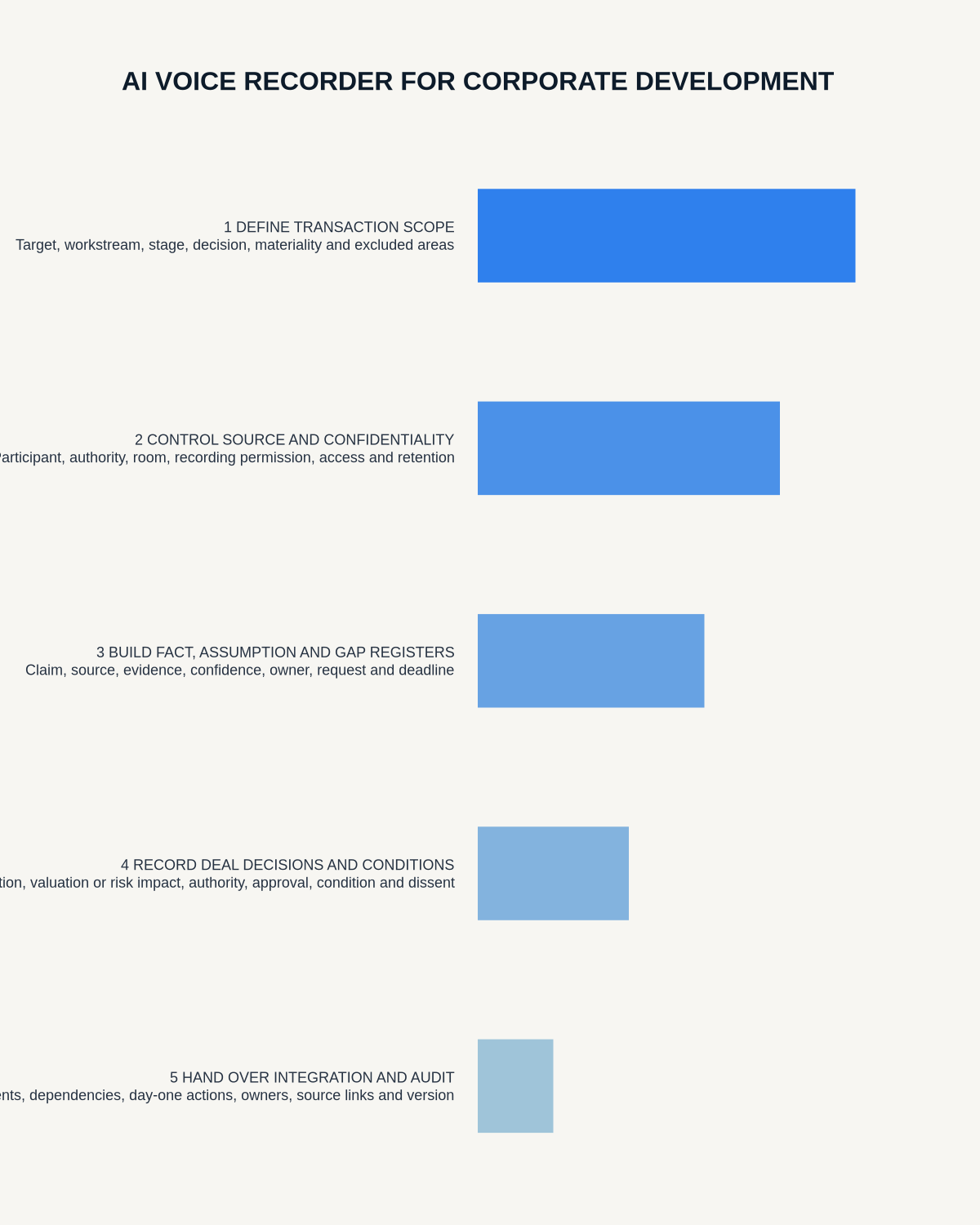
Visual map for AI Voice Recorder for Corporate Development: Controlled Diligence and Deal Decisions
- Prepare the approved useDefine purpose, safe position, permission and the required formal record.
- Capture context firstState the case, asset, person, location or event identifier before detail.
- Human-verify evidenceCheck technical terms, units, names, dates, decisions and uncertainty.
- Complete the formal recordTransfer only verified information and apply access and retention controls.
On this page
More in this topic: Management and business workflows
Show 9 closely related guides
- AI Voice Recorder for Management Consultants: Better Interviews, Workshops and Evidence
- AI Voice Recorder for Account Managers: Clearer Client Commitments and CRM Notes
- AI Voice Recorder for Operations Directors: Better Reviews, Incidents and Action Closure
- AI Voice Recorder for Programme Managers: Stronger Governance and Dependencies
- AI Voice Recorder for Bid Managers: Better Win Themes and Review Actions
- AI Voice Recorder for Sustainability Managers: Better Audits, Claims and Action Plans
- All-Day AI Voice Recorder: Battery, Storage and Workflow Test
- AI Voice Recorder for Retail Managers: Close Every Store-Walk Action
- AI Voice Recorder for Small Business Owners: Clear the Voice Inbox Daily
Related guides
See whether Halo fits this workflow
Review the NERALVO Halo specifications, included services, delivery information and current offer only after completing the guide.
Found an error or an out-of-date claim? Email support@neralvo.com with the article address and a supporting source.