The 60-second verdict
Quick answer: an AI voice recorder can help credit controllers preserve authorised payment calls and disputes, but every invoice, amount, date, condition and speaker’s authority must be verified before the ledger or collection status is updated.
Best fit: Credit Controllers who need recoverable audio and human-verified notes in an authorised workflow. Use another method when: recording is prohibited, a participant declines or the approved process requires manual notes.
Evidence basis and limits
- Decision factors covered: Create a payment-call record; Separate dispute from delay; Promises to pay need precision.
- Evidence rule: The decision is based on the complete capture-to-action workflow, not a single feature or marketing accuracy percentage.
- Boundary: Examples and workflow recommendations must be tested with representative recordings, the intended users and the actual approval process before rollout.
Credit-control calls often turn on exact wording: why an invoice is disputed, what evidence is missing and whether a customer has made a genuine promise to pay. The useful output is a precise, traceable payment-call record—not a general transcript.
Create a payment-call record
- customer and account reference;
- invoice numbers and amounts;
- reason for non-payment;
- disputed and undisputed balances;
- documents requested;
- promise-to-pay amount and date;
- conditions attached to payment;
- who made the promise and their role;
- authority or escalation required;
- next contact date.
Separate dispute from delay
| Status | What the note should show |
|---|---|
| Administrative delay | Invoice received, approval route and expected payment run |
| Document query | Missing purchase order, delivery proof, credit note or statement |
| Price or quantity dispute | Specific line, amount and customer position |
| Service dispute | Issue raised, operational owner and evidence needed |
| Cash-flow difficulty | Customer account, proposed arrangement and approval status |
| No clear reason | Questions unanswered and escalation required |
AI should not label a customer unwilling or unable to pay based on tone or incomplete comments.
Promises to pay need precision
A strong record states the amount, invoices, date and condition:
“Customer contact stated that £12,450 relating to invoices 4312 and 4318 would be paid by bank transfer on 25 July, subject to receipt of the missing delivery note for invoice 4318.”
This is more useful than “customer promised to pay next week.” Repeat the amount, invoice references, date and condition at the end of the call.
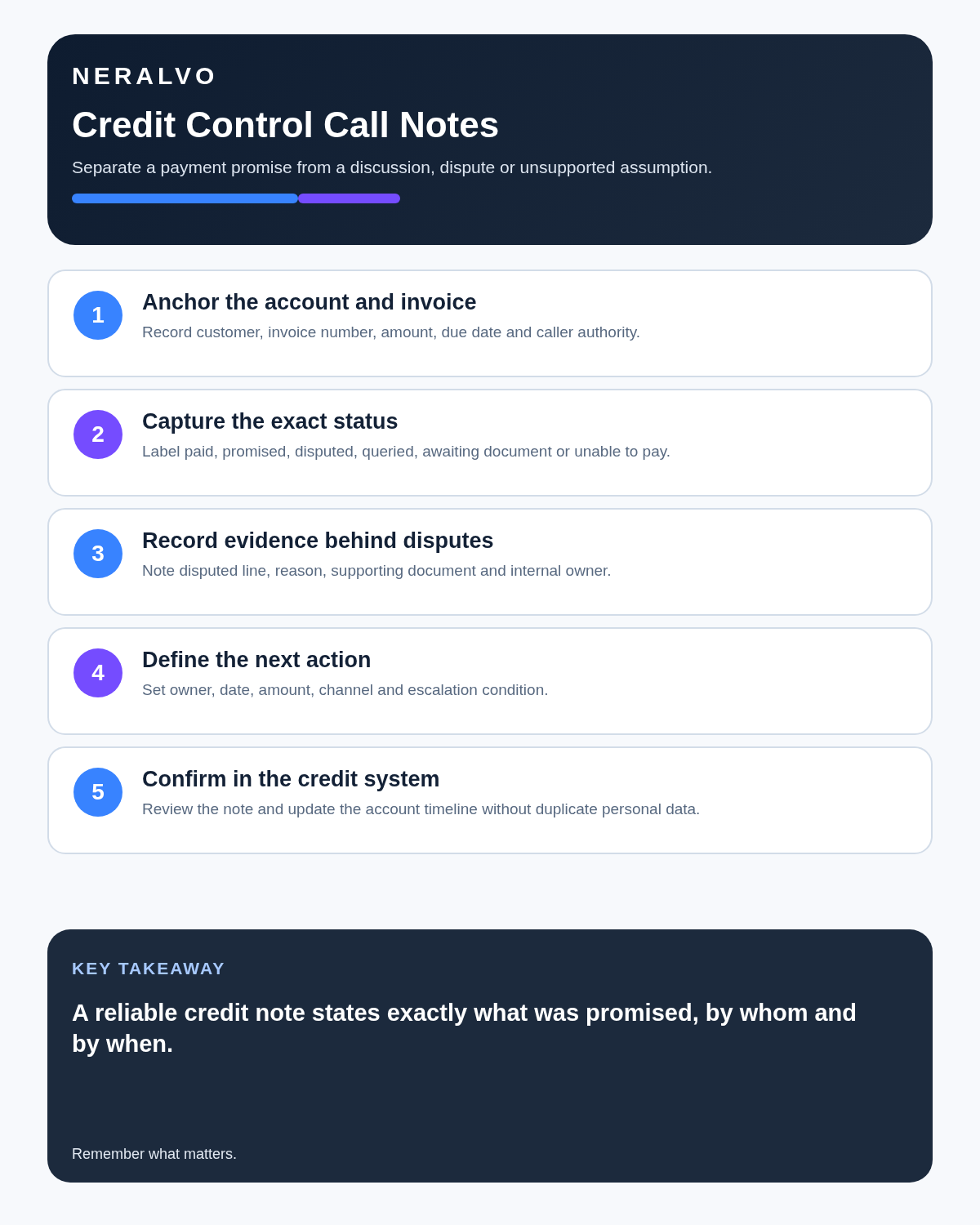
A practical payment-call workflow
- Follow the organisation’s approved call-recording process.
- State the account reference and call purpose.
- Confirm the balance being discussed.
- Work through invoices separately.
- Identify the dispute, evidence gap and responsible department.
- Repeat any payment commitment and condition.
- Generate a transcript and call-note draft.
- Check amounts, references, dates, speaker and authority.
- Update the credit system through normal controls.
- Send agreed documents and schedule follow-up.
Create a clear internal handover
When sales, operations or customer service must resolve the issue, record:
- customer’s stated problem;
- invoice and order references;
- evidence attached or missing;
- commercial or operational owner;
- response required and deadline;
- impact on collection activity;
- next customer update.
Keep internal opinion separate from the customer’s recorded statement.
Control payment-plan status
Where a customer proposes instalments, distinguish:
- customer proposal;
- information required;
- internal review;
- approved arrangement;
- rejected or revised terms;
- missed instalment and escalation.
A transcript may preserve the proposal, but approval must follow the organisation’s authority and documentation process.
What must be checked manually
- legal customer name;
- account and invoice references;
- gross, disputed and undisputed amounts;
- currency, dates and payment method;
- conditions attached to payment;
- credit notes or deductions discussed;
- speaker’s role and authority;
- next action, owner and deadline.
The ledger, invoice system and approved arrangement record remain authoritative.
Protect financial and personal information
Do not record payment-card data, passwords, security answers or unnecessary personal details. Restrict source audio and transcripts to authorised users, avoid sending raw files through general messaging and apply the organisation’s retention process.
How NERALVO Halo fits credit control
View Halo specifications for credit controllers use can support approved payment calls and internal handovers through NOTE mode, supported CALL capture, 64GB local storage and DOWAY transcription and structured notes. CALL compatibility varies by phone, operating system and route, so test the exact telephony setup.
Cloud software, a dedicated recorder or manual notes?
For Credit Controllers, the right answer changes with the setting. This matrix deliberately gives each method a situation where it can be the strongest choice.
| Situation | Best starting point | Reason |
|---|---|---|
| scheduled remote meetings | Cloud meeting software | Native remote-meeting workflows can be more efficient here. |
| in-person or mobile work | Dedicated recorder | A separate battery and recoverable local source improve resilience. |
| recording is refused or prohibited | Manual notes or an approved alternative | Manual notes are the correct control when recording is unavailable. |
| mixed online and offline work | Governed hybrid | A hybrid can combine automation with reliable physical capture. |
Frequently asked questions
Does a recorded promise automatically change the account status?
No. Verify the wording and follow the organisation’s approved ledger and arrangement process.
Can AI determine whether a customer is refusing or unable to pay?
No. Record the stated reason and evidence rather than inferring intent from tone.
Should the raw transcript be shared with sales?
Usually a checked, concise issue handover is more appropriate.
Can an instalment proposal be treated as approved?
No. Keep proposed and approved status separate.
Call-note quality check
- Invoice references and amounts are exact.
- The dispute or delay status is clear.
- Conditions attached to payment are preserved.
- Proposals are distinguished from approved arrangements.
- The speaker’s role and authority are recorded.
- Every action has an owner and date.
- The wording of a promise can be checked against the source.
- The authorised credit system has been updated.
Bottom line: an AI recorder is most valuable when it creates a precise call note that clarifies the dispute, evidence gap and payment commitment without making assumptions about intent or authority.
Related guides
Profession workflow
Visual map for AI Voice Recorder for Credit Controllers: Clearer Payment Calls and Disputes
- Prepare the approved useDefine purpose, safe position, permission and the required formal record.
- Capture context firstState the case, asset, person, location or event identifier before detail.
- Human-verify evidenceCheck technical terms, units, names, dates, decisions and uncertainty.
- Complete the formal recordTransfer only verified information and apply access and retention controls.
On this page
Related guides
See whether Halo fits this workflow
Review the NERALVO Halo specifications, included services, delivery information and current offer only after completing the guide.
Found an error or an out-of-date claim? Email support@neralvo.com with the article address and a supporting source.