
The 60-second verdict
Quick answer: housing officers can use an AI voice recorder for approved tenancy visits, estate walkarounds and resident meetings when every note is linked to the correct tenancy or property and clearly separates resident statements, officer observations, evidence, risk, action and formal decision status.
Best fit: Housing Officers who need recoverable audio and human-verified notes in an authorised workflow. Use another method when: recording is prohibited, a participant declines or the approved process requires manual notes.
Evidence basis and limits
- Decision factors covered: Start with the correct housing anchor; Separate five evidence states; Use a structured tenancy-visit note.
- Evidence rule: A claim earns weight only when the source, date, configuration and limitation are clear enough for a reader to check.
- Boundary: Examples and workflow recommendations must be tested with representative recordings, the intended users and the actual approval process before rollout.
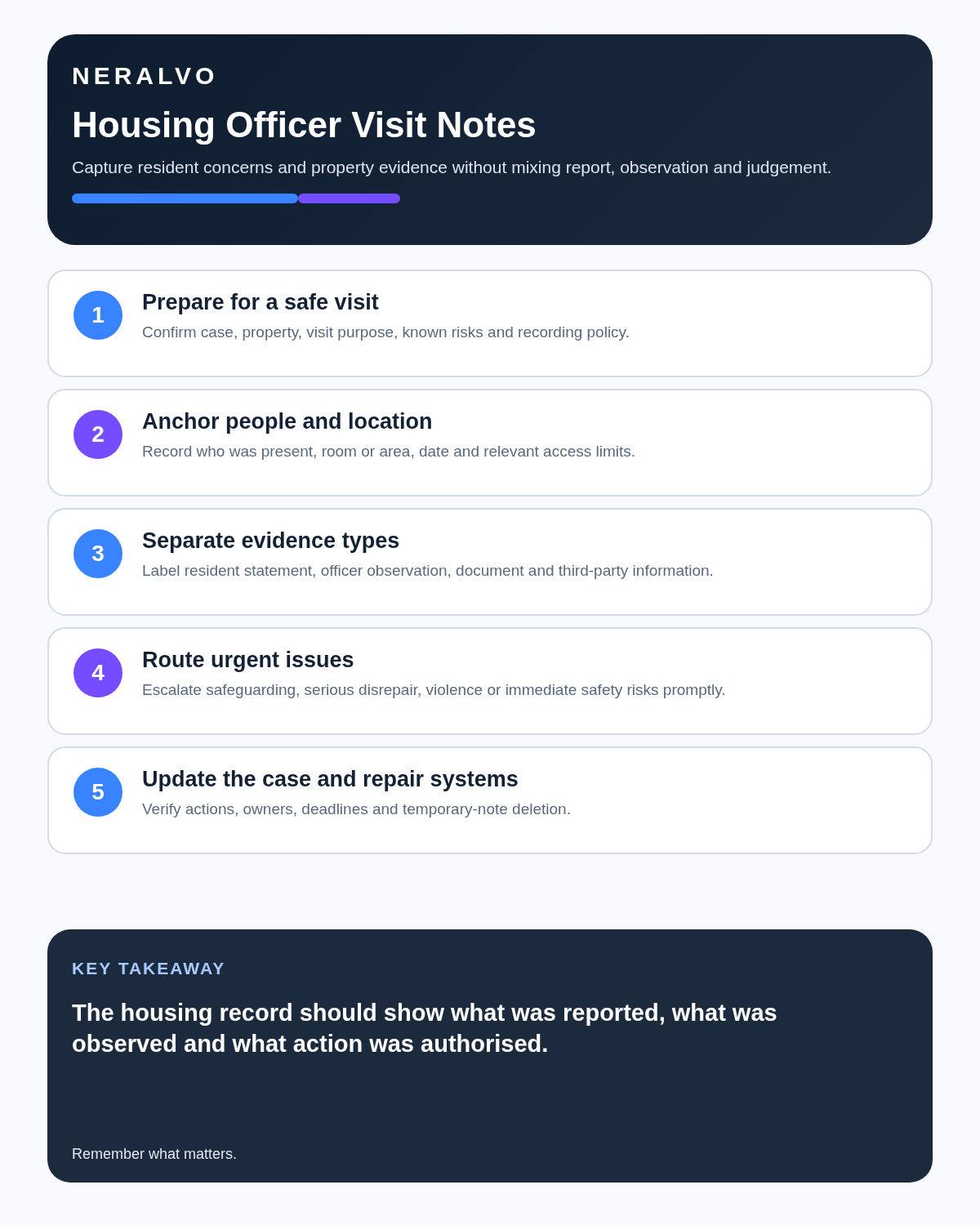
Housing work combines personal accounts, property condition, neighbourhood issues, vulnerability, contractor actions and legal process. A recording can preserve detail, but it must not turn an allegation into fact, a provisional discussion into a tenancy decision or a promised visit into completed action.
Start with the correct housing anchor
State the organisation’s approved case, tenancy, property or estate reference before discussing detail. Include the date, visit type, location and people present. Avoid speaking unnecessary identifiers into the audio.
Separate five evidence states
| Status | Meaning |
|---|---|
| Resident account | What the tenant, leaseholder or household member reports |
| Officer observation | What the housing officer directly sees or hears |
| Third-party report | Information from a neighbour, contractor or agency |
| Documented evidence | Photo, inspection record, message, tenancy document or system record |
| Formal decision | Outcome reached through the authorised housing process |
An AI summary should not rewrite “resident reports persistent damp” as “property has confirmed penetrating damp” without inspection evidence.
Use a structured tenancy-visit note
- Purpose: why the visit was arranged.
- Resident priorities: concerns and requested outcome.
- Property or estate condition: direct observations and limitations.
- Evidence: photographs, documents, readings or prior reports.
- Risk: immediate safety, safeguarding, health, security or tenancy concern.
- Action: task, owner, deadline and resident update.
- Decision status: information only, proposed, referred, approved or formally issued.
Build a property-condition record
For every material condition, capture:
- exact room, elevation, communal area or asset;
- visible condition and extent;
- photograph or inspection reference;
- resident’s account of timing and impact;
- previous repair or report reference;
- access or inspection limitation;
- possible cause, clearly labelled as unconfirmed;
- immediate control and further investigation.
The recorder is not a diagnostic instrument. Moisture, structural, gas, electrical and other specialist issues require the appropriate competent process.
Use an urgent-risk fast lane
Follow the approved emergency or safeguarding process immediately for:
- immediate danger or uninhabitable conditions;
- gas, electrical, fire or structural concern;
- domestic abuse or coercion risk;
- child or adult safeguarding concern;
- serious antisocial behaviour or violence risk;
- security failure or unlawful entry;
- medical emergency.
Do not wait for transcription. Record the factual concern, action, person notified and time in the authorised system.
Handle neighbour and antisocial-behaviour information fairly
Keep allegation, witness account, officer observation, system record and investigation finding separate. Record dates, locations, frequency and impact where relevant, but avoid unnecessary characterisation of residents or neighbours.
Do not use voice analytics or sentiment to infer aggression, credibility, vulnerability or intent.
Record vulnerability and reasonable adjustments proportionately
Capture only information needed to provide the service safely and fairly:
- communication preference;
- access or appointment adjustment;
- support person or advocate;
- known risk affecting service delivery;
- consent or sharing boundary;
- review date.
Health and family information should not be copied broadly into contractor or general estate notes.
Control access appointments and no-entry situations
Record:
- appointment date and purpose;
- notice or contact method;
- who attended;
- whether access was gained;
- resident explanation where offered;
- urgent risk or service consequence;
- next authorised step.
A missed appointment does not automatically establish refusal or breach. Preserve the source and formal decision route.
Turn the visit into precise actions
| Action field | Required detail |
|---|---|
| Task | Specific investigation, repair, referral or communication |
| Owner | Named team, contractor or officer |
| Priority | Immediate, urgent, routine or monitor |
| Deadline | Date and time where material |
| Dependency | Access, approval, inspection, evidence or funding |
| Resident update | Who will communicate and when |
| Closure evidence | Inspection, photograph, certificate, system update or resident confirmation |
Estate walkarounds need location precision
Use building, block, floor, communal area, asset and photograph reference. Separate cleanliness, repair, safety, security, grounds and antisocial-behaviour observations into different actions where they require different owners.
Formal tenancy decisions remain separate
A discussion about warning, enforcement, transfer, support, access, allocation or tenancy action is not itself a formal decision. Record:
- issue and evidence considered;
- policy or legal route;
- authority required;
- resident representation or response;
- decision status;
- notice or written communication issued;
- review or appeal route.
Use a controlled visit-to-case workflow
- Confirm the approved recording and participant process.
- State the correct housing reference and visit purpose.
- Capture resident priorities and direct observations separately.
- Link photographs, documents and inspection evidence.
- Escalate urgent risk immediately.
- Correct names, dates, addresses, locations and contractor references.
- Create precise actions with owners and closure evidence.
- Update the authorised housing, repairs and safeguarding systems.
- Send the resident a clear checked follow-up where appropriate.
- Delete or retain source audio under policy.
How NERALVO Halo may support housing work
Assess Halo against the housing officers workflow matrix can support approved tenancy visits, estate walkarounds, resident meetings and private post-visit debriefs through NOTE mode, supported CALL capture, 64GB local storage and DOWAY transcription tools.
Housing providers should approve the device, app, access, export, safeguarding and retention workflow before use. The housing case, repair, inspection and legal systems remain authoritative.
Cloud software, a dedicated recorder or manual notes?
For Housing Officers, the right answer changes with the setting. This matrix deliberately gives each method a situation where it can be the strongest choice.
| Situation | Best starting point | Reason |
|---|---|---|
| scheduled remote meetings | Cloud meeting software | Auto-join and central collaboration can remove routine admin. |
| in-person or mobile work | Dedicated recorder | Dedicated hardware suits movement, variable rooms and offline source capture. |
| recording is refused or prohibited | Manual notes or an approved alternative | A clear alternative respects policy and participant choice. |
| mixed online and offline work | Governed hybrid | One governed process prevents gaps between desk and field work. |
Frequently asked questions
Can a resident’s recorded account prove a repair cause or tenancy breach?
No. It is one source and must be considered with inspection, documents and the formal process.
Should contractors receive the full transcript?
Usually no. Give them the minimum verified work instruction and necessary access information.
Can AI assess vulnerability or credibility?
No. Use professional assessment and the organisation’s safeguarding and support processes.
Should urgent hazards wait for the written note?
No. Follow the emergency route immediately.
Final housing-note checklist
- Correct tenancy, property or estate anchor used.
- Resident account and officer observation are separate.
- Evidence and limitations are linked.
- Urgent safety and safeguarding action occurred immediately.
- Vulnerability information is proportionate and restricted.
- Actions have owners, deadlines and closure evidence.
- Formal decisions use the authorised route.
- Housing and repair systems are updated.
Bottom line: a strong housing voice note connects a resident’s account and a precise property observation to fair evidence, accountable action and the correct formal record.
Related AI voice recorder guides
On this page
Related guides
See whether Halo fits this workflow
Review the NERALVO Halo specifications, included services, delivery information and current offer only after completing the guide.
Found an error or an out-of-date claim? Email support@neralvo.com with the article address and a supporting source.