The 60-second verdict
Quick answer: an AI voice recorder can support audit walkthroughs and interviews by preserving explanations and drafting structured notes, but enquiry must remain separate from observation, inspection, reperformance and the evidence supporting the final conclusion.
Best fit: Auditors who need recoverable audio and human-verified notes in an authorised workflow. Use another method when: recording is prohibited, a participant declines or the approved process requires manual notes.
Evidence basis and limits
- Decision factors covered: Record the control story in stages; Separate four types of information; Walkthrough interview prompts.
- Evidence rule: Claims are weighted by consequence: capture failure, changed meaning, access and recovery matter more than polished wording.
- Boundary: Examples and workflow recommendations must be tested with representative recordings, the intended users and the actual approval process before rollout.
Audit interviews and process walkthroughs contain explanations that are useful for understanding controls but are not automatically sufficient audit evidence. An AI voice recorder can preserve the conversation and help draft walkthrough notes, provided the auditor separates enquiry from observation, inspection and reperformance.
Record the control story in stages
A walkthrough note should show:
- process objective
- transaction initiation
- systems and people involved
- control activity
- evidence produced
- exceptions and overrides
- monitoring
- changes since the prior period
The transcript is the source for the explanation. The audit file needs a reviewed note linked to the actual evidence examined.
Separate four types of information
| Type | Example | Audit treatment |
|---|---|---|
| Enquiry | Process owner explains approval | Corroborate as required |
| Observation | Auditor sees the control performed | Document date, person and circumstances |
| Inspection | Auditor reviews a report or record | Reference the evidence |
| Reperformance | Auditor independently executes the control or calculation | Document procedure and result |
An AI summary should not merge these categories into a statement that “the control operates effectively.”
Walkthrough interview prompts
- Show me how a transaction begins.
- What prevents or detects an error?
- What evidence remains?
- Who can override the process?
- What happens when the control fails?
- How are exceptions followed up?
- What changed this year?
- Can we trace one item from start to finish?
Use timestamps as evidence pointers
When a discussion refers to a report, screen or document, state the reference aloud and note the timestamp. Example: “At 14 minutes, process owner demonstrates the monthly exception report dated 30 June.”
The recording is not a substitute for retaining or referencing the actual audit evidence in accordance with the engagement methodology.
Interview-note workflow
- Follow the firm’s approved recording and confidentiality process.
- State engagement, process, participants and purpose.
- Record the explanation without leading the witness.
- Ask for demonstration and supporting evidence.
- Repeat key control frequencies and thresholds.
- Generate a transcript and process-flow draft.
- Check speaker attribution and document references.
- Separate enquiry from other procedures.
- Record audit conclusions through the normal review process.
- Apply retention rules to the recording.
Fraud and sensitive interviews
Do not introduce recording into a sensitive or investigative interview without specific approval and planning. The way questions are asked, evidence is handled and participants are informed may be critical.
AI-generated summaries should not infer motive, honesty or responsibility.
Internal audit use
Internal auditors can use recordings for stakeholder interviews, control design workshops and debriefs. Useful outputs include:
- risk-and-control matrix draft
- process map
- evidence request
- issue chronology
- management action list
Findings and ratings require the internal audit methodology and evidence, not transcript sentiment.
External audit use
For external audit, the recorder can support note drafting, but engagement standards, firm policy, client confidentiality and documentation requirements govern whether and how it is used.
Where NERALVO Halo fits
Check whether NERALVO Halo fits auditors work can capture approved walkthroughs, interviews and internal debriefs. Its current specification includes 64GB local storage, NOTE and CALL modes, up to 35 hours of recording and Bluetooth transfer to DOWAY.
DOWAY can create transcripts, summaries, speaker-separated notes, templates, translations and mind maps. CALL mode compatibility varies by phone and call route.
Use only within firm-approved audit, confidentiality, recording and evidence-handling procedures.
Audit-note quality check
- Is the process explanation attributed?
- Are enquiry, observation, inspection and reperformance separated?
- Are documents and samples referenced?
- Are control frequency, owner and evidence clear?
- Are exceptions and overrides recorded?
- Is the conclusion supported outside the AI summary?
Cloud software, a dedicated recorder or manual notes?
For Auditors, the right answer changes with the setting. This matrix deliberately gives each method a situation where it can be the strongest choice.
| Situation | Best starting point | Reason |
|---|---|---|
| scheduled remote meetings | Cloud meeting software | Calendar automation and shared integrations are usually the strongest advantage. |
| in-person or mobile work | Dedicated recorder | Independent capture reduces reliance on an active phone or laptop. |
| recording is refused or prohibited | Manual notes or an approved alternative | The boundary takes priority over convenience. |
| mixed online and offline work | Governed hybrid | Use each method only in the setting it actually fits. |
Related guides
- How to Choose an AI Voice Recorder: Complete Buyer’s Guide
- AI Voice Recorder for Environmental Consultants: Site Inspections, Interviews and Evidence
- AI Voice Recorder for Genealogists: Family Interviews, Names and Evidence
- AI Voice Recorder for Claims Handlers: First Notification, Evidence and Updates
- AI Voice Recorder for Underwriters: Risk Interviews, Assumptions and Decisions
- AI Voice Recorder for Credit Controllers: Payment Calls, Disputes and Promises
Bottom line
An AI recorder can reduce drafting time during walkthroughs and interviews. Its value is a traceable account of what was explained and demonstrated. Audit evidence and conclusions still require corroboration, professional judgement and the engagement’s normal review controls.
Profession workflow
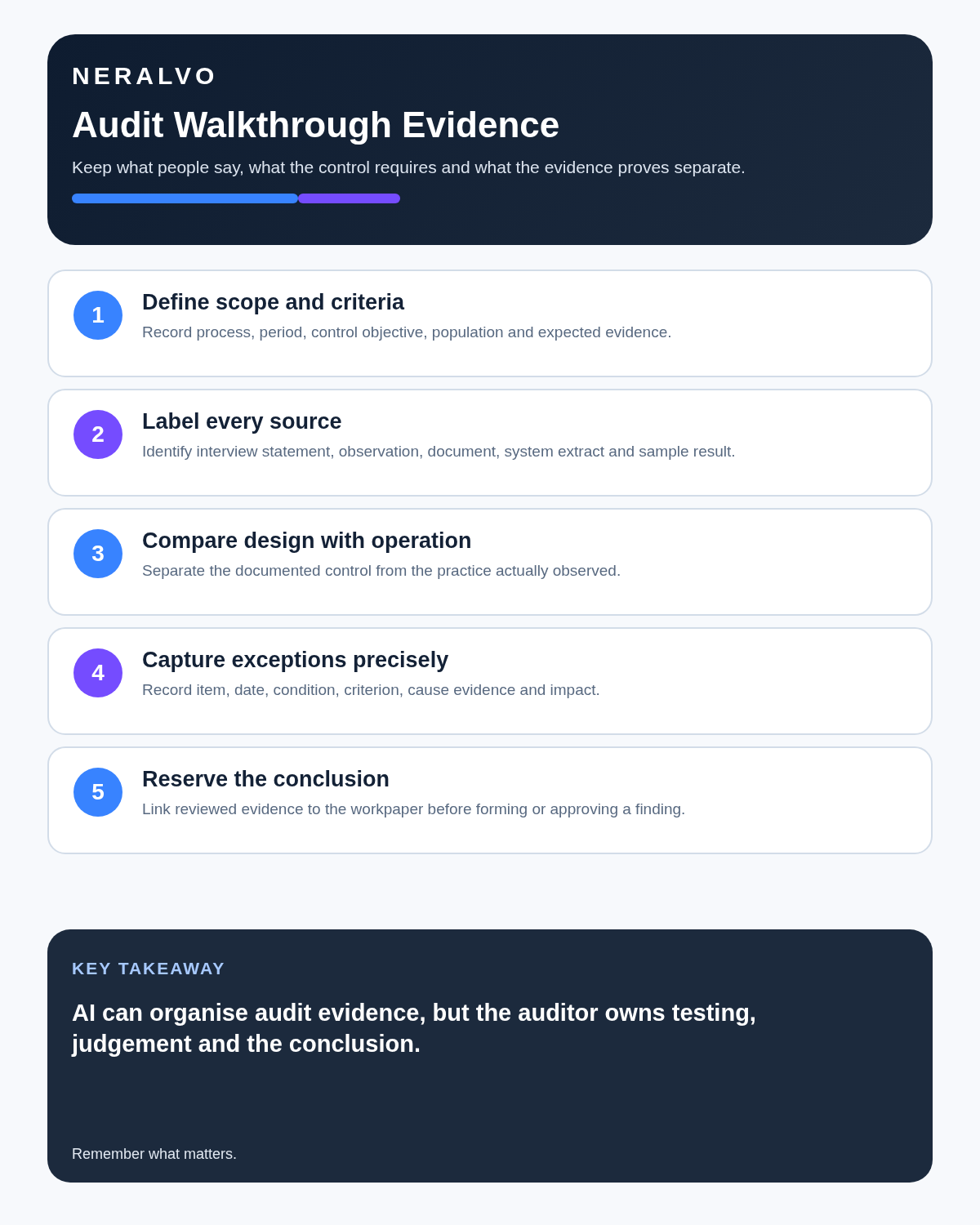
Visual map for AI Voice Recorder for Auditors: Better Walkthroughs and Evidence Trails
- Prepare the approved useDefine purpose, safe position, permission and the required formal record.
- Capture context firstState the case, asset, person, location or event identifier before detail.
- Human-verify evidenceCheck technical terms, units, names, dates, decisions and uncertainty.
- Complete the formal recordTransfer only verified information and apply access and retention controls.
On this page
Related guides
See whether Halo fits this workflow
Review the NERALVO Halo specifications, included services, delivery information and current offer only after completing the guide.
Found an error or an out-of-date claim? Email support@neralvo.com with the article address and a supporting source.