The 60-second verdict
Quick answer: data protection officers can use an AI voice recorder for authorised DPIA interviews, supplier discussions, governance meetings and incident debriefs. The recording itself becomes another personal-data asset, so necessity, purpose, participant information, processing, access, evidence status, retention and deletion must be designed before capture.
Best fit: Data Protection Officers who need recoverable audio and human-verified notes in an authorised workflow. Use another method when: recording is prohibited, a participant declines or the approved process requires manual notes.
Evidence basis and limits
- Decision factors covered: Start with purpose and necessity; Assess the complete recording route; Interview the complete data lifecycle.
- Evidence rule: The decision is based on the complete capture-to-action workflow, not a single feature or marketing accuracy percentage.
- Boundary: Examples and workflow recommendations must be tested with representative recordings, the intended users and the actual approval process before rollout.
A DPO rarely receives a complete description of personal-data use from one source. Policy, system configuration and daily practice may differ. Recording can preserve detailed explanations, but it must demonstrate the same minimisation and accountability expected from the processing being assessed.
Start with purpose and necessity
Define the required output: a checked data flow, DPIA evidence note, supplier-control interview, incident chronology, governance decision or action list. Use documents, system exports or conventional notes where they provide the evidence with less intrusion.
Assess the complete recording route
- approved device, phone, account and app;
- local storage and synchronisation;
- processing and hosting locations;
- provider administrators and subprocessors;
- model-training or reuse settings;
- exports, shared links and integrations;
- retention, deletion and account closure;
- correction, objection and incident routes.
Interview the complete data lifecycle
- Collection: what data enters and from whom?
- Purpose: what outcome does each field support?
- Access: which people, roles, systems and suppliers can use it?
- Movement: where is it copied, integrated or transferred?
- Decision use: does it influence eligibility, monitoring or automated decisions?
- Retention: what starts the period and proves deletion?
- Rights: how is data found, corrected, restricted or removed?
Separate four evidence statuses
| Status | Meaning | Example |
|---|---|---|
| Documented | Stated in policy, contract or procedure | Retention schedule defines a period |
| Described | Explained by a participant | Team lead says access is reviewed quarterly |
| Observed | Seen in a system or demonstration | Reviewer watches the report being generated |
| Verified | Supported by retained evidence | Completed review records and remediation tickets |
An AI summary must not turn a described control into a verified one.
Build a DPIA record that supports decisions
Capture:
- the proposed processing and expected benefit;
- the people affected, including vulnerable groups;
- data categories, scale, frequency and sensitivity;
- systems, processors, locations and transfer routes;
- why the data is necessary;
- less intrusive alternatives considered;
- likely harm if processing fails or is misused;
- existing controls and evidence of operation;
- residual uncertainty and accountable owners;
- the approval, escalation or consultation route.
The transcript is source material. The DPIA remains a concise, reviewed assessment of organisational reasoning.
Turn supplier reassurance into evidence requests
Convert statements about security, deletion, retention, incidents and international processing into named documents or demonstrations, owners, due dates and review outcomes. “Robust controls” is not evidence.
Useful requests include:
- subprocessor list and processing locations;
- security and access documentation;
- retention and deletion evidence;
- incident-notification process;
- data export and return arrangements;
- change-notification obligations;
- relevant assurance reports or certifications.
Create a fact-controlled incident chronology
Label detection time, affected systems, data, people, containment and notifications as verified fact, participant account, working assumption or open question. AI must not decide whether a legal notification threshold is met.
Minimise the recording and derived copies
Use project references instead of unnecessary identifiers, avoid reading credentials or special-category detail aloud and pause for unrelated personal discussion. Control local audio, synced audio, transcript, summary, downloads, email attachments and project notes separately.
A practical file label can include:
- assessment or incident reference;
- date;
- interview role rather than unnecessary personal name;
- classification;
- review status;
- deletion date.
Access to the transcript should not automatically mean access to the source audio.
Common failure modes
- recording every interview “just in case”;
- uploading sensitive audio before approving the processor route;
- treating an interview statement as control evidence;
- allowing an AI summary to remove uncertainty;
- keeping audio indefinitely after the assessment is complete;
- including personal details irrelevant to the purpose;
- circulating the transcript more widely than the final assessment.
Use a controlled DPO workflow
- Define purpose, necessity and output.
- Approve device, app, transfer and storage.
- Inform participants and record restrictions.
- Use a structured assessment question set.
- Label statements by evidence status.
- Verify names, systems and technical terms.
- Extract actions and evidence requests.
- Draft the formal assessment or incident record.
- Obtain accountable review and approval.
- Delete or retain audio under the defined schedule.
Where NERALVO Halo fits
View Halo specifications for data protection officers use can support approved DPIA interviews, supplier calls and incident debriefs with NOTE mode, supported CALL capture, 64GB local storage and structured DOWAY notes. The DPO should assess the current device-and-app data path before organisational use.
Cloud software, a dedicated recorder or manual notes?
For Data Protection Officers, the right answer changes with the setting. This matrix deliberately gives each method a situation where it can be the strongest choice.
| Situation | Best starting point | Reason |
|---|---|---|
| scheduled remote meetings | Cloud meeting software | Native remote-meeting workflows can be more efficient here. |
| in-person or mobile work | Dedicated recorder | A separate battery and recoverable local source improve resilience. |
| recording is refused or prohibited | Manual notes or an approved alternative | Manual notes are the correct control when recording is unavailable. |
| mixed online and offline work | Governed hybrid | A hybrid can combine automation with reliable physical capture. |
Frequently asked questions
Can a recording replace a DPIA?
No. It supplies source evidence; the DPIA requires reviewed analysis and approval.
Should every privacy interview be recorded?
No. Recording must be necessary and proportionate.
Can supplier claims be accepted from the transcript?
No. Material claims require evidence.
Can AI decide whether a breach is reportable?
No. The authorised privacy, legal and security process decides.
Does deleting the transcript remove every copy?
Not necessarily. Check exports, workspaces, backups, downloads and provider settings.
Official guidance and related reading
- ICO guidance on DPIAs
- ICO guidance on processor contracts
- ICO guidance on reporting a personal data breach
- How to Run a Voice Recording DPIA Workshop
- How to Test an AI Voice Recorder Workflow with Sensitive Data
Final DPO checklist
- Recording necessary and proportionate.
- Participants informed.
- Evidence statuses separated.
- Facts and assumptions labelled.
- Supplier claims linked to evidence.
- Derived copies controlled.
- Retention and deletion decision clear.
Bottom line: the value of recording is not faster transcription alone. It is preserving complex explanations while maintaining evidence discipline, minimisation and accountability.
Profession workflow
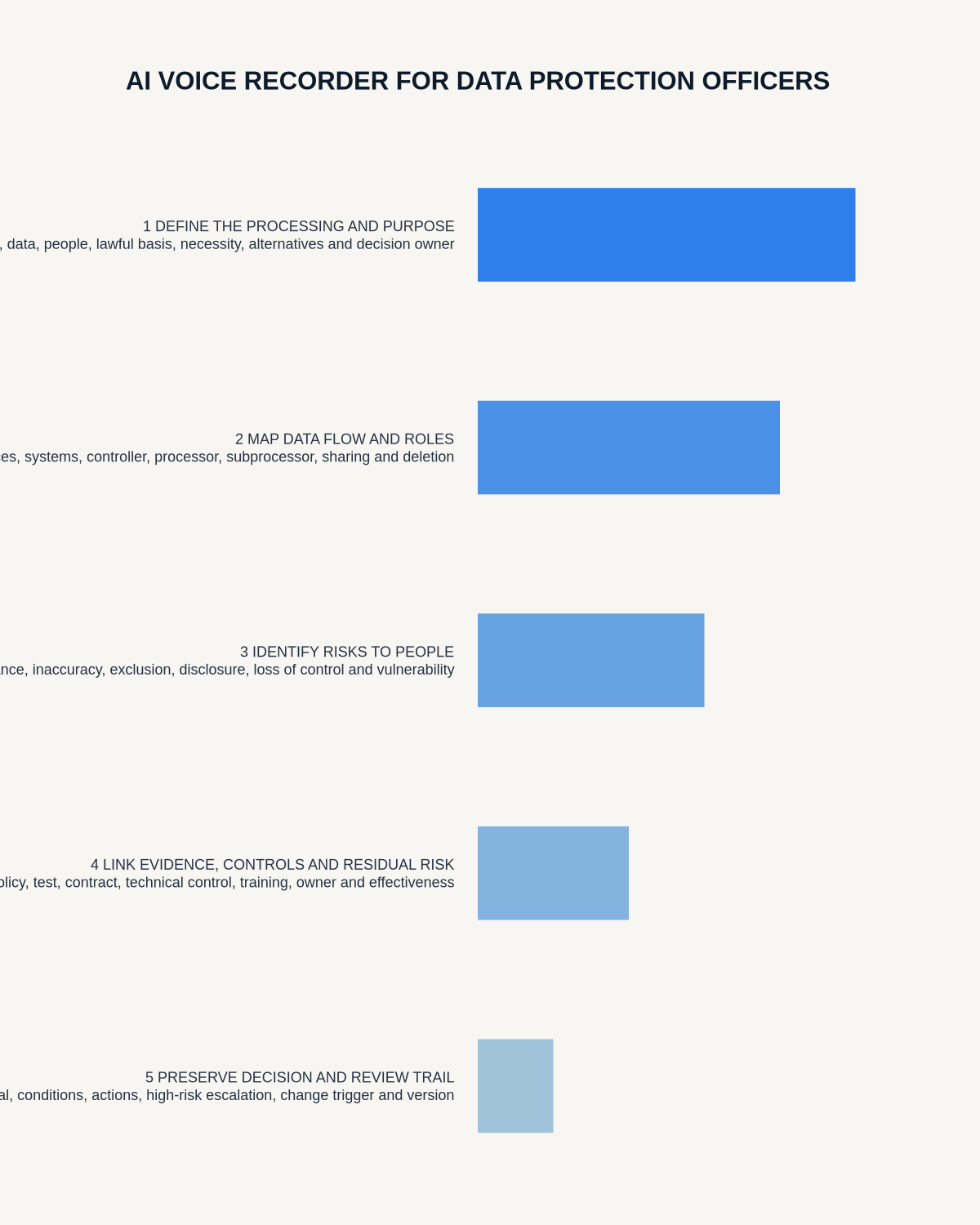
Visual map for AI Voice Recorder for Data Protection Officers: Better DPIA Interviews and Evidence Trails
- Prepare the approved useDefine purpose, safe position, permission and the required formal record.
- Capture context firstState the case, asset, person, location or event identifier before detail.
- Human-verify evidenceCheck technical terms, units, names, dates, decisions and uncertainty.
- Complete the formal recordTransfer only verified information and apply access and retention controls.
On this page
Related guides
See whether Halo fits this workflow
Review the NERALVO Halo specifications, included services, delivery information and current offer only after completing the guide.
Found an error or an out-of-date claim? Email support@neralvo.com with the article address and a supporting source.