The 60-second verdict
Quick answer: test an AI voice recorder workflow involving sensitive data with synthetic or safely prepared material first, a verified ground-truth transcript, a map of every storage and transfer point, role-based user tests and clear release thresholds. Do not begin with real client, patient, employee or case data merely because the technology needs a realistic test.
Decision focus: use the method below only where it produces a recoverable source, a verifiable output and a clear next action. If one of those fails, change the workflow rather than trusting a polished summary.
Evidence basis and limits
- Decision factors covered: Define the proposed use and the unacceptable failures; Create a synthetic test pack; Build a verified ground truth.
- Evidence rule: Claims are weighted by consequence: capture failure, changed meaning, access and recovery matter more than polished wording.
- Boundary: Examples and workflow recommendations must be tested with representative recordings, the intended users and the actual approval process before rollout.
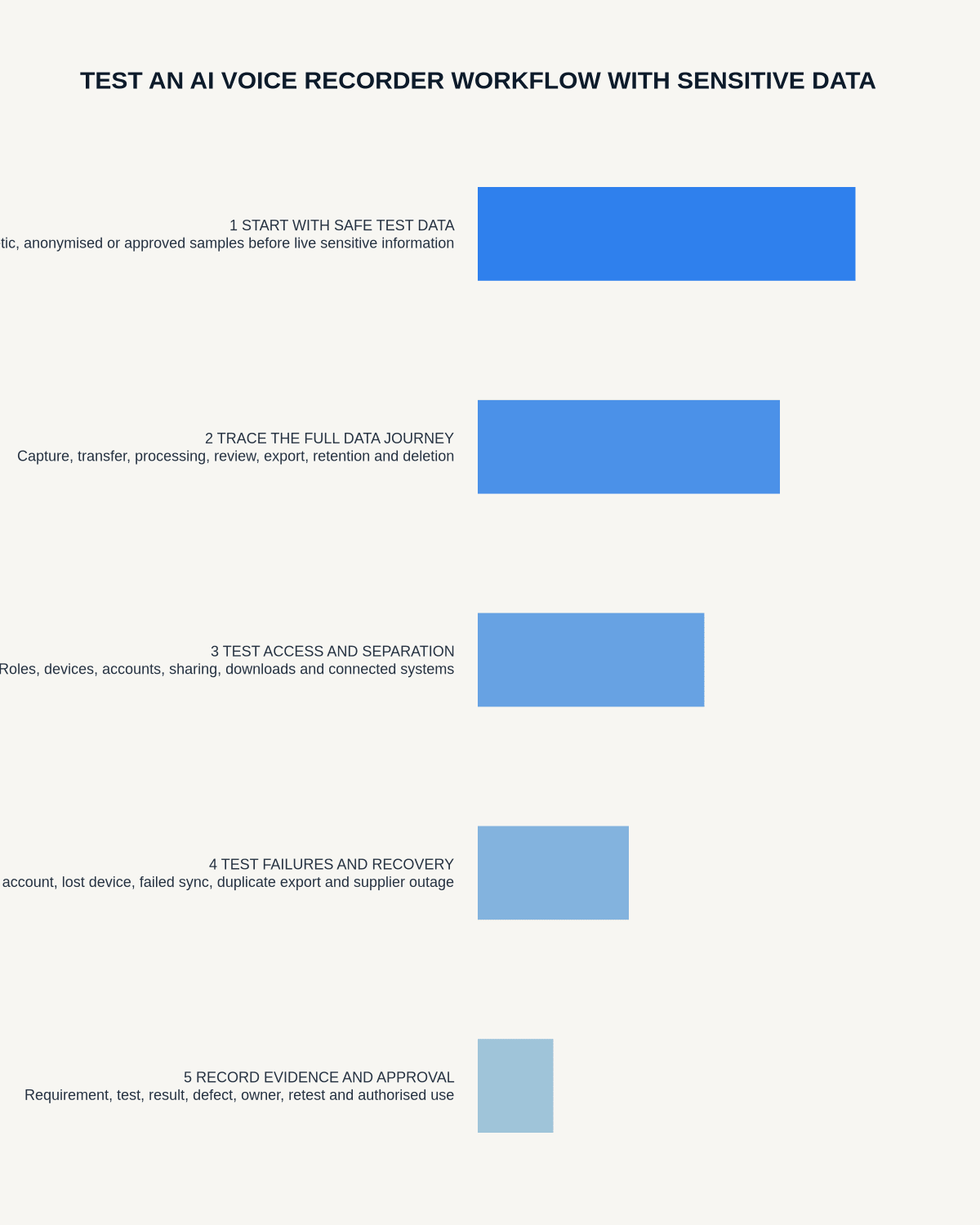
A sensitive-data test must assess more than transcription accuracy. It should prove that recording, access, sharing, correction, export, retention, deletion and incident handling all work as intended.

Define the proposed use and the unacceptable failures
Describe the exact recording purpose, users, participants, environment, output and business destination. Then list failures that would block release, such as:
- recording without clear notice or permission;
- missing or misattributed critical speech;
- incorrect names, numbers or negatives;
- unauthorised access or sharing;
- uncontrolled downloads;
- inability to delete or apply retention;
- AI summaries turning proposals into decisions;
- no recovery process after sync or device loss.
Testing should be designed around these risks, not around producing an impressive demo.
Create a synthetic test pack
Use invented people, organisations, reference numbers and scenarios. Include realistic complexity without reusing live records:
- two or more speakers;
- similar names;
- dates, amounts and identifiers;
- one negative statement;
- a rejected proposal;
- a conditional decision;
- an uncertain or interrupted passage;
- one item that should be excluded from the final note;
- a retention and deletion instruction.
Label the material clearly as synthetic so it cannot be mistaken for a genuine case.
Build a verified ground truth
Create an authoritative script and expected output before running the system. The ground truth should show:
- exact spoken wording;
- correct speakers;
- critical facts and figures;
- decision status;
- action owner and deadline;
- information that must not appear in the final record.
This prevents testers from judging only whether the AI output sounds fluent.
Map the complete data path
- Audio is captured on the recorder.
- The source is stored locally.
- The file transfers to a phone or app.
- It uploads or processes through the service.
- Transcript and summary copies are created.
- Users review and correct them.
- The approved record is exported.
- Temporary copies, source audio and backups follow retention or deletion rules.
For each stage, record the owner, location, security control, access roles, supplier involvement and deletion method.
Test the real user tasks
| Task | Pass condition |
|---|---|
| Start recording | Mode and status are unambiguous |
| Stop and save | Complete source is preserved |
| Find a recording | Correct file located without exposing unnecessary identity |
| Review transcript | Critical errors can be replayed and corrected |
| Share or export | Only approved recipient and format are available |
| Delete | Every defined copy follows the tested process |
Measure transcription and summary risk
Count errors that change meaning, including:
- names and identifiers;
- numbers, dates and units;
- missing negatives;
- speaker-label errors;
- lost qualifications;
- invented decisions;
- wrong action owners;
- omitted safeguarding, safety or legal concerns.
Set a review rule for every high-risk field. A generally readable transcript can still fail the workflow if one critical fact is wrong.
Test access, sharing and deletion
Use representative role accounts to confirm least-privilege access. Attempt an unauthorised view, create and revoke a test link, download a copy, disable a user and run the full deletion process. Follow the more detailed controls in How to Audit AI Voice Recorder Access and Sharing.
Run incident and recovery scenarios
Test at least:
- lost or stolen recorder;
- failed sync;
- interrupted upload;
- wrong recipient;
- accidental recording;
- full storage;
- low battery during capture;
- supplier outage;
- user leaving the organisation.
Each scenario needs a visible warning, immediate response, owner, escalation route and evidence that recovery or containment worked.
Set release gates
Do not move to real sensitive data until the required gates are met:
- purpose and lawful organisational basis approved;
- privacy assessment completed where required;
- data flow and suppliers understood;
- accuracy thresholds met;
- access and deletion verified;
- incident process tested;
- users trained;
- fallback method available;
- residual risks accepted by the correct authority.
Use a staged pilot
Begin with a small group, limited use case and defined review period. Monitor error rates, correction time, access issues, user workarounds, participant concerns and unprocessed recordings. Pause the pilot if the workflow creates uncontrolled copies or high-risk errors.
Workflow choice matrix for How to Test an AI Voice Recorder Workflow with Sensitive Data
Choose the method that protects the source and reduces downstream correction. The table makes the non-hardware options explicit.
| Condition | Preferred route | Why |
|---|---|---|
| Repeatable remote work with approved integrations | Cloud software | Automation and central collaboration may outweigh device independence. |
| In-person, mobile or unreliable-connectivity work | Dedicated recorder | Independent capture and a recoverable local source are usually more resilient. |
| Recording is refused, prohibited or unnecessary | Manual notes / no recording | Respecting the boundary is the correct workflow, not a product failure. |
| High-risk or mixed work | Governed hybrid | Separate capture, review, approval and retention rather than trusting one tool. |
Frequently asked questions
Can anonymised real recordings be used for the first test?
Synthetic material is usually safer because audio can reveal identity and context even after names are removed. Use real material only through an approved process when it is genuinely necessary.
What is the most important accuracy metric?
Critical meaning errors and time to verified output are more useful than one overall word-accuracy percentage.
Does successful deletion in the app prove everything was deleted?
No. Check the recorder, phone, downloads, exports, integrations, backups and supplier process defined in the data map.
When is a DPIA workshop appropriate?
Where processing is likely to create high risk or the use is novel, large-scale or particularly sensitive, use the organisation’s privacy process and see How to Run a Voice Recording DPIA Workshop.
Useful resources
- ICO guidance on data protection impact assessments
- ICO guidance on data minimisation
- How to Create a Voice Recording Exception and Escalation Process
Final release checklist
- Synthetic test pack prepared
- Ground truth approved
- Complete data path mapped
- User tasks observed
- Critical errors measured
- Access, sharing and deletion tested
- Incident scenarios passed
- Release gates approved
- Staged pilot and review date defined
On this page
Related guides
See whether Halo fits this workflow
Review the NERALVO Halo specifications, included services, delivery information and current offer only after completing the guide.
Found an error or an out-of-date claim? Email support@neralvo.com with the article address and a supporting source.