The 60-second verdict
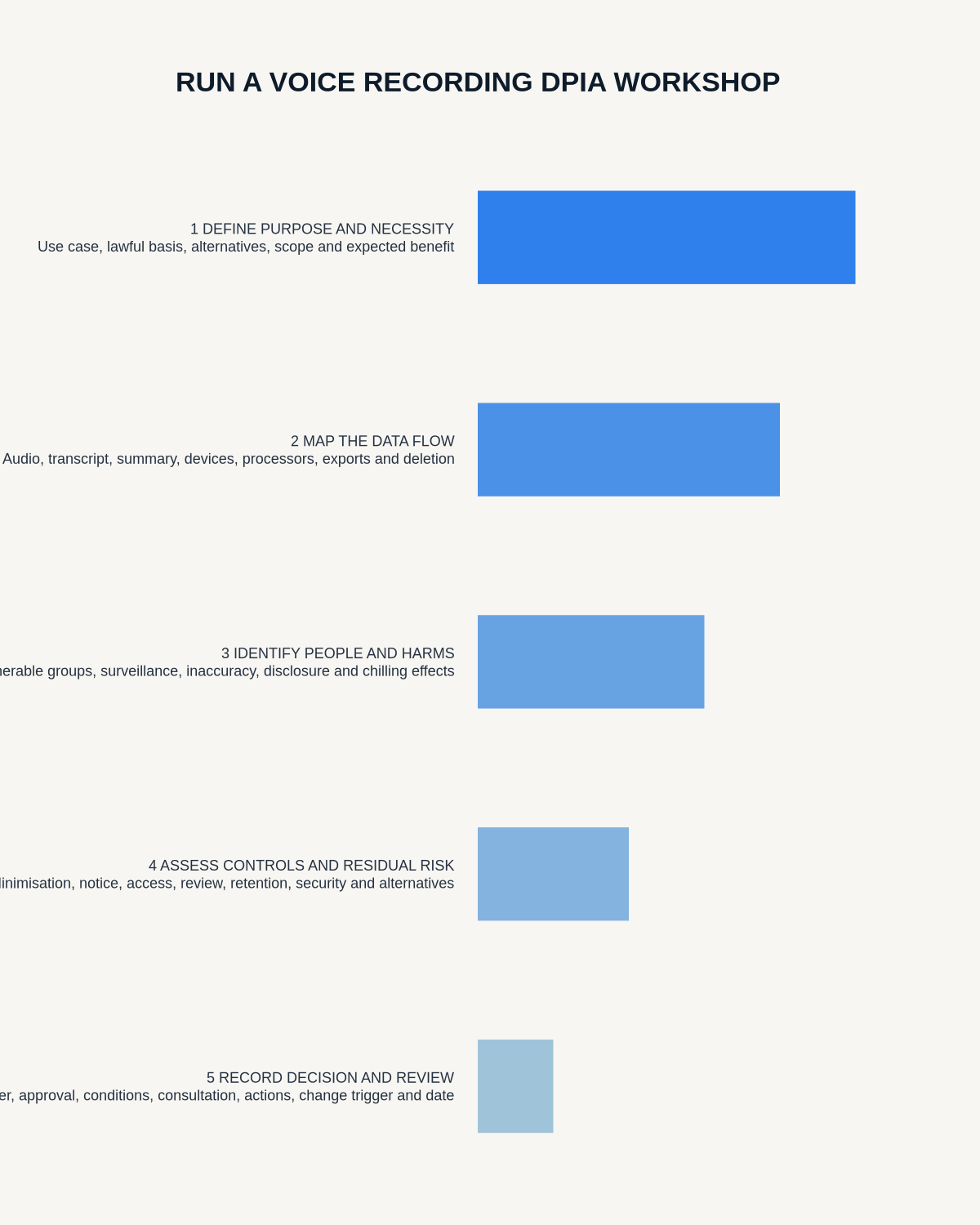
Quick answer: run a voice recording DPIA workshop by bringing together the business owner, privacy, security, operational users, records or information management and a representative of the people affected. Map the purpose and complete data flow, challenge necessity and proportionality, identify possible harm, agree evidenced controls and record who accepts the residual risk.
Decision focus: use the method below only where it produces a recoverable source, a verifiable output and a clear next action. If one of those fails, change the workflow rather than trusting a polished summary.
Evidence basis and limits
- Decision factors covered: Decide when a workshop is needed; Invite the right participants; Prepare a concise evidence pack.
- Evidence rule: A claim earns weight only when the source, date, configuration and limitation are clear enough for a reader to check.
- Boundary: Examples and workflow recommendations must be tested with representative recordings, the intended users and the actual approval process before rollout.
A workshop does not replace the organisation’s formal data protection process or legal advice. Its value is that it exposes assumptions before a voice-recording workflow reaches real people and sensitive data.

Decide when a workshop is needed
Use the organisation’s screening process. A structured workshop is particularly useful when recording involves:
- sensitive or special-category information;
- employees, patients, clients, children or vulnerable people;
- large-scale or systematic monitoring;
- automated transcription, summaries or profiling;
- new suppliers or international transfers;
- call recording or public-space capture;
- high-impact legal, clinical, employment or safeguarding decisions;
- a materially new use of existing recordings.
Invite the right participants
Include people who can describe and challenge the workflow:
- business or service owner;
- data protection or privacy adviser;
- information-security representative;
- records or information-management owner;
- operational users;
- technical or integration owner;
- procurement or supplier-management representative;
- someone able to represent participant or employee impact;
- specialist legal, clinical or safeguarding input where necessary.
The supplier should provide evidence, but the organisation remains responsible for its own decision.
Prepare a concise evidence pack
Send participants:
- proposed purpose and use cases;
- people and data affected;
- device, app and supplier information;
- draft data-flow diagram;
- retention and deletion proposal;
- access-role proposal;
- security and supplier evidence;
- pilot or test results;
- known alternatives and current process;
- open questions requiring a decision.
A workshop should test evidence, not spend the entire session discovering the basic workflow.
Start with purpose, necessity and alternatives
Ask:
- What specific problem is recording intended to solve?
- Which conversations need recording and which do not?
- Could a less intrusive method achieve the same outcome?
- Is source audio required, or would a verified note be enough?
- Which AI outputs are necessary?
- Who benefits and who bears the risk?
- What happens if a person refuses or cannot participate?
“Useful for productivity” is too broad to justify collecting every conversation.
Map the complete data flow
| Stage | Questions |
|---|---|
| Capture | Who is recorded, where and with what notice? |
| Local storage | What remains on the recorder or phone? |
| Transfer and processing | Which suppliers, locations and accounts are involved? |
| Review and sharing | Who can view, edit, export or create links? |
| Business record | What becomes the approved record and where is it stored? |
| Retention and deletion | When and how is every copy removed? |
Run a people-impact challenge
Consider possible effects on participants, not only technical security:
- loss of confidentiality or trust;
- people changing what they say because they are recorded;
- power imbalance or inability to refuse;
- misquotation or wrong speaker attribution;
- AI summaries overstating certainty;
- discrimination from uneven transcription quality;
- unexpected reuse of recordings;
- exposure of bystanders or third parties;
- harm following a breach, device loss or wrong recipient.
Describe who may be affected, the severity and the likelihood before and after controls.
Challenge the proposed controls
For every control, ask who owns it and how it will be tested. Relevant controls may include:
- clear recording notice and participant choice;
- approved use cases and prohibited uses;
- shorter retention for source audio;
- role-based access and strong authentication;
- restricted sharing and downloads;
- human verification of high-risk outputs;
- safe alternatives where recording is unsuitable;
- supplier terms and security review;
- incident, exception and escalation procedures;
- training, audit and periodic review.
A policy statement without an owner, test or evidence is not yet an effective control.
Record residual risk and decisions
For each significant risk, document:
- inherent risk;
- control owner and deadline;
- evidence required;
- residual likelihood and impact;
- whether the risk is accepted, reduced, avoided or requires consultation;
- the accountable decision-maker.
Do not approve the workflow merely because the workshop has ended. Unresolved high risks need formal action.
Use a practical workshop agenda
- Purpose, scope and decision required — 10 minutes.
- End-to-end data flow — 20 minutes.
- Necessity and alternatives — 15 minutes.
- People-impact and misuse scenarios — 20 minutes.
- Security, access, retention and supplier controls — 25 minutes.
- Residual risks, owners and deadlines — 20 minutes.
- Approval route and review triggers — 10 minutes.
Allow more time for complex, multi-supplier or high-impact uses.
Set review triggers
Review the DPIA when the purpose, scale, people affected, supplier, app, AI model, integrations, retention, location or security posture changes. Incidents, complaints and evidence of systematic transcription bias are also review triggers.
Workflow choice matrix for How to Run a Voice Recording DPIA Workshop
Choose the method that protects the source and reduces downstream correction. The table makes the non-hardware options explicit.
| Condition | Preferred route | Why |
|---|---|---|
| Repeatable remote work with approved integrations | Cloud software | Automation and central collaboration may outweigh device independence. |
| In-person, mobile or unreliable-connectivity work | Dedicated recorder | Independent capture and a recoverable local source are usually more resilient. |
| Recording is refused, prohibited or unnecessary | Manual notes / no recording | Respecting the boundary is the correct workflow, not a product failure. |
| High-risk or mixed work | Governed hybrid | Separate capture, review, approval and retention rather than trusting one tool. |
Frequently asked questions
Is a DPIA required for every voice recording?
Not automatically. Use the organisation’s screening process and applicable law and guidance. Higher-risk, novel or large-scale processing is more likely to require one.
Can the supplier provide the DPIA?
A supplier can provide evidence and its own assessment, but the organisation must assess its particular purpose, people, context and controls.
Should the workshop happen before testing?
Initial screening and risk planning should happen before live sensitive data. A synthetic-data test can then provide evidence for the detailed assessment. See How to Test an AI Voice Recorder Workflow with Sensitive Data.
What if one team needs an exception?
Use a controlled, time-limited process rather than informal workarounds. See How to Create a Voice Recording Exception and Escalation Process.
Useful resources
- ICO guidance on data protection impact assessments
- How to Audit AI Voice Recorder Access and Sharing
Final workshop checklist
- Purpose and scope are specific
- Correct participants invited
- Complete data flow mapped
- Necessity and alternatives challenged
- People impacts assessed
- Controls have owners and evidence
- Residual risks recorded
- Approval authority identified
- Review triggers scheduled
On this page
More in this topic: Recording governance and quality
Show 7 closely related guides
- How to Review AI Transcripts Before They Enter Business Systems
- What to Do When Someone Refuses to Be Recorded
- How to Draft a Consultation Response from Recorded Feedback
- How to Create an AI Voice Recording Quality Scorecard
- How to Create a Voice Recording Exception and Escalation Process
- How to Train Staff to Use AI Voice Recorders Responsibly
- How to Build an Approved-Use Matrix for Voice Recording
Related guides
See whether Halo fits this workflow
Review the NERALVO Halo specifications, included services, delivery information and current offer only after completing the guide.
Found an error or an out-of-date claim? Email support@neralvo.com with the article address and a supporting source.