The 60-second verdict
Quick answer: charity managers can use an AI voice recorder for approved operational meetings, trustee discussions, donor calls and service debriefs, but one transcript may contain several information classes. Each point must be classified, minimised and routed into the correct safeguarding, service, volunteer, HR, fundraising, finance or governance system.
Best fit: Charity Managers who need recoverable audio and human-verified notes in an authorised workflow. Use another method when: recording is prohibited, a participant declines or the approved process requires manual notes.
Evidence basis and limits
- Decision factors covered: Why catch-all transcripts create risk; The classify → prioritise → minimise → route → own → close workflow; Use explicit routing categories.
- Evidence rule: The decision is based on the complete capture-to-action workflow, not a single feature or marketing accuracy percentage.
- Boundary: Examples and workflow recommendations must be tested with representative recordings, the intended users and the actual approval process before rollout.

View Halo specifications for charity managers use can support approved meetings and private drafting. It is not a safeguarding, case, HR, CRM, finance or governance platform.
Why catch-all transcripts create risk
A single charity meeting can contain routine operational actions, trustee decisions, service-user feedback, complaints, confidential employment matters and a safeguarding disclosure. A broadly shared AI summary can send all of those items into the wrong document and expose information to people who need only one action.
The useful question is not simply “What was said?” It is: what type of record is this, who is authorised to receive it and what must happen next?
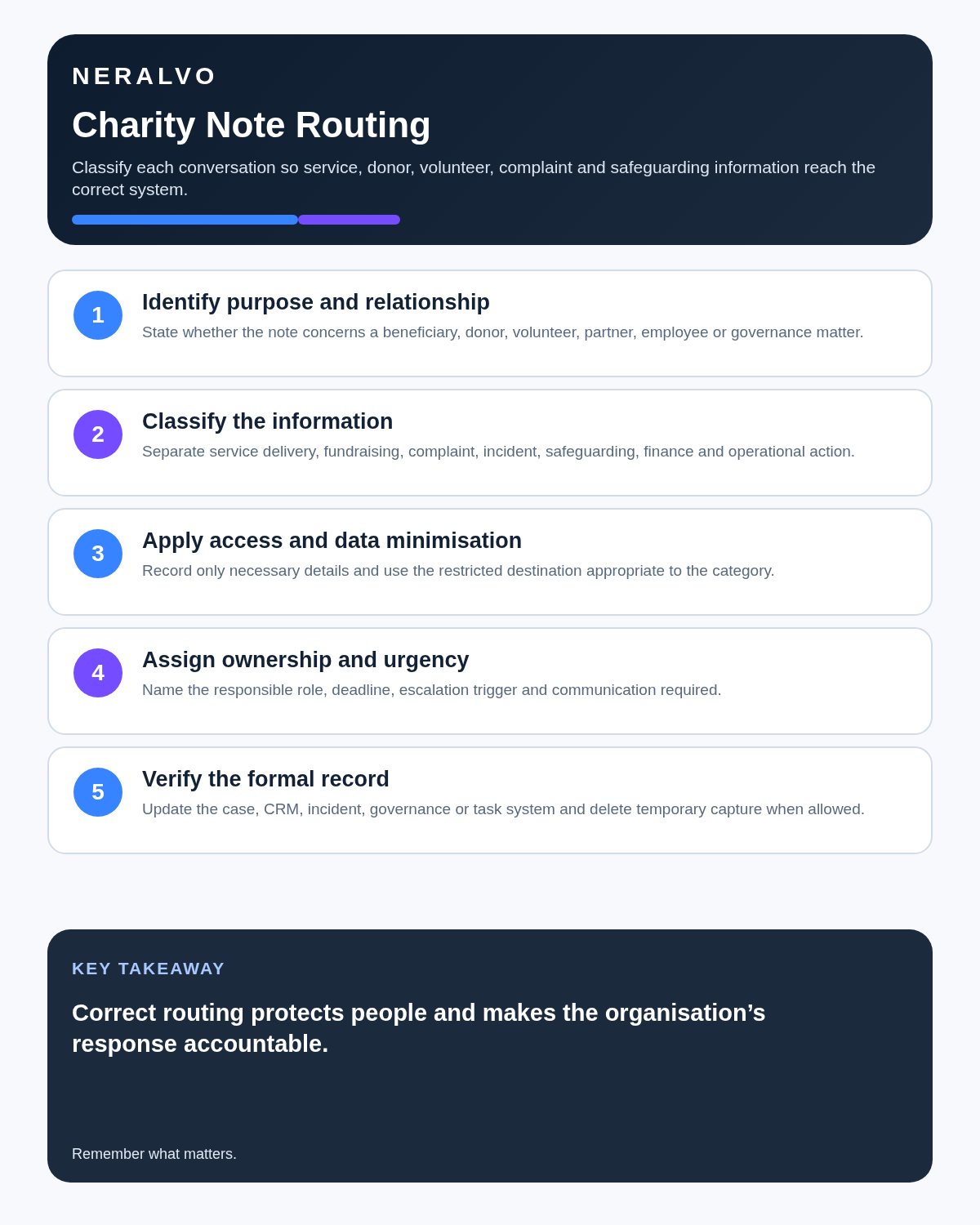
The classify → prioritise → minimise → route → own → close workflow
| Stage | Question | Output |
|---|---|---|
| Classify | What type of information is this? | Correct record category |
| Prioritise | Does it require urgent safeguarding, safety or fraud action? | Immediate route |
| Minimise | What detail is genuinely necessary? | Proportionate record |
| Route | Which authorised system and audience? | Controlled destination |
| Own | Who is accountable and by when? | Action |
| Close | What proves completion? | Verified outcome |
Use explicit routing categories
| Information class | Typical destination | Access principle |
|---|---|---|
| Service-user or beneficiary | Authorised case or service system | Need-to-know service roles |
| Safeguarding | Restricted safeguarding route | Designated safeguarding roles and relevant authorities |
| Volunteer | Volunteer-management record | Authorised coordinator and manager |
| Employment | Confidential HR process | Restricted HR and management access |
| Fundraising | CRM and finance system | Approved fundraising and finance roles |
| Trustee or governance | Approved minutes and decision log | Trustees and authorised officers |
| Finance, fraud or control | Finance, risk and incident process | Restricted finance, risk and investigation roles |
| Routine operations | Action or project system | Relevant delivery staff |
Decide whether recording is appropriate before the meeting
Recording should be purposeful, proportionate and approved. Define:
- the specific purpose;
- which meeting sections are eligible;
- who will attend and how they will be informed;
- whether a non-recorded route is needed;
- where audio and transcript will be stored;
- who can access, correct, export and delete them;
- how long each source is required.
Do not create an unofficial archive in a personal app account merely because it is convenient.
Create a ROUTE note for every material point
- R — Reference: meeting, service, project or case.
- O — Observation or evidence: fact, feedback, event or document.
- U — Urgency: routine, deadline-sensitive or immediate escalation.
- T — Type: operations, governance, feedback, HR, finance, fundraising or safeguarding.
- E — Executor: authorised owner, deadline and review point.
This produces a usable record without copying every conversational detail into every system.
Use an urgent-concern fast lane
Safeguarding, immediate safety, serious misconduct, fraud, data breach or welfare risk should enter the designated response process before the transcript is reviewed. Do not leave urgent information inside a general recording awaiting tomorrow’s summary.
A possible safeguarding concern should not remain buried in meeting notes while someone waits for polished text. Follow the charity’s approved procedure immediately, preserve necessary evidence and create the restricted record.
Separate fact, report, analysis and decision
- Observed: directly seen or heard.
- Reported: supplied by another person.
- Documented: supported by an authorised record.
- Analysis: professional or managerial interpretation.
- Decision: authorised outcome.
- Action: owner, task and deadline.
AI may help locate possible actions or decisions, but it cannot reliably determine the correct legal, governance or safeguarding route.
Turn trustee discussion into proper minutes
Trustee minutes are not a verbatim transcript. They should show the matter considered, relevant evidence, material challenge, conflicts of interest, decision, significant reasons, delegated authority and agreed actions.
Use AI to locate possible decisions and supporting passages, then have an authorised person prepare and approve the formal record.
Keep service feedback separate from fundraising stories
For feedback, distinguish:
- the person’s own account;
- verified service evidence;
- the manager’s interpretation;
- the improvement action;
- permission for any quotation, case study or publication.
Agreement to provide internal feedback does not automatically authorise public use in fundraising or marketing.
Example: one meeting, four different records
Imagine a partnership meeting where a service manager reports a room-booking problem, a trustee approves extra training expenditure, a participant complains about appointment delays and a volunteer mentions a possible welfare concern.
- The room-booking action goes to the operations tracker.
- The training approval goes into the trustee decision record with authority and budget.
- The appointment complaint goes into the complaints or service-improvement process.
- The welfare concern is escalated immediately through the restricted safeguarding procedure.
One general summary sent to every attendee would mishandle at least three of those four items.
Adapt the process to different participants
Charity meetings may involve trustees, employees, volunteers, beneficiaries, carers, interpreters and external partners. Explain recording in accessible language, allow questions and consider communication needs, capacity, power imbalance and the practical consequences of refusing.
Where participation in a service depends on sharing sensitive experiences, recording should not become an unnecessary condition of access.
Apply need-to-know access
Create a concise approved extract for each team rather than circulating the full transcript. A fundraiser does not need confidential HR detail; a volunteer coordinator does not need donor wealth information; trustees may need assurance without unnecessary case identifiers.
Control cross-system duplication
- Identify the authoritative destination.
- Create the minimum verified record.
- Link rather than duplicate where possible.
- Restrict the source transcript.
- Remove temporary exports and public links.
- Apply the correct retention schedule.
- Record deletion or justified retention.
Assess the recorder and app as a complete system
Before routine use, check:
- whether recording can continue offline;
- where original audio remains after transfer;
- team-account and permission controls;
- how access is revoked after staff or volunteers leave;
- export, correction and deletion capability;
- subscription and service-change effects;
- lost-device and compromised-account response;
- processing locations, subprocessors and model-training terms.
Post-meeting routing process
- Transfer and process the recording through the approved account.
- Correct names, dates, organisations and speaker attribution.
- Identify each material point and assign its route.
- Separate facts, direct accounts and interpretation.
- Escalate safeguarding concerns without waiting for general notes.
- Prepare trustee minutes through the governance process.
- Move complaints and feedback into the correct case or improvement system.
- Send operational actions only to relevant owners.
- Remove irrelevant personal and confidential detail.
- Delete source audio when the approved purpose and retention requirement end.
Cloud software, a dedicated recorder or manual notes?
For Charity Managers, the right answer changes with the setting. This matrix deliberately gives each method a situation where it can be the strongest choice.
| Situation | Best starting point | Reason |
|---|---|---|
| scheduled remote client meetings | Cloud meeting software | Native remote-meeting workflows can be more efficient here. |
| in-person visits and travel | Dedicated recorder | A separate battery and recoverable local source improve resilience. |
| a client declines or policy requires manual notes | Manual notes or an approved alternative | Manual notes are the correct control when recording is unavailable. |
| mixed CRM and field work | Governed hybrid | A hybrid can combine automation with reliable physical capture. |
Frequently asked questions
Can a whole management transcript be stored in one shared folder?
That is often inappropriate. Classify and route information by purpose and access need.
Can AI decide whether something is a safeguarding concern?
No. People must follow the charity’s designated process and seek the appropriate lead.
Should raw audio be the official record?
Usually no. The official record belongs in the authorised system after review.
Final charity-management checklist
- Recording purpose and audience approved.
- Urgent concerns routed immediately.
- Information classified accurately.
- Facts separated from analysis.
- Minimum necessary detail used.
- Each record sent to the correct system.
- Trustee decisions show authority and conflicts.
- Feedback remains separate from publicity permission.
- Actions are owned and evidenced.
- Raw source access and retention are controlled.
Bottom line: responsible charity recording does not create one giant institutional memory; it sends each verified fact to the people and process authorised to act.
Related guides
See the guides for volunteer coordinators, fundraisers and social workers.
On this page
Related guides
See whether Halo fits this workflow
Review the NERALVO Halo specifications, included services, delivery information and current offer only after completing the guide.
Found an error or an out-of-date claim? Email support@neralvo.com with the article address and a supporting source.