The 60-second verdict
Counselling records should support continuity, risk management and professional accountability without turning the therapeutic relationship into a surveillance system. A complete transcript may contain far more intimate detail than the service needs and may change what a client feels able to say.
Best fit: Counsellors who need recoverable audio and human-verified notes in an authorised workflow. Use another method when: recording is prohibited, a participant declines or the approved process requires manual notes.
Evidence basis and limits
- Decision factors covered: Use a minimum-necessary note model; Separate client words from counsellor formulation; Decide whether recording is necessary before the session.
- Evidence rule: A claim earns weight only when the source, date, configuration and limitation are clear enough for a reader to check.
- Boundary: Examples and workflow recommendations must be tested with representative recordings, the intended users and the actual approval process before rollout.
An AI voice recorder for counsellors is usually best suited to limited private post-session drafting, supervision preparation and agreed administrative calls. Routine recording of therapy sessions should not be the default. The device cannot formulate a client, assess risk, decide safeguarding action or replace professional judgement and the approved record system.
Use a minimum-necessary note model
| Record area | What may be necessary |
|---|---|
| Session context | Date, format, attendance and agreed boundaries |
| Client material | Main themes relevant to ongoing work |
| Therapeutic work | Intervention, focus and client response |
| Risk or safeguarding | Relevant concern, consultation and action |
| Agreement | Action, boundary, referral or next appointment |
| Reflection | Question for supervision, clearly separated from fact |
The final note should be proportionate. A full transcript is rarely necessary when a concise verified record meets the purpose.
Separate client words from counsellor formulation
Use explicit categories:
- Client stated: attributed words or meaning expressed by the client.
- Counsellor observed: relevant behaviour or affect seen in the session.
- Therapeutic formulation: the counsellor’s working interpretation and uncertainty.
- Risk information: factual concern, action and consultation.
- Agreement: what the client and counsellor decided to do next.
An AI summary should not present an interpretation as an established fact or create a diagnosis the counsellor did not make.
Decide whether recording is necessary before the session
Ask:
- What specific therapeutic or administrative purpose requires audio?
- Can a less intrusive note achieve the same outcome?
- Could recording affect disclosure, trust or power?
- Can the client decline without any disadvantage?
- Who will process, access and retain the audio?
- What happens if the purpose changes or the client withdraws agreement?
Wanting perfect recall or faster notes is not automatically a sufficient reason to create highly sensitive session audio.
Use post-session drafting as the safer default
After the session, move to a private approved location and record a short structured reflection while memory is fresh. Avoid unnecessary identifiers and third-party detail. Transfer the checked material into the authorised record, then handle the temporary audio under the retention policy.
This approach allows the counsellor to remain fully present during therapy and reduces the amount of raw client material created.
Create a supervision question sheet
Supervision preparation should focus on the professional question:
- What feels stuck or unclear?
- Which boundary or ethical issue needs review?
- What risk or safeguarding decision needs consultation?
- What response in the counsellor requires reflection?
- Which client information is genuinely necessary for supervision?
Use anonymisation or pseudonymisation where appropriate. Raw session audio should not be shared unless this has a clear professional, contractual and secure basis.
Use a risk-and-safeguarding fast lane
AI cannot determine suicide risk, abuse, exploitation, capacity or the correct safeguarding response. If concern emerges, act through the professional and organisational process immediately.
The restricted record should preserve the relevant facts, exact words where important, consultation, decision, action and follow-up. Do not wait for transcript processing before responding.
Protect third-party confidentiality
Clients often discuss partners, relatives, colleagues and professionals. Record only the third-party detail needed for the therapeutic or safeguarding purpose. Avoid turning every person mentioned into a searchable identifiable record.
Plan retention before creating audio
Decide the purpose, access, storage, deletion point and handling of synced copies or exports before recording. Local storage does not remove professional, contractual or data-protection responsibilities.
How NERALVO Halo may fit a limited counselling workflow
Assess Halo against the counsellors workflow matrix provides NOTE recording, supported CALL capture, 64GB local storage, up to 35 hours of recording and Bluetooth sync with DOWAY. DOWAY can create transcripts, summaries, templates, translations, mind maps and exports, with one year of DOWAY Max included from activation.
Halo is a consumer AI voice recorder. Counselling use would require assessment of the device, DOWAY processing, confidentiality, insurance, professional standards and the practice’s record policy before use.
Record-release check
- Was recording genuinely necessary and proportionate?
- Could the client decline without disadvantage?
- Are client material and counsellor formulation separated?
- Were risk and safeguarding actions handled immediately?
- Is third-party information minimised?
- Is the final note concise and professionally useful?
- Was supervision material limited to the purpose?
- Has temporary audio been handled under the agreed policy?
The strongest counselling record protects the therapeutic relationship while preserving what is needed for continuity, risk and accountability. Recording should remain a limited tool, not the centre of the work.
Cloud software, a dedicated recorder or manual notes?
For Counsellors, the right answer changes with the setting. This matrix deliberately gives each method a situation where it can be the strongest choice.
| Situation | Best starting point | Reason |
|---|---|---|
| scheduled remote meetings | Cloud meeting software | Auto-join and central collaboration can remove routine admin. |
| in-person or mobile work | Dedicated recorder | Dedicated hardware suits movement, variable rooms and offline source capture. |
| recording is refused or prohibited | Manual notes or an approved alternative | A clear alternative respects policy and participant choice. |
| mixed online and offline work | Governed hybrid | One governed process prevents gaps between desk and field work. |
Related professional guides
See GP consultation records and person-centred assessment notes.
Related guides
Profession workflow
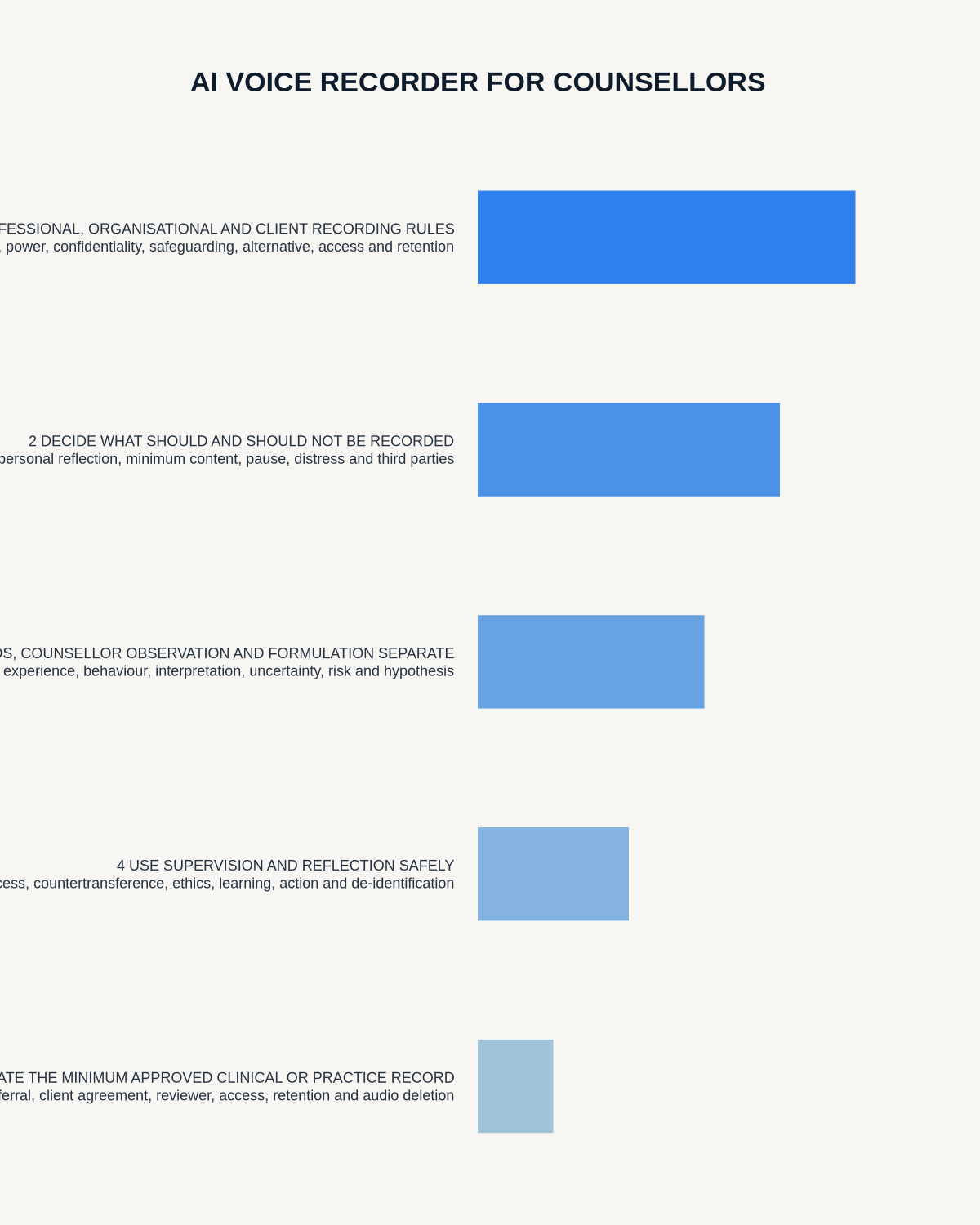
Visual map for AI Voice Recorder for Counsellors: Session Notes, Supervision and Reflective Practice
- Prepare the approved useDefine purpose, safe position, permission and the required formal record.
- Capture context firstState the case, asset, person, location or event identifier before detail.
- Human-verify evidenceCheck technical terms, units, names, dates, decisions and uncertainty.
- Complete the formal recordTransfer only verified information and apply access and retention controls.
On this page
Related guides
See whether Halo fits this workflow
Review the NERALVO Halo specifications, included services, delivery information and current offer only after completing the guide.
Found an error or an out-of-date claim? Email support@neralvo.com with the article address and a supporting source.