
The 60-second verdict
Quick answer: use an AI voice recorder for inspections only as a temporary capture tool. Every item must be tied to the exact location, requirement, observable condition, evidence, finding status, action owner and closure test before entering the official inspection or compliance system.
Best fit: Inspections who need recoverable audio and human-verified notes in an authorised workflow. Use another method when: recording is prohibited, a participant declines or the approved process requires manual notes.
Evidence basis and limits
- Decision factors covered: Define scope and criteria before recording; Use a requirement → observation → evidence → finding → action → closure workflow; Use explicit evidence states.
- Evidence rule: Claims are weighted by consequence: capture failure, changed meaning, access and recovery matter more than polished wording.
- Boundary: Examples and workflow recommendations must be tested with representative recordings, the intended users and the actual approval process before rollout.
An inspection note becomes defensible when another authorised reviewer can answer five questions: what requirement applied, what was observed, what evidence supports the finding, who owns the corrective action and what proves closure.
Define scope and criteria before recording
- inspection type and purpose;
- site, area, asset, process or sample included;
- areas excluded or inaccessible;
- standard, policy, contract or specification used;
- people present and their roles;
- recording authority and information boundaries;
- required official output.
Without a clear criterion, a voice note can describe a condition but cannot support a compliance finding.
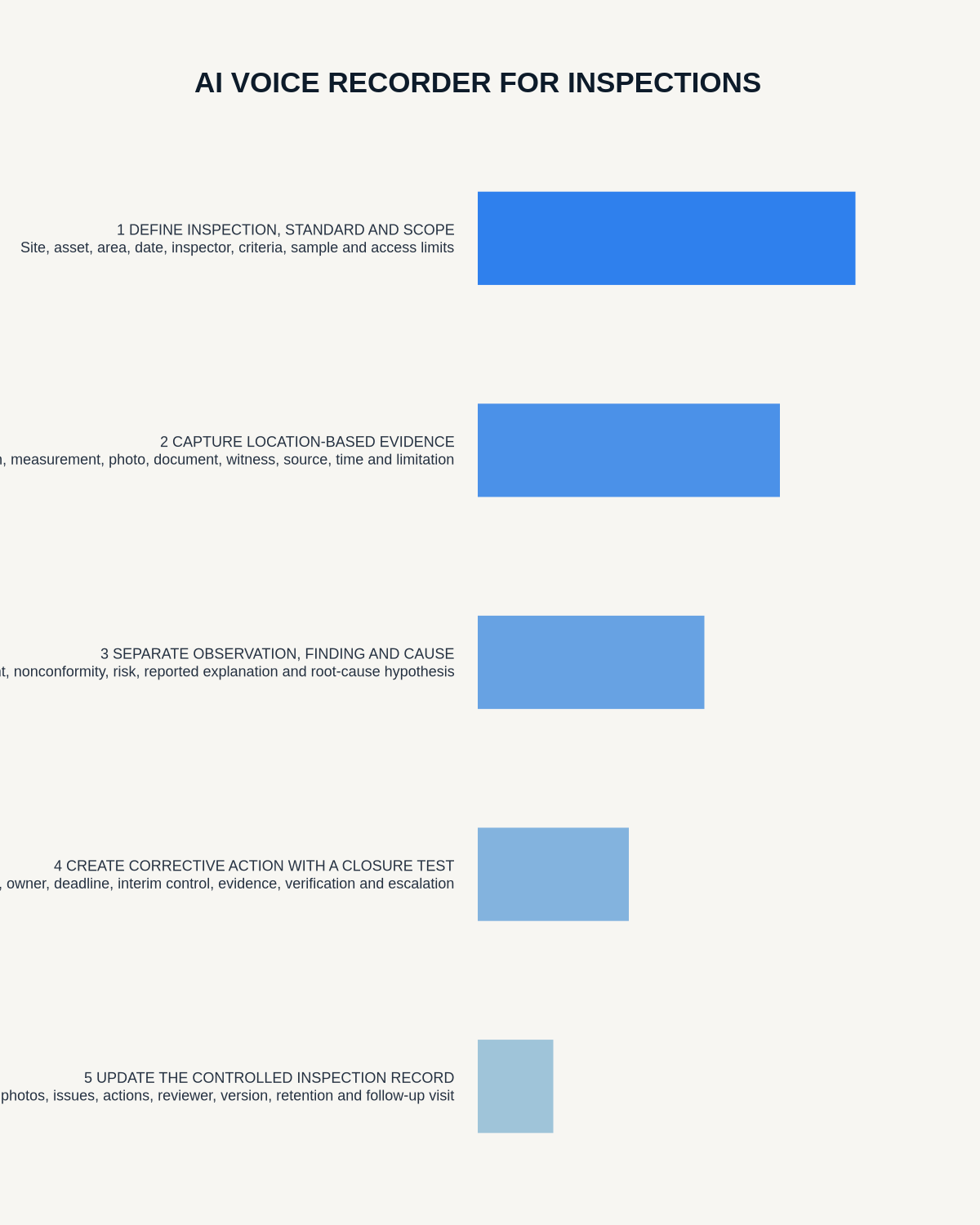
Use a requirement → observation → evidence → finding → action → closure workflow
| Stage | Question | Output |
|---|---|---|
| Requirement | What standard or control applies? | Named criterion and version |
| Observation | What was directly seen, measured or demonstrated? | Neutral factual note |
| Evidence | Which photo, document, sample, log or interview supports it? | Traceable reference |
| Finding | Does the evidence meet, partly meet or fail the criterion? | Authorised status |
| Action | What correction is required, by whom and by when? | Owned remediation |
| Closure | What proves implementation and effectiveness? | Verified completion |
Use explicit evidence states
- Observed: directly seen or measured.
- Reported: stated by another person.
- Documented: supported by a record.
- Sampled: based on a defined subset, not the full population.
- Inaccessible: could not be inspected.
- Possible cause: hypothesis requiring further work.
- Confirmed finding: authorised conclusion against the criterion.
An AI summary must not turn “reported,” “sampled” or “possible” into confirmed compliance or non-compliance.
Anchor every field observation
State the site, building, floor, room, asset, process step or record reference before describing the issue. Repeat the anchor after moving. Link every photograph, measurement and document to the same reference.
Describe before diagnosing
Record the visible or measurable condition first. Then label interpretation and cause separately.
Weak: “Poor maintenance caused the failure.”
Stronger: “Asset AHU-04: filter housing has a visible gap at the lower seal; photograph 17. Maintenance cause not established. Inspection and service history requested.”
Use a finding-severity model
| Status | Typical meaning | Required response |
|---|---|---|
| Immediate danger or critical control failure | Serious current risk or prohibited condition | Apply emergency, isolation or escalation process immediately |
| Major non-conformance | Material failure against a requirement | Contain, assign senior owner and define urgent evidence |
| Minor non-conformance | Limited failure that still requires correction | Owned corrective action and due date |
| Observation or improvement | No confirmed breach, but a relevant weakness or opportunity | Review and decide proportionate action |
| Conforming | Evidence meets the assessed criterion | Record the evidence and scope sampled |
| Unable to determine | Evidence or access is insufficient | Identify the additional inspection or document required |
The accountable inspection process determines classification; AI must not assign severity automatically.
Interview evidence needs careful handling
When staff, contractors or service users explain a process, record:
- speaker role and basis of knowledge;
- what they personally observed or performed;
- what they believe usually happens;
- which document, system or demonstration supports the statement;
- what remains unverified.
“We always complete the check” is not enough. Request the sample, system record or demonstration required by the inspection method.
Control photographs and measurements
For every material item, record:
- exact location and direction;
- photograph or video reference;
- scale or measurement method;
- instrument and calibration status where relevant;
- unit and tolerance;
- environmental or access limitation;
- person who verified the value.
The transcript is not the authoritative measurement record.
Use an urgent-issue fast lane
Do not wait for transcription when the inspection identifies an immediate safety, safeguarding, environmental, security, legal or service-critical risk. Follow the authorised escalation process first. Record the factual condition, temporary control, people notified and time in the official system.
Create corrective actions that can close
| Action field | Required detail |
|---|---|
| Finding reference | Exact criterion and evidence |
| Correction | Immediate step to address the current condition |
| Corrective action | Change intended to prevent recurrence |
| Owner | One accountable person or role |
| Deadline | Date and time where material |
| Dependency | Access, design, budget, supplier or approval |
| Implementation evidence | Document, photo, test or completed record |
| Effectiveness test | How the organisation will prove the control works |
| Closure authority | Person authorised to accept completion |
A promise to fix an issue is not closure. A new procedure may prove implementation but not effectiveness.
Manage inaccessible and concealed areas honestly
State what could not be seen, why, the resulting uncertainty and the additional access, opening-up, document or specialist assessment required. Do not imply that concealed work or unsampled records were inspected.
Use a controlled post-inspection workflow
- Secure and label the source recording.
- Correct locations, asset IDs, names, dates and technical terms.
- Match photographs, measurements, samples and documents.
- Separate observations, reports, hypotheses and findings.
- Apply the authorised severity and escalation process.
- Create actions with owners, deadlines and closure evidence.
- Transfer the verified record into the official inspection or compliance system.
- Complete reinspection or effectiveness testing.
- Close only through the authorised reviewer.
- Delete or retain source audio under policy.
Accuracy and personal information
Where inspection records identify workers, residents, customers or other individuals, distinguish fact from opinion, correct inaccuracies and preserve the source and review status. The ICO accuracy guidance explains the obligation to take reasonable steps to ensure personal data is accurate and, where necessary, kept up to date.
How NERALVO Halo fits inspection work
Check whether NERALVO Halo fits inspections work provides portable NOTE recording, supported CALL capture, 64GB local storage, up to 35 hours of recording and Bluetooth sync with DOWAY. DOWAY can create transcripts, summaries, speaker-separated notes, templates, translations, mind maps and exports, with one year of DOWAY Max included from activation.
Halo can support approved field narration, interviews and post-visit debriefs. It is not a measuring instrument, inspection certificate, compliance decision engine or system of record.
Cloud software, a dedicated recorder or manual notes?
For Inspections, the right answer changes with the setting. This matrix deliberately gives each method a situation where it can be the strongest choice.
| Situation | Best starting point | Reason |
|---|---|---|
| scheduled remote meetings | Cloud meeting software | Calendar automation and shared integrations are usually the strongest advantage. |
| in-person or mobile work | Dedicated recorder | Independent capture reduces reliance on an active phone or laptop. |
| recording is refused or prohibited | Manual notes or an approved alternative | The boundary takes priority over convenience. |
| mixed online and offline work | Governed hybrid | Use each method only in the setting it actually fits. |
Frequently asked questions
Can AI decide whether a requirement is met?
No. It can organise evidence, but the authorised inspector must assess the criterion, scope and limitations.
Can audio replace photographs or measurements?
No. Use it to connect and explain the evidence.
Should urgent hazards wait for the final report?
No. Apply the required immediate control and escalation process.
When is a corrective action complete?
When implementation evidence exists and the required effectiveness test and closure review are complete.
Final inspection checklist
- Scope, exclusions and criterion are clear.
- Every observation has an exact anchor.
- Evidence status and sampling limitations are visible.
- Reports and hypotheses are separate from findings.
- Urgent risk was escalated immediately.
- Severity was assigned by the authorised process.
- Actions have owners, dates and evidence.
- Effectiveness and closure were verified.
- The official inspection system is updated.
Bottom line: a strong inspection voice note preserves the evidence chain from requirement to verified closure without inventing access, diagnosis, compliance or completion.
Related AI voice recorder guides
On this page
Related guides
See whether Halo fits this workflow
Review the NERALVO Halo specifications, included services, delivery information and current offer only after completing the guide.
Found an error or an out-of-date claim? Email support@neralvo.com with the article address and a supporting source.