The 60-second verdict
Nursing documentation must show the patient’s current state, meaningful change, treatment, risk, pending work and the exact action expected from the next person. A long transcript can still be unsafe if it hides priorities or mixes information between patients.
Best fit: Nurses who need recoverable audio and human-verified notes in an authorised workflow. Use another method when: recording is prohibited, a participant declines or the approved process requires manual notes.
Evidence basis and limits
- Decision factors covered: Use a patient-state handover; Preserve trends, not isolated values; Create a medicine reconciliation checkpoint.
- Evidence rule: A claim earns weight only when the source, date, configuration and limitation are clear enough for a reader to check.
- Boundary: Examples and workflow recommendations must be tested with representative recordings, the intended users and the actual approval process before rollout.
An AI voice recorder for nurses may support an organisation-approved handover or a private post-care draft. It cannot assess deterioration, administer medicines, make a care decision or replace observation charts, medicine records, care plans and the electronic patient record.
Use a patient-state handover
| State area | What to hand over |
|---|---|
| Identity and location | Required identifiers, ward or setting and responsible team |
| Current condition | Reason for care and present clinical state |
| Change | What has improved, worsened or remained unresolved |
| Risk | Deterioration, falls, skin, safeguarding or other priority |
| Treatment | Medicines, fluids, oxygen, wound or device plan |
| Pending work | Tests, reviews, referrals, discharge steps and results |
| Next action | Owner, deadline and escalation trigger |
Each handover should describe the patient at a clear time. Avoid importing yesterday’s status into today’s note.
Preserve trends, not isolated values
Record the direction and context of change:
- observation trends
- pain and response
- consciousness and behaviour
- mobility and falls risk
- fluid balance and elimination
- nutrition and intake
- skin, wounds, lines and drains
- response to treatment
Verify every value, unit and time against the authorised chart or device. A transcript is not the observation record.
Create a medicine reconciliation checkpoint
Before approving a draft, check:
- patient identity and allergy status
- medicine, formulation and strength
- dose, route, frequency and time
- prescription or authorised plan
- omitted, delayed, refused or PRN doses
- infusions, monitoring and changes
- what is next due and who is responsible
AI must not infer administration or rewrite a missed dose as completed.
Use closed-loop action ownership
Every significant action should show:
Task — patient — owner — deadline — escalation condition — confirmation method.
“Bloods tomorrow” is incomplete. The handover should identify which test, who will request or take it, when the result is expected and what happens if it is abnormal or delayed.
Record escalation as a chronology
For deterioration or concern, preserve:
- what changed and when
- verified observations
- who was contacted
- advice or decision received
- intervention completed
- patient response
- next review point
Do not let a summary remove delay, uncertainty or the sequence of events.
Protect safeguarding and restricted information
Safeguarding, capacity, coercion and sensitive social information may require restricted handling. Record the clinically relevant concern and action in the correct system. Avoid placing unnecessary details in a general handover or shared transcript.
Build discharge from unresolved risks backward
Before discharge, check medicines, wound or equipment care, mobility, food and fluid needs, follow-up, transport, carer support, communication needs and warning signs. State which barriers are resolved and which person or service owns the remaining action.
Patient-facing instructions must be reviewed, accessible and understood. Do not issue an unchecked AI summary.
Protect privacy in shared environments
Direct recording may be unsuitable in bays, bedside areas, homes or other spaces where unrelated people would be captured. Use a private approved drafting method instead. Explain any planned recording and provide the organisation’s alternative where needed.
How NERALVO Halo may fit an approved nursing workflow
Assess Halo against the nurses workflow matrix can capture notes and supported calls, with 64GB local storage, up to 35 hours of recording and Bluetooth sync with DOWAY. DOWAY can create transcripts, summaries, templates, translations, mind maps and exports, with one year of DOWAY Max included from activation.
Halo is a consumer AI voice recorder. A healthcare or care organisation would need to assess the device, application, data processing, clinical risk, privacy and procurement before use with patient information.
Handover release check
- Is the patient identity verified?
- Does the note show current state and meaningful change?
- Are values and medicines checked against authorised systems?
- Does every priority action have an owner and deadline?
- Is escalation chronology complete?
- Is safeguarding information in the correct restricted record?
- Are discharge barriers and warning signs clear?
- Has the final note entered the official clinical system?
The strongest nursing handover is not the longest. It gives the next professional a current, prioritised and verified picture of the patient, with no uncertainty about what must happen next.
Cloud software, a dedicated recorder or manual notes?
For Nurses, the right answer changes with the setting. This matrix deliberately gives each method a situation where it can be the strongest choice.
| Situation | Best starting point | Reason |
|---|---|---|
| scheduled remote consultations | Cloud meeting software | Auto-join and central collaboration can remove routine admin. |
| in-person consultations or ward handovers | Dedicated recorder | Dedicated hardware suits movement, variable rooms and offline source capture. |
| a patient declines or policy prohibits recording | Manual notes or an approved alternative | A clear alternative respects policy and participant choice. |
| mixed remote and clinical work | Governed hybrid | One governed process prevents gaps between desk and field work. |
Related healthcare guides
See GP consultation notes, medicine safety records and care handover actions.
Related guides
Profession workflow
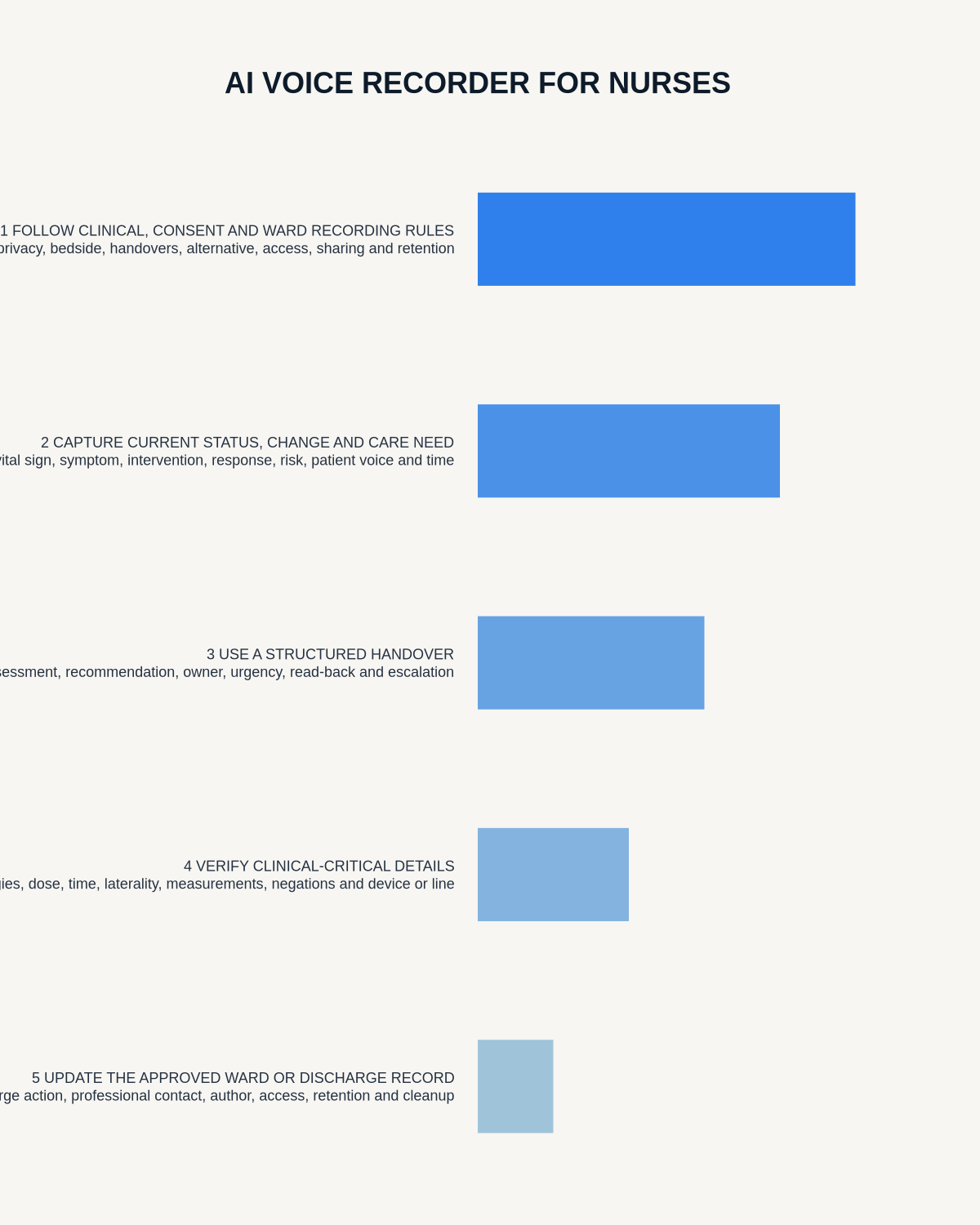
Visual map for AI Voice Recorder for Nurses: Patient Handover, Ward Notes and Discharge Preparation
- Prepare the approved useDefine purpose, safe position, permission and the required formal record.
- Capture context firstState the case, asset, person, location or event identifier before detail.
- Human-verify evidenceCheck technical terms, units, names, dates, decisions and uncertainty.
- Complete the formal recordTransfer only verified information and apply access and retention controls.
On this page
Related guides
See whether Halo fits this workflow
Review the NERALVO Halo specifications, included services, delivery information and current offer only after completing the guide.
Found an error or an out-of-date claim? Email support@neralvo.com with the article address and a supporting source.