The 60-second verdict
Quick answer: use an AI voice recorder in supplier meetings to capture specifications, evidence, commercial terms, delivery conditions, risks and commitments, then verify every critical detail against the contract, quotation, drawing, quality record or approved source before creating actions.
Best fit: Supplier Meetings who need recoverable audio and human-verified notes in an authorised workflow. Use another method when: recording is prohibited, a participant declines or the approved process requires manual notes.
Evidence basis and limits
- Decision factors covered: Define the meeting type; Build the agenda around controlled evidence; Confirm recording and confidentiality.
- Evidence rule: A claim earns weight only when the source, date, configuration and limitation are clear enough for a reader to check.
- Boundary: Examples and workflow recommendations must be tested with representative recordings, the intended users and the actual approval process before rollout.

Assess Halo against the supplier meetings workflow matrix can preserve an authorised source while procurement, contract, quality and project systems remain authoritative.
Define the meeting type
Supplier meetings can serve very different purposes:
- Initial capability assessment.
- Specification clarification.
- Commercial negotiation.
- Implementation or mobilisation.
- Quality review.
- Delivery recovery.
- Performance review.
- Risk and continuity planning.
- Contract change.
- Relationship improvement.
The record should match the meeting. A technical clarification is not automatically a contract variation, and a supplier-performance discussion is not the same as a formal acceptance decision.
Build the agenda around controlled evidence
| Section | Evidence or decision required |
|---|---|
| Specification | Current document, revision and acceptance criteria |
| Commercial | Price basis, assumptions, exclusions and validity |
| Delivery | Lead time, milestones, dependencies and capacity |
| Quality | Inspection, testing, certificates and non-conformance process |
| Compliance | Required declarations, standards and approvals |
| Risk | Supply, capacity, location, financial, security and continuity risks |
| Change | Requested difference, impact and approval route |
| Actions | Owner, deadline, evidence and target system |
Confirm recording and confidentiality
Before recording, explain:
- The purpose of the source audio.
- Who can access it.
- Whether automated transcription is used.
- Which information should not be spoken.
- How commercially sensitive material will be handled.
- Which record becomes authoritative.
- How long audio and drafts will be retained.
Trade secrets, personal data, privileged advice and security-sensitive material may be unsuitable for routine recording. Use the least intrusive approved method that still creates a reliable record.
Use verbal status labels
- Specification requirement: mandatory technical requirement.
- Clarification: explanation without changing the document.
- Assumption: point requiring confirmation.
- Supplier statement: attributed information not yet verified.
- Evidence: controlled certificate, test, drawing, schedule or system record.
- Supplier proposal: option offered but not accepted.
- Buyer position: requested outcome but not necessarily agreed.
- Commitment: confirmed undertaking within authority.
- Subject to approval: conditional point.
- Change request: proposed departure requiring formal control.
- Action: task, owner, deadline and evidence of completion.
An AI summary must not turn a proposal into a commitment, a statement into evidence or a clarification into a specification change.
Confirm authority before recording a commitment
Clarify who can approve:
- Price changes.
- Specification changes.
- Delivery-date changes.
- Quality concessions.
- Contract terms.
- Additional spend.
- Subcontractor use.
- Risk acceptance.
A technical specialist may explain feasibility without having commercial authority to bind either organisation.
Keep specification references precise
When a requirement is discussed, record:
- Document title and identifier.
- Revision or version.
- Clause, drawing or part number.
- Unit of measure.
- Tolerance or performance level.
- Test or acceptance method.
- Owner of any clarification.
- Formal change route if wording must change.
Avoid phrases such as “the latest drawing,” “same as before” or “the usual tolerance.” Link the final note to the controlling document.
Separate price from the assumptions behind it
| Commercial point | Detail to confirm |
|---|---|
| Unit price | Quantity band, currency and tax basis |
| Freight | Included, excluded or separately calculated |
| Tooling | Ownership, maintenance and amortisation |
| Lead time | Which approval, payment or information event starts the clock |
| Validity | How long the offer remains open |
| Indexation | Trigger, formula and notice process |
| Minimum order | Quantity, frequency and exception process |
| Payment | Milestone, invoice and acceptance conditions |
| Warranty | Coverage, exclusions, claim route and duration |
A price without its assumptions can create a misleading commercial record.
Capture quality evidence, not reassurance alone
“Quality will be fine” is not an auditable control. Record:
- Required inspection and test plan.
- Sample or first-article approval.
- Certificate and traceability requirements.
- Measurement method and equipment.
- Non-conformance ownership.
- Containment and corrective-action process.
- Concession approval route.
- Retention of quality records.
Obtain and verify the actual controlled documents. A certificate discussed in a meeting has not been reviewed merely because it was mentioned.
Make delivery dates conditional where they are conditional
A delivery date may depend on:
- Forecast or purchase-order receipt.
- Drawing approval.
- Deposit or credit approval.
- Material availability.
- Tooling completion.
- Test approval.
- Customer-furnished information.
- Shipping method and customs requirements.
Record each dependency with an owner and due date. Do not present the final date without its conditions.
Use a structured risk record
| Risk | Evidence and response to record |
|---|---|
| Single-source component | Alternative, stock, lead time and recovery plan |
| Capacity constraint | Available capacity, allocation, priority and trigger |
| Subcontractor reliance | Approved source, oversight and traceability |
| Financial pressure | Appropriate commercial review and contingency |
| Location disruption | Continuity and logistics plan |
| Quality trend | Evidence, containment, corrective action and verification |
| Data or security exposure | Required controls, access and approvals |
| Regulatory change | Applicable requirement, owner and effective date |
Track commitments precisely
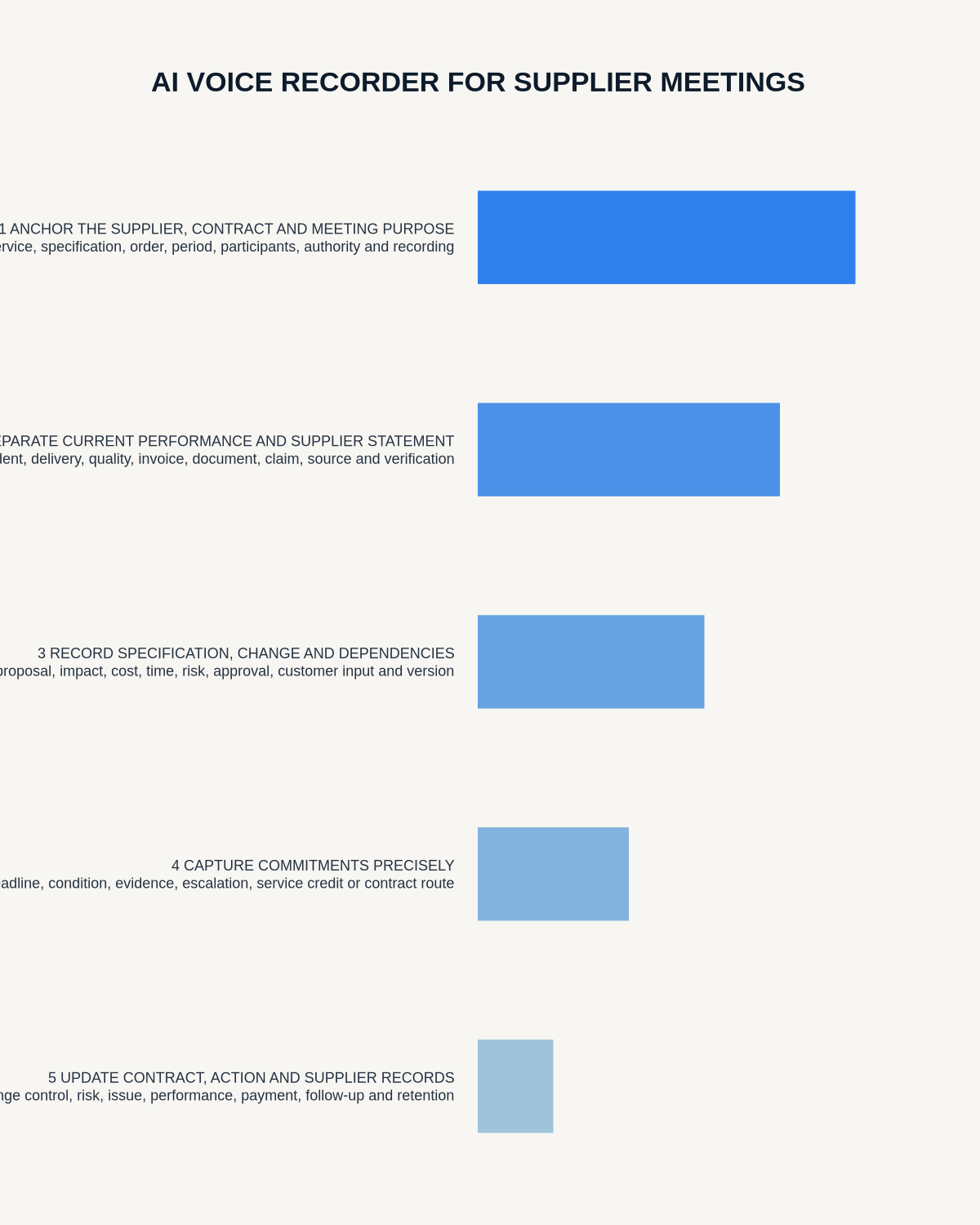
Every commitment should include one accountable owner, a visible deliverable, deadline, dependency, authority and evidence of completion. Examples include supplying a test report, confirming production capacity, issuing a revised quotation or replacing a failed sample.
At the end of the meeting, read back the exact commitment and ask the responsible person to confirm it.
Reconcile the audio with controlled documents
- Confirm participants and authority.
- Correct names, quantities, part numbers, units and dates.
- Link every material point to the relevant document revision.
- Separate proposals, assumptions, statements, evidence and commitments.
- Check commercial terms with authorised owners.
- Identify conflicts with the contract, purchase order or specification.
- Raise formal change requests where required.
- Move actions into the controlled system.
- Issue the checked supplier summary.
Do not let the transcript change the contract silently
If spoken discussion conflicts with an approved document:
- Do not edit the document informally.
- Record the conflict clearly.
- Identify the controlling document.
- Seek commercial or legal review where needed.
- Use the approved variation or change process.
- Confirm effective date and authorised sign-off.
The existing baseline remains in force until the authorised process changes it.
Create separate outputs
- Shared meeting summary: agreed facts, decisions, actions and open points.
- Internal commercial note: negotiating position, approval needs and risk.
- Controlled change record: approved specification, price, delivery or contract variation.
- Supplier action log: owner, deadline, evidence and status.
- Quality record: inspections, certificates, non-conformance and corrective actions.
Close the meeting explicitly
- Read back confirmed facts.
- State decisions and authority.
- List proposed changes separately.
- Confirm actions and deadlines.
- Identify documents to be issued.
- State which baseline remains current.
- Confirm when the next review occurs.
How NERALVO Halo fits supplier meetings
NERALVO Halo includes NOTE mode for suitable face-to-face meetings, supported CALL mode for compatible remote conversations where recording is lawful and disclosed, 64GB local storage, up to 35 hours of recording and Bluetooth sync with DOWAY. DOWAY can generate transcripts, summaries, speaker-separated notes, templates, translations, mind maps and exports, with one year of DOWAY Max included.
Halo can support portable permitted capture. The final supplier, quality, commercial and contract records should remain in approved systems.
Cloud software, a dedicated recorder or manual notes?
For Supplier Meetings, the right answer changes with the setting. This matrix deliberately gives each method a situation where it can be the strongest choice.
| Situation | Best starting point | Reason |
|---|---|---|
| scheduled remote meetings | Cloud meeting software | Auto-join and central collaboration can remove routine admin. |
| in-person or mobile work | Dedicated recorder | Dedicated hardware suits movement, variable rooms and offline source capture. |
| recording is refused or prohibited | Manual notes or an approved alternative | A clear alternative respects policy and participant choice. |
| mixed online and offline work | Governed hybrid | One governed process prevents gaps between desk and field work. |
Frequently asked questions
Does a recorded supplier promise automatically change the contract?
No. Use the authorised contractual and commercial process and obtain advice where needed.
Can AI identify every supplier commitment?
No. Conditional language, authority and document conflicts require human review.
Should internal negotiation notes be sent to the supplier?
No. Keep internal strategy and shared factual records separate.
Can the transcript replace quality records?
No. Use the controlled inspection, test, certificate and corrective-action records required by the process.
What should be sent after the meeting?
A concise checked summary of agreed facts, decisions, actions, owners, dates and unresolved points.
Final supplier-meeting checklist
- Meeting purpose and recording permission clear.
- Contract and specification references correct.
- Authority confirmed.
- Statements separated from evidence.
- Prices, quantities, units and dates verified.
- Commercial assumptions visible.
- Quality evidence and acceptance criteria defined.
- Delivery dependencies recorded.
- Risks and continuity actions owned.
- Changes controlled formally.
- Actions have owners, deadlines and completion evidence.
- Formal systems and documents updated.
Bottom line: AI can accelerate supplier-meeting review, but commercial and technical control still determines what was actually agreed.
Related guides
On this page
Related guides
See whether Halo fits this workflow
Review the NERALVO Halo specifications, included services, delivery information and current offer only after completing the guide.
Found an error or an out-of-date claim? Email support@neralvo.com with the article address and a supporting source.