The 60-second verdict
Quick answer: local councillors can use an AI voice recorder to turn approved surgeries, calls, community meetings and walkabouts into checked casework and action notes, but constituent data, political discussion and official public-meeting records require clear separation.
Best fit: Local Councillors who need recoverable audio and human-verified notes in an authorised workflow. Use another method when: recording is prohibited, a participant declines or the approved process requires manual notes.
Evidence basis and limits
- Decision factors covered: Casework needs a minimum useful record; Surgeries: record the action, not the whole life story; Use a controlled casework workflow.
- Evidence rule: Claims are weighted by consequence: capture failure, changed meaning, access and recovery matter more than polished wording.
- Boundary: Examples and workflow recommendations must be tested with representative recordings, the intended users and the actual approval process before rollout.

Check whether NERALVO Halo fits local councillors work can support approved calls, office meetings, community debriefs and private action capture. It does not replace council casework, democratic or official minute systems.
Casework needs a minimum useful record
- Constituent or case reference.
- Contact date and channel.
- Issue raised.
- Relevant ward or location.
- What the person is asking the councillor to do.
- Documents, reference numbers or evidence offered.
- Consent or authority needed for referral.
- Action, destination and expected update.
Do not include unrelated personal history merely because it was discussed.
Surgeries: record the action, not the whole life story
Residents may explain a long chronology. Use the transcript only to identify material dates, organisations, evidence and the requested outcome.
| Section | Content |
|---|---|
| Problem | What is happening now |
| History | Only relevant dates and previous contacts |
| Evidence | Letters, reference numbers, photographs or other records |
| Requested outcome | What the constituent wants the councillor to seek or clarify |
| Authority | Permission required to contact another body or share information |
| Next action | Who will do what and by when |
Use a controlled casework workflow
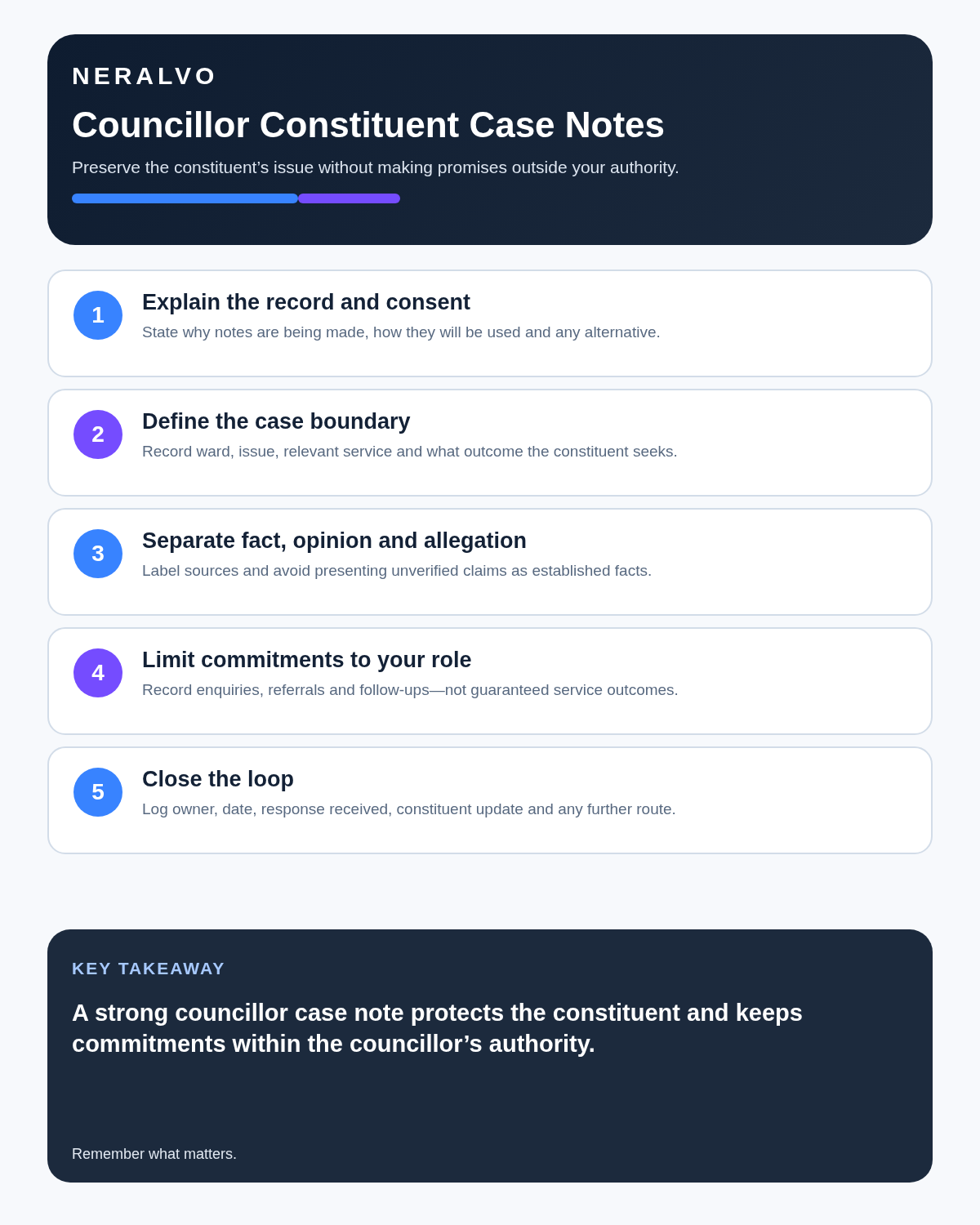
- Follow the council or office’s approved approach to recording.
- Explain the purpose, access and retention where recording is used.
- Identify the issue and requested outcome.
- Repeat reference numbers, names and key dates.
- Confirm what information may be shared and with whom.
- Generate a concise casework draft.
- Check names, references, evidence and actions.
- Enter the reviewed note into the authorised casework system.
- Send the referral or enquiry through the correct route.
- Record the response, next update and closure.
- Apply retention rules to audio and working drafts.
Public and community meetings
Recording may support action tracking where the meeting process permits it. The output should distinguish:
- Public questions.
- Officer or organiser responses.
- Formal decisions.
- Informal suggestions.
- Actions and owners.
- Matters referred elsewhere.
- Points requiring an official response or later verification.
An AI summary is not the official minute unless adopted through the relevant process.
Do not merge political and casework records
A resident’s service complaint and political discussion may occur in the same conversation. Store and use information according to its purpose. Avoid allowing a general transcript to become a mixed record containing unnecessary political opinions, campaigning information and personal case details.
Route constituent service enquiries, democratic records, political correspondence and campaign information into their respective approved systems.
Community walkabouts
Short location-anchored notes may capture:
- Exact street, estate, asset or location.
- Issue directly observed.
- Resident-reported information kept separate.
- Photograph or evidence reference.
- Responsible service to confirm.
- Urgency or immediate safety concern.
- Follow-up action, owner and update date.
Use a post-event debrief where recording people nearby would be unnecessary or inappropriate. Immediate danger should be reported through the emergency route before note-taking.
Preserve source and evidence status
- Constituent reported: attributed account.
- Councillor observed: direct observation.
- Document supplied: evidence received but not necessarily verified.
- Service confirmed: response from the responsible body.
- Formal decision: decision made through the authorised process.
- Open question: point still awaiting evidence or response.
Do not let AI turn a resident’s allegation into an established fact or an officer’s initial response into a final decision.
Handle disagreement fairly
Community meetings can be contentious. AI should not decide who was reasonable, infer political motive or summarise tone as fact. Record the substantive point, speaker or source where needed, evidence, response and next action. Preserve uncertainty and material minority views.
Protect constituent information
Casework may include health, housing, immigration, financial, family and safeguarding information. Record only what is necessary for the stated purpose. Avoid passwords, payment data, unnecessary identity details and unrelated third-party information.
Use restricted access and the approved referral route. A councillor should not copy the full transcript into email, chat and several systems where a concise case note is sufficient.
Close the loop
Each case should show the enquiry sent, receiving organisation, date, expected response, interim update, response received, action communicated to the constituent and whether the matter is closed, referred or awaiting further evidence.
Do not promise an outcome controlled by another body. Promise only the next action or update the councillor can deliver.
How NERALVO Halo fits local councillor work
NERALVO Halo includes NOTE mode, supported CALL mode, 64GB local storage, up to 35 hours of recording and Bluetooth sync with DOWAY. CALL mode is not universal, so test the exact phone, case and route.
DOWAY can create transcripts, summaries, speaker-separated notes, templates, translations, mind maps and exports, with one year of DOWAY Max included. Use only within relevant council, office, data-handling and public-meeting procedures.
Cloud software, a dedicated recorder or manual notes?
For Local Councillors, the right answer changes with the setting. This matrix deliberately gives each method a situation where it can be the strongest choice.
| Situation | Best starting point | Reason |
|---|---|---|
| scheduled remote meetings | Cloud meeting software | Calendar automation and shared integrations are usually the strongest advantage. |
| in-person or mobile work | Dedicated recorder | Independent capture reduces reliance on an active phone or laptop. |
| recording is refused or prohibited | Manual notes or an approved alternative | The boundary takes priority over convenience. |
| mixed online and offline work | Governed hybrid | Use each method only in the setting it actually fits. |
Frequently asked questions
Should every constituent conversation be recorded?
No. Use ordinary notes where they meet the purpose with less intrusion.
Does an AI summary become the official public-meeting minute?
No. Official minutes follow the relevant democratic or organisational process.
Can political opinions be stored in the constituent case record?
Only where genuinely necessary for the casework purpose. Keep political and service records separate.
Can a councillor promise that a council service will take a particular action?
Only where the councillor has the relevant authority. Otherwise record the enquiry and next update, not a guaranteed outcome.
Final casework checklist
- Requested outcome clear.
- Names, dates and references checked.
- Source and evidence status visible.
- Authority for referral recorded.
- Political and casework records separated.
- Public questions, formal decisions and informal suggestions distinguished.
- Walkabout issues linked to exact locations and evidence.
- Disagreement and uncertainty preserved.
- Each action has an owner and update date.
- Unnecessary personal detail removed.
- Constituent received an appropriate update or closure.
Bottom line: for local councillors, an AI recorder should produce proportionate casework and accountable actions—not a permanent archive of every conversation.
Related guides
See the guides for housing officers, planning officers and community engagement.
On this page
Related guides
See whether Halo fits this workflow
Review the NERALVO Halo specifications, included services, delivery information and current offer only after completing the guide.
Found an error or an out-of-date claim? Email support@neralvo.com with the article address and a supporting source.