The 60-second verdict
Quick answer: community engagement officers can use an AI voice recorder to preserve authorised public feedback, then convert each issue into a feedback-evidence-status-action-response record. Repeated comments, minority views, authority levels and promised follow-up must be handled explicitly so consultation does not become a transcript archive or false consensus.
Best fit: Community Engagement Officers who need recoverable audio and human-verified notes in an authorised workflow. Use another method when: recording is prohibited, a participant declines or the approved process requires manual notes.
Evidence basis and limits
- Decision factors covered: Set context and transparency first; Use a feedback-to-action matrix; Handle repeated feedback accurately.
- Evidence rule: Claims are weighted by consequence: capture failure, changed meaning, access and recovery matter more than polished wording.
- Boundary: Examples and workflow recommendations must be tested with representative recordings, the intended users and the actual approval process before rollout.
Good engagement records show what people said, what evidence exists, what the organisation can actually do and how each issue was closed. Recording can reduce missed detail, but it must remain transparent, inclusive and proportionate.

Set context and transparency first
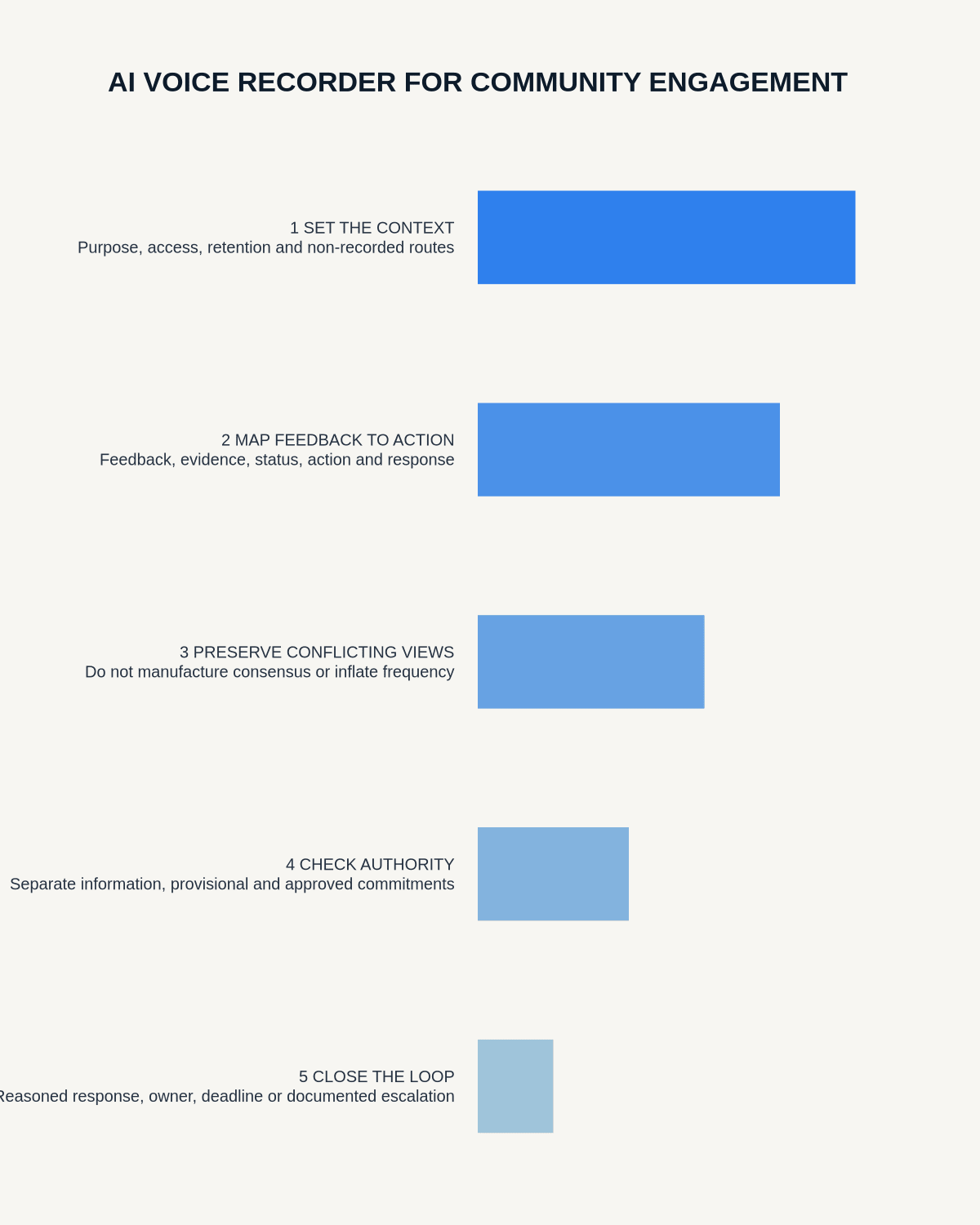
Explain the session purpose, recording use, access and retention. Offer a non-recorded contribution route. Start each file with project, place, date, session type, facilitator and participant group.
Avoid collecting names, addresses or sensitive personal details unless necessary. Use participant codes or broad descriptors where suitable.
Use a feedback-to-action matrix
- Feedback: concern, experience or suggestion in neutral language.
- Evidence: documents, photographs, observations or service data.
- Status: confirmed, partly confirmed, disputed, outside scope or awaiting evidence.
- Action: the next step.
- Response: what will be communicated, by whom and when.
This prevents a concern from becoming a confirmed fact or an acknowledgment from becoming an approved promise.
Handle repeated feedback accurately
Group comments describing the same issue while preserving the number and type of independent sources. Do not count repeated statements from one participant as several independent views.
Frequency matters, but it is not the only measure of importance.
Preserve conflicting and minority views
Record competing positions and the reasons behind them. A proposal may benefit one group while creating access, cost, noise or displacement concerns for another.
Do not manufacture consensus by removing dissent or presenting the most frequent comment as the only legitimate outcome.
Include underrepresented voices
Record barriers affecting disabled people, carers, older residents, people with limited English and digitally excluded participants. Note the accessible formats and routes offered.
Silence does not prove agreement. Where participation is uneven, document the limitation and plan targeted follow-up.
Separate authority from aspiration
- Information only: explanation of current policy or process.
- Action for review: request requiring assessment.
- Provisional commitment: intended action subject to checks.
- Approved commitment: authorised action with owner and deadline.
Staff should not promise outcomes outside their authority. Record referrals to other organisations and what is needed for a useful handover.
Close the feedback loop
Provide a reasoned response for each material issue. Explain when a request cannot be accepted and link the decision to evidence, policy, budget or scope.
Closure means the participant or community has received a response, or a documented escalation remains active—not simply that the note was filed.
Use a controlled post-session workflow
- Transfer audio to the approved workspace.
- Correct names, places, dates and numbers.
- Remove unnecessary personal information.
- Code issues into the feedback matrix.
- Assign authority, owners and response dates.
- Publish or send an accessible response.
- Delete source audio when the approved purpose ends.
Cloud software, a dedicated recorder or manual notes?
For Community Engagement Officers, the right answer changes with the setting. This matrix deliberately gives each method a situation where it can be the strongest choice.
| Situation | Best starting point | Reason |
|---|---|---|
| scheduled remote meetings | Cloud meeting software | Calendar automation and shared integrations are usually the strongest advantage. |
| in-person or mobile work | Dedicated recorder | Independent capture reduces reliance on an active phone or laptop. |
| recording is refused or prohibited | Manual notes or an approved alternative | The boundary takes priority over convenience. |
| mixed online and offline work | Governed hybrid | Use each method only in the setting it actually fits. |
Frequently asked questions
Can repeated comments be counted separately?
Only when they come from genuinely independent sources.
Does silence mean agreement?
No. It may reflect access barriers, limited trust or an unsuitable engagement method.
When is a public commitment valid?
When it is authorised, specific and linked to an owner, deadline and dependencies.
Should raw recordings be published?
Normally not. Publish a checked, minimised and accessible response through the approved process.
Useful resources
- GOV.UK guidance on planning accessible public content
- AI Voice Recorder for Urban Designers
- AI Voice Recorder for Transport Planners
- Check whether NERALVO Halo fits community engagement officers work
Engagement checklist
- Recording transparency and alternative route provided
- Feedback and evidence separated
- Repeated comments counted fairly
- Conflicting and minority views visible
- Accessibility gaps documented
- Commitments carry correct authority status
- Every action has owner and response date
- Each open issue has a response or escalation
On this page
Related guides
See whether Halo fits this workflow
Review the NERALVO Halo specifications, included services, delivery information and current offer only after completing the guide.
Found an error or an out-of-date claim? Email support@neralvo.com with the article address and a supporting source.