The 60-second verdict
Quick answer: museum curators can use an authorised AI voice recorder for donor interviews, provenance discussions, condition reviews and exhibition decisions. Every spoken claim must be attached to the correct object, attributed to its source, given an evidence status and reviewed before entering the collections-management system.
Best fit: Museum Curators who need recoverable audio and human-verified notes in an authorised workflow. Use another method when: recording is prohibited, a participant declines or the approved process requires manual notes.
Evidence basis and limits
- Decision factors covered: Anchor every recording to an object or project; Separate five evidence types; Capture donor knowledge before it disappears.
- Evidence rule: Claims are weighted by consequence: capture failure, changed meaning, access and recovery matter more than polished wording.
- Boundary: Examples and workflow recommendations must be tested with representative recordings, the intended users and the actual approval process before rollout.

Museum objects carry information held across catalogues, documents, photographs and human memory. Recording can preserve knowledge that might otherwise disappear, but a transcript is not itself a collection record.
Anchor every recording to an object or project
State the accession or temporary object number, object name, meeting purpose, date, participants and documents or photographs being discussed. Announce a new identifier whenever the conversation moves to another object.
Separate five evidence types
| Type | Treatment |
|---|---|
| Documentary evidence | Reference and verify receipts, catalogues, correspondence or records |
| Attributed oral account | Record speaker and basis of knowledge |
| Institutional record | Check record history and source |
| Professional interpretation | State evidence, reasoning and reviewer |
| Unresolved claim | Preserve uncertainty and create a research action |
Capture donor knowledge before it disappears
Ask how and when the object was acquired, who and what it is connected to, how it was used or stored, whether it was repaired or altered, which documents survive, which names or local terms matter and what remains uncertain. Ask how the person knows each point.
Record condition information precisely
Describe visible condition, exact location and linked evidence before discussing cause or treatment. Reference photographs, reports and handling restrictions aloud. Separate observation, reported history, suspected cause, specialist recommendation and approved action.
Keep loan discussion separate from formal approval
Use status labels including borrower request, lender preference, condition under review, specialist recommendation, approved loan condition and formal agreement completed. Informal comfort is not contractual approval.
Preserve contested interpretation
Record the interpretive question, evidence supporting each view, communities or specialists consulted, disputed terminology, uncertainty, decision authority, final approved wording and review date. Do not allow a summary to create certainty or consensus that the meeting did not produce.
Record rights and restrictions beside the content
- Rights in the audio and quoted speech.
- Copyright in documents and images shown.
- Personal and family information.
- Culturally sensitive knowledge.
- Online publication and reuse.
- Access restrictions and closure periods.
Permission to speak does not automatically authorise unrestricted reuse.
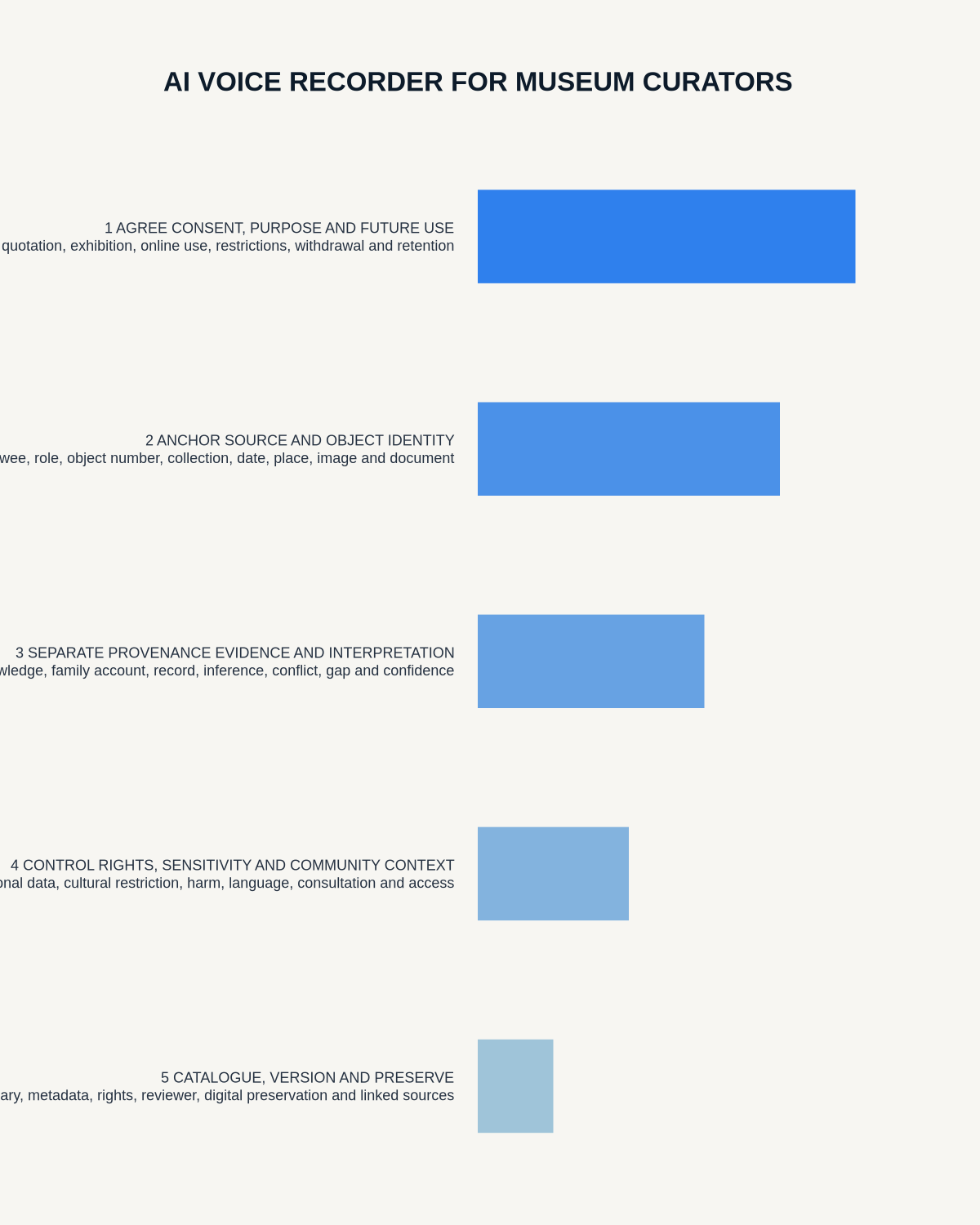
Move only reviewed information into collection records
- Confirm purpose and participant arrangements.
- State object and project references.
- Use source labels during provenance discussion.
- Reference evidence aloud.
- Generate and correct the transcript.
- Extract verified facts, attributed accounts and research leads separately.
- Review rights and sensitivity.
- Update the collections system through its normal approval process.
- Preserve or delete audio under policy.
Where NERALVO Halo fits
Check whether NERALVO Halo fits museum curators work can support approved donor interviews, object-research sessions, loan meetings and exhibition debriefs through portable NOTE recording, 64GB local storage and DOWAY structured notes. The museum remains responsible for the permitted data route and long-term record.
Cloud software, a dedicated recorder or manual notes?
For Museum Curators, the right answer changes with the setting. This matrix deliberately gives each method a situation where it can be the strongest choice.
| Situation | Best starting point | Reason |
|---|---|---|
| scheduled remote meetings | Cloud meeting software | Calendar automation and shared integrations are usually the strongest advantage. |
| in-person or mobile work | Dedicated recorder | Independent capture reduces reliance on an active phone or laptop. |
| recording is refused or prohibited | Manual notes or an approved alternative | The boundary takes priority over convenience. |
| mixed online and offline work | Governed hybrid | Use each method only in the setting it actually fits. |
Frequently asked questions
Can an AI transcript be pasted directly into the object record?
No. It must be attributed, verified, minimised and rights-checked first.
Should contested interpretations be simplified?
No. Material disagreement and uncertainty should remain visible.
Can donor comments be published automatically?
No. Publication and quotation rights require separate review.
Can oral history prove provenance?
It can provide evidence or research leads but should be assessed alongside documentary and collection records.
Should source audio be retained permanently?
Only under the museum’s approved preservation, rights and retention decision.
Authoritative guidance and related reading
- Collections Trust Spectrum standard
- Museums Association
- AI Voice Recorder for Archivists
- AI Voice Recorder for Auctioneers
Final collection-record checklist
- Correct object reference attached
- Provenance claims source-labelled
- Condition observations linked to evidence
- Loan discussion separated from approval
- Contested interpretations preserved
- Rights and restrictions recorded
- Reviewed information entered into the authorised system
On this page
More in this topic: Heritage, service and creative work
Show 8 closely related guides
- AI Voice Recorder for Translators and Interpreters: Better Terminology, Review and Handover
- AI Voice Recorder for Genealogists: Better Family Interviews and Source Control
- AI Voice Recorder for Funeral Directors: Clearer Family Arrangements and Service Notes
- AI Voice Recorder for Faith Leaders: Pastoral Notes, Sermons and Community Follow-Up
- AI Voice Recorder for Chefs: Better Recipe Development and Kitchen Briefings
- AI Voice Recorder for Salon Owners: Better Consultations and Team Handover
- How Tour Guides Can Build Better Tours from Research and Rehearsal Notes
- AI Voice Recorder for Landscapers: Garden Briefs, Site Surveys and Maintenance Notes
Related guides
See whether Halo fits this workflow
Review the NERALVO Halo specifications, included services, delivery information and current offer only after completing the guide.
Found an error or an out-of-date claim? Email support@neralvo.com with the article address and a supporting source.