The 60-second verdict
Planning officers move between site visits, applicant meetings, public representations and internal discussions. An AI voice recorder can speed up factual site notes and action tracking, but it must not turn informal conversation into a planning decision or replace the authority’s formal record.
Best fit: Planning Officers who need recoverable audio and human-verified notes in an authorised workflow. Use another method when: recording is prohibited, a participant declines or the approved process requires manual notes.
Evidence basis and limits
- Decision factors covered: Use a location-led site note; Site-note structure; Applicant and agent meetings.
- Evidence rule: The decision is based on the complete capture-to-action workflow, not a single feature or marketing accuracy percentage.
- Boundary: Examples and workflow recommendations must be tested with representative recordings, the intended users and the actual approval process before rollout.
Use a location-led site note
On site, record observations in a consistent order:
- application or site reference
- date, time and weather where relevant
- viewpoint or location
- what is directly visible
- relationship to neighbouring land or buildings
- access limits
- photograph number
- matter requiring verification
Keep direct observation separate from statements made by applicants, agents, neighbours or other parties.
Site-note structure
| Field | Example |
|---|---|
| Viewpoint | Rear boundary looking north |
| Observation | Upper-floor window visible above fence line |
| Photo | Image 12 |
| Reported information | Agent states fence height is 1.8m |
| To verify | Scale drawing and boundary position |
| Potential relevance | To consider through normal assessment |
Avoid dictating a conclusion before the full application, policy context and representations have been reviewed.
Applicant and agent meetings
A useful note distinguishes:
- proposal as currently presented
- questions asked by the officer
- clarifications supplied
- possible amendments discussed
- documents promised
- points explicitly not agreed
- next procedural step
Language such as “may assist,” “subject to assessment” and “no commitment given” should not disappear from the summary.
Public representations
When residents explain concerns verbally, preserve the substantive planning point and source. Avoid storing unnecessary personal or emotional detail in the final note.
Separate:
- issue raised
- location affected
- evidence or document referenced
- matter outside the planning process
- follow-up or signposting provided
Internal case discussion
AI can draft an action log from a case conference, but the final decision record must follow the authority’s established process. Record:
- issue requiring discussion
- evidence considered
- options
- further information required
- action owner
- review or decision route
A practical workflow
- Use the authority’s approved approach to recording.
- State application reference and purpose.
- Use location-led observations on site.
- Reference photographs aloud.
- Record third-party statements as attributed information.
- Generate a transcript and site-note draft.
- Check addresses, references and photo numbers.
- Integrate only relevant facts into the case file.
- Record assessment and decision separately through normal procedures.
- Apply retention rules to source audio.
Committee and public meetings
Where meeting recording is already governed by formal arrangements, a personal recorder should not create an uncontrolled parallel record. AI may assist the authorised minute or action process only within the relevant procedure.
Where NERALVO Halo fits
NERALVO Halo can support approved site dictation, applicant calls and internal debriefs. Its current specification includes 64GB local storage, NOTE and CALL modes, up to 35 hours of recording and Bluetooth transfer to DOWAY.
DOWAY can generate transcripts, summaries, speaker-separated notes, templates, translations and mind maps. CALL mode compatibility varies by phone and route.
Use only within the planning authority’s approved recording, information-management and case-file procedures.
Review the current NERALVO Halo details.
Planning-note quality check
- Is every observation tied to a location?
- Are photographs referenced correctly?
- Are third-party statements attributed?
- Are informal discussions separated from decisions?
- Are matters to verify visible?
- Has unnecessary personal information been removed?
Cloud software, a dedicated recorder or manual notes?
For Planning Officers, the right answer changes with the setting. This matrix deliberately gives each method a situation where it can be the strongest choice.
| Situation | Best starting point | Reason |
|---|---|---|
| scheduled remote meetings | Cloud meeting software | Native remote-meeting workflows can be more efficient here. |
| in-person or mobile work | Dedicated recorder | A separate battery and recoverable local source improve resilience. |
| recording is refused or prohibited | Manual notes or an approved alternative | Manual notes are the correct control when recording is unavailable. |
| mixed online and offline work | Governed hybrid | A hybrid can combine automation with reliable physical capture. |
Related guides
Bottom line
For planning officers, an AI recorder is most useful as a disciplined field-note and action-capture tool. It should strengthen factual traceability while leaving assessment, judgement and the formal decision record to the authorised planning process.
Profession workflow
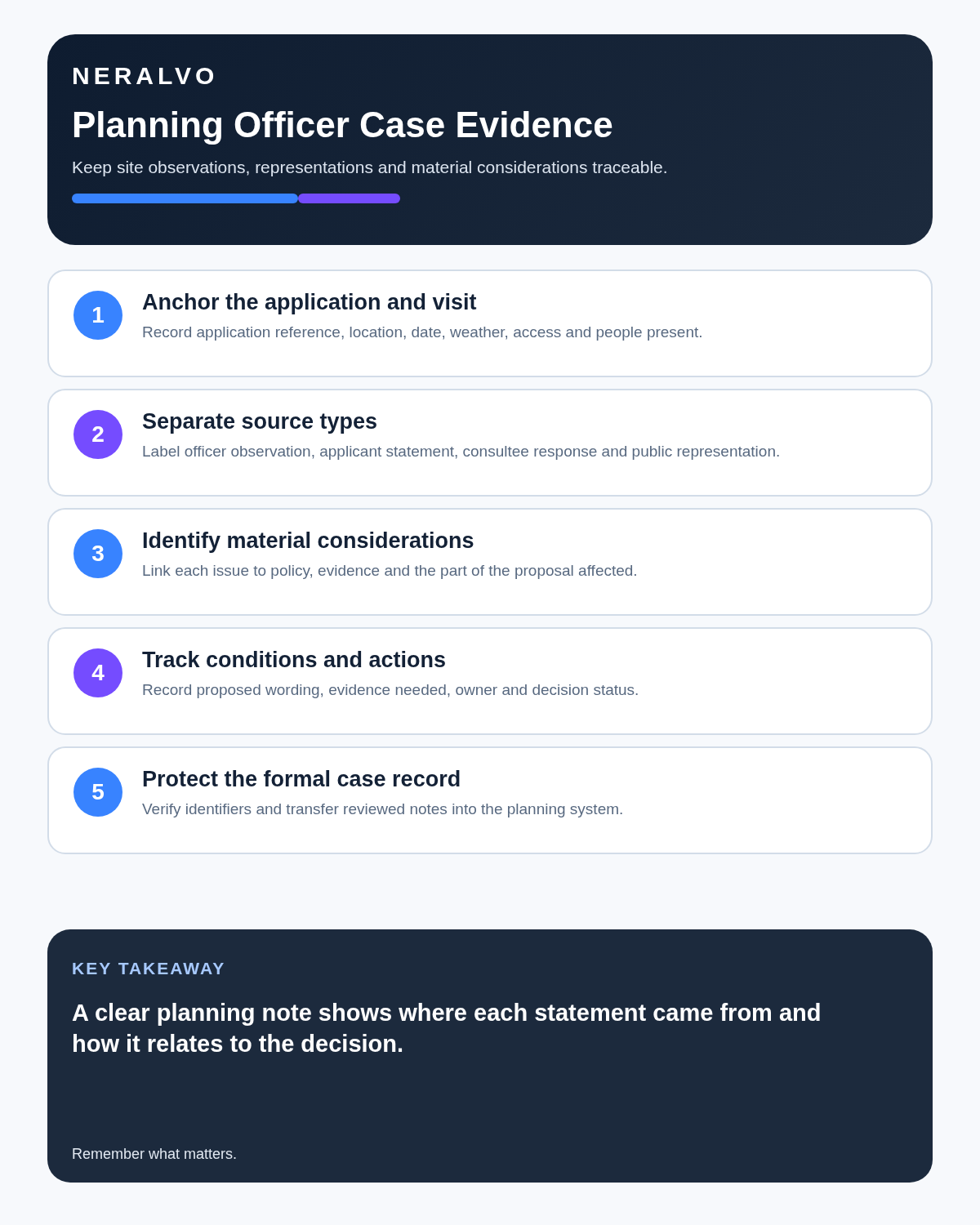
Visual map for AI Voice Recorder for Planning Officers: Better Consultations and Case Notes
- Prepare the approved useDefine purpose, safe position, permission and the required formal record.
- Capture context firstState the case, asset, person, location or event identifier before detail.
- Human-verify evidenceCheck technical terms, units, names, dates, decisions and uncertainty.
- Complete the formal recordTransfer only verified information and apply access and retention controls.
On this page
Related guides
See whether Halo fits this workflow
Review the NERALVO Halo specifications, included services, delivery information and current offer only after completing the guide.
Found an error or an out-of-date claim? Email support@neralvo.com with the article address and a supporting source.