The 60-second verdict
Quick answer: loss adjusters can use an AI voice recorder to create a disciplined site diary, but every note must remain linked to an exact location, source, photograph, measurement, uncertainty and next action. Recording cannot determine causation, coverage or claim outcome.
Best fit: Loss Adjusters who need recoverable audio and human-verified notes in an authorised workflow. Use another method when: recording is prohibited, a participant declines or the approved process requires manual notes.
Evidence basis and limits
- Decision factors covered: Use voice capture as a site diary, not a running conclusion; Use a field-note structure that survives handover; Keep policyholder statements separate.
- Evidence rule: Claims are weighted by consequence: capture failure, changed meaning, access and recovery matter more than polished wording.
- Boundary: Examples and workflow recommendations must be tested with representative recordings, the intended users and the actual approval process before rollout.

Check whether NERALVO Halo fits loss adjusters work can support deliberate field dictation, authorised interviews and post-visit debriefs. The claim, evidence, safety and report systems remain authoritative.
Use voice capture as a site diary, not a running conclusion
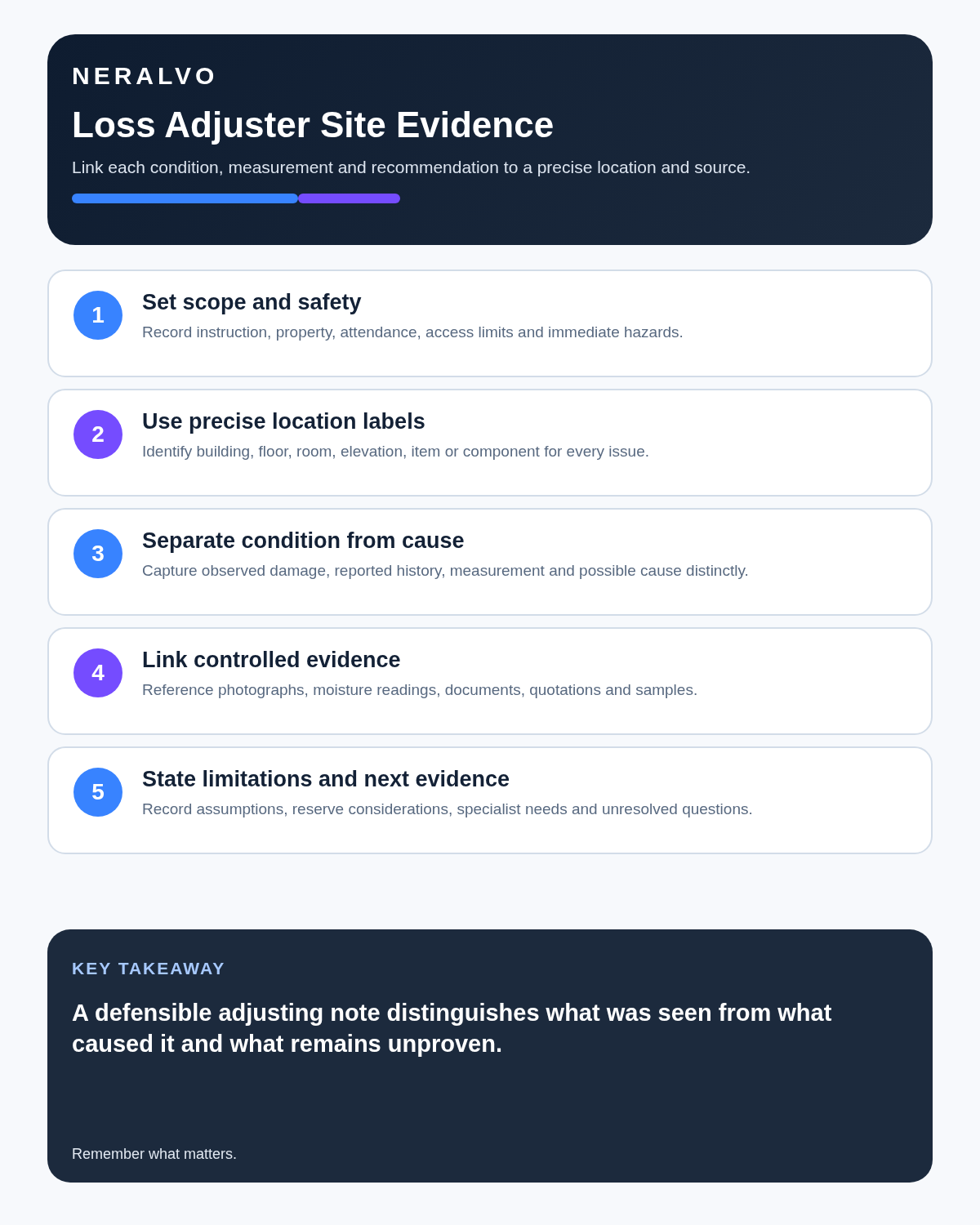
During an inspection, dictate observations in a neutral sequence:
- Identify the room, elevation, zone, item or component.
- State what is directly visible.
- Record measurements and source references.
- Name the related photograph, video or document.
- Separate reported history from direct observation.
- Mark uncertainty, access limits and further evidence needed.
- State the next action and owner.
“Water staining visible on the north wall, photograph 14” is stronger than “leak caused by the roof.” Causation may require further inspection or specialist opinion.
Use a field-note structure that survives handover
| Field | Example content |
|---|---|
| Location | Kitchen, rear elevation, roof void or insured item |
| Observation | Visible cracking, staining, displacement or damage |
| Source | Adjuster observation, policyholder account, contractor comment or document |
| Evidence link | Photo, video, document, sample or measurement reference |
| Uncertainty | Cause not established, access restricted or date unverified |
| Potential relevance | Issue requiring assessment without prejudging coverage |
| Next action | Engineer review, estimate, document request or further inspection |
Keep policyholder statements separate
A transcript can help preserve when damage was first noticed, what happened immediately beforehand, previous repairs, mitigation steps, occupancy and access, and documents or photographs available.
Check names, dates and sequence, then label the information as reported rather than independently verified. Do not rewrite recollection as established chronology.
Link spoken notes to photographs and measurements
Use a consistent phrase such as “Photo 23, bedroom ceiling, east side.” For measurements, state the location, value, unit, method, instrument where relevant and operating or environmental condition.
After the visit, confirm that image numbers, room names, measurements and transcript references agree. AI must not invent a link between an observation and an image.
Separate condition, cause and coverage
- Condition: what is directly observed or measured.
- Reported event: policyholder or witness account.
- Possible cause: provisional explanation requiring evidence.
- Specialist opinion: attributed technical interpretation with scope and limitations.
- Coverage consideration: issue for the authorised policy assessment.
- Claim decision: outcome made through the insurer’s controlled process.
An AI summary must not convert a visible condition into a cause or a cause hypothesis into a coverage decision.
Handle noisy and hazardous environments safely
Wind, machinery, PPE and movement can reduce intelligibility and attention. Run a short test, position the recorder away from clothing friction, avoid speaking while moving through hazards or extreme noise, and repeat critical dimensions in a quieter safe location.
Recording must never distract from site safety, structural hazards, contamination, water, electricity, fire damage or other controls.
Record access and evidence limitations
State areas not inspected, items concealed, unsafe or inaccessible locations, destructive inspection not undertaken, documents unavailable, weather or lighting limitations and assumptions still in use.
An uninspected area should not disappear from a smooth summary. Limitations determine what conclusions can reasonably be drawn.
Use a controlled post-visit report workflow
- Confirm the complete recording and all media files.
- Rename and store them by claim, date and site through the approved route.
- Generate the transcript.
- Separate observations, reported information, specialist opinion and hypotheses.
- Match photographs, measurements and documents.
- Create an issues list and evidence request.
- Draft report sections with limitations and source status visible.
- Check names, dates, values and material statements against the source.
- Complete any authorised causation and coverage assessment separately.
- Store the approved output in the claim system and control temporary audio.
Control contractor and expert discussions
When a contractor or specialist proposes scope, cost or cause, record:
- What they inspected.
- Their role and basis of knowledge.
- Assumptions and limitations.
- Excluded work.
- Estimated quantities and rates.
- Timescale and access requirements.
- Temporary protection or mitigation.
- Who will provide the written estimate or report.
- Whether the proposal is accepted, rejected or still under review.
Do not let an AI summary merge a contractor’s proposal with the adjuster’s assessment or an insurer’s decision.
Build a clear evidence request
For each unresolved issue, identify the exact document, photograph, statement, invoice, maintenance record, expert report or other evidence required; who should provide it; why it matters; and the deadline or review point.
A generic request for “more information” is difficult to close.
Protect claimant and property information
Recordings may reveal addresses, security arrangements, health information, financial circumstances, household details and damage vulnerabilities. Use approved accounts, restrict access, minimise identifiers and avoid unnecessary ambient capture.
Raw audio should not be circulated where a checked extract or final report is sufficient.
How NERALVO Halo fits loss adjusting
NERALVO Halo includes NOTE mode, supported CALL mode, 64GB local storage, up to 35 hours of recording and Bluetooth sync with DOWAY. DOWAY can create transcripts, summaries, speaker-separated notes, templates, translations, mind maps and exports, with one year of DOWAY Max included.
Use the device only within the firm’s approved recording, safety, privacy and evidence-handling procedures. CALL mode is not universal, so test the exact handset, case and call route.
Cloud software, a dedicated recorder or manual notes?
For Loss Adjusters, the right answer changes with the setting. This matrix deliberately gives each method a situation where it can be the strongest choice.
| Situation | Best starting point | Reason |
|---|---|---|
| scheduled remote meetings | Cloud meeting software | Calendar automation and shared integrations are usually the strongest advantage. |
| in-person or mobile work | Dedicated recorder | Independent capture reduces reliance on an active phone or laptop. |
| recording is refused or prohibited | Manual notes or an approved alternative | The boundary takes priority over convenience. |
| mixed online and offline work | Governed hybrid | Use each method only in the setting it actually fits. |
Frequently asked questions
Can AI determine the cause of damage?
No. It can organise observations and hypotheses, but causation requires appropriate evidence and professional assessment.
Can a contractor’s view be copied into the adjuster’s conclusion?
No. Attribute it, record scope and limitations, and assess it through the authorised process.
Does an accurate transcript prove policy coverage?
No. Coverage depends on the policy, verified facts and the authorised claim decision.
Should every site recording be retained?
No. Apply the firm’s evidence and retention rules separately to source audio, working transcripts and the approved claim record.
Final site-record checklist
- Every observation has an exact location.
- Photographs, measurements and documents are referenced correctly.
- Reported history is separated from direct observation.
- Condition, possible cause, specialist opinion and coverage remain distinct.
- Names, dates and measurements are verified.
- Access limits and evidence gaps are explicit.
- Contractor proposals are attributed and status-labelled.
- Evidence requests have owners and deadlines.
- Approved report entered the claim system.
- Source audio and drafts are controlled.
Bottom line: an AI recorder helps loss adjusters most when it strengthens the evidence trail without turning early impressions into unsupported conclusions.
Related guides
See the guides for claims handlers, building surveyors and insurance brokers.
On this page
Related guides
See whether Halo fits this workflow
Review the NERALVO Halo specifications, included services, delivery information and current offer only after completing the guide.
Found an error or an out-of-date claim? Email support@neralvo.com with the article address and a supporting source.