The 60-second verdict
A forty-five-minute site meeting can create months of commercial work. A wall build-up changes. Access is delayed. The contractor proposes an alternative. The client asks for a price “as soon as possible”. Everyone leaves with a slightly different understanding of what was instructed and what remains only a proposal.
Best fit: Quantity Surveyors who need recoverable audio and human-verified notes in an authorised workflow. Use another method when: recording is prohibited, a participant declines or the approved process requires manual notes.
Evidence basis and limits
- Decision factors covered: Why site discussion becomes commercial risk; Use a variation status ladder; A commercial capture sheet.
- Evidence rule: The decision is based on the complete capture-to-action workflow, not a single feature or marketing accuracy percentage.
- Boundary: Examples and workflow recommendations must be tested with representative recordings, the intended users and the actual approval process before rollout.
An AI voice recorder for quantity surveyors can preserve the wording and context of authorised site and commercial meetings. Its value is not a longer set of minutes. It is a clearer path from conversation to variation register, cost report, decision log and formal notice.
Why site discussion becomes commercial risk
Spoken construction language is often deliberately provisional. Phrases such as “look at”, “price”, “proceed if”, “we should be able to” and “subject to design approval” carry different levels of commitment. A summary can accidentally flatten them into “agreed”.
For every commercial issue, the note should answer:
- What physical work or obligation is affected?
- Who raised it?
- What evidence or drawing was referenced?
- Was it a request, proposal, recommendation, instruction or approval?
- What cost and programme information is known?
- Which formal step is required next?
Use a variation status ladder
- Potential change: an issue may alter scope or cost.
- Information required: design, quantity or responsibility is unclear.
- Proposal requested: the contractor or consultant is asked to develop an option.
- Quotation submitted: cost and programme effect have been provided.
- Under review: the proposal is being assessed.
- Instruction issued: the authorised contractual route has been used.
- Valuation agreed: the commercial value has been determined through the process.
- Disputed: entitlement, scope, value or time remains contested.
The transcript can support the movement between stages, but it should never move an item automatically.
A commercial capture sheet
| Field | What belongs there |
|---|---|
| Issue reference | Unique number linked to meeting item or variation register |
| Location and scope | Area, element, drawing and work affected |
| Trigger | Design development, client request, site condition, error or other cause |
| Statement status | Request, proposal, recommendation, instruction or approval |
| Cost basis | Quantity, rate, quotation, allowance or estimate |
| Programme effect | Stated impact, dependency and evidence required |
| Contract route | Notice, instruction, quotation or assessment required |
| Owner and date | Named person and next deadline |
Read numbers aloud, then verify them elsewhere
Quantity surveyors work with values that speech recognition frequently mishears: drawing revisions, dimensions, quantities, percentages, rates and dates. Repeat important numbers with their unit and context.
“Provisional quantity is one hundred and eighty square metres, subject to take-off from drawing A-142 revision C.”
The transcript is still not the measurement record. Check the drawing, take-off, bill, quotation or cost system before the figure enters a valuation or report.
Keep entitlement, valuation and payment separate
Commercial discussions often mix three different questions:
- Entitlement: is there a contractual basis for the claim or change?
- Valuation: what is the correct amount?
- Payment: when and through which process does the amount become payable?
An AI summary may turn a discussion of probable cost into an apparent agreement to pay. The reviewed note should show which question was actually addressed.
Capture the assumption behind every estimate
An estimate without assumptions is difficult to challenge later. Record:
- scope included and excluded
- quantity basis
- rates or quotations used
- access and working-hour assumptions
- preliminaries and programme basis
- design information outstanding
- risk and contingency
- expiry or review date
If the estimate changes, the team can then see which assumption changed rather than arguing over the original conversation.
Use the meeting recap as a control point
At the end of each commercial section, read back:
- the issue
- the current status
- what has not been agreed
- the required document or action
- the owner
- the deadline
This creates a clearer source and allows participants to correct misunderstandings while everyone is present.
From recording to commercial systems
The transcript should be broken into controlled outputs:
- variation register updates
- cost-report commentary
- risk or opportunity items
- information requests
- formal notices or instructions to draft
- payment or valuation actions
- decision-log entries
Do not circulate the raw transcript as a substitute for these records. It may include confidential rates, personal comments, duplicated discussion and unapproved statements.
A post-meeting workflow for quantity surveyors
- Confirm recording authority and the purpose of capture.
- State the project, meeting date and participants.
- Use issue references during the discussion.
- Mark status words clearly: “proposal”, “not instructed”, “to price”, “approved subject to”.
- Repeat critical figures and drawing references.
- Generate and review the transcript promptly.
- Check numbers against drawings, quotations and cost systems.
- Update the variation, risk and action registers.
- Prepare formal communications through the contract process.
- Apply project retention and access controls to the source audio.
Recording is not contractual authority
A spoken comment does not replace the notice, certificate, instruction, assessment or approval required by the contract. Even where the recording proves what was said, the commercial effect depends on the contract and the authorised process.
Use the transcript to improve contemporaneous evidence and reduce misunderstanding. Do not describe a discussion as legally binding unless the appropriate professional review supports that conclusion.
How NERALVO Halo may support site and commercial meetings
View Halo specifications for quantity surveyors use provides portable recording, 64GB local storage and DOWAY transcription and summary tools. It may help a quantity surveyor focus on the commercial discussion, then recover exact wording and actions afterwards.
Test performance in site cabins, open-plan meetings and locations with machinery or echo. Establish how recordings link to project references and who can access commercially sensitive output. The related contract manager guide covers obligation and change-control language in more detail.
Commercial-note review
- Is the physical scope and location clear?
- Is the status of the discussion correctly labelled?
- Are drawing references, quantities, rates and dates verified?
- Are entitlement, valuation and payment separated?
- Are assumptions visible?
- Has every required formal step been identified?
- Do actions have owners and deadlines?
An AI recorder can help quantity surveyors preserve the commercial context that ordinary minutes lose. The benefit appears when the reviewed conversation becomes precise registers, notices, valuations and decisions—not when a transcript is mistaken for the contract.
Source check: For quantity-surveying work, align any recording workflow with the organisation's professional procedures and the relevant RICS standards. Read the official RICS Black Book guidance.
Cloud software, a dedicated recorder or manual notes?
For Quantity Surveyors, the right answer changes with the setting. This matrix deliberately gives each method a situation where it can be the strongest choice.
| Situation | Best starting point | Reason |
|---|---|---|
| scheduled video briefings | Cloud meeting software | Native remote-meeting workflows can be more efficient here. |
| site visits, inspections or mobile calls | Dedicated recorder | A separate battery and recoverable local source improve resilience. |
| a restricted site or participant prevents recording | Manual notes or an approved alternative | Manual notes are the correct control when recording is unavailable. |
| office-to-site work | Governed hybrid | A hybrid can combine automation with reliable physical capture. |
Related guides
Profession workflow
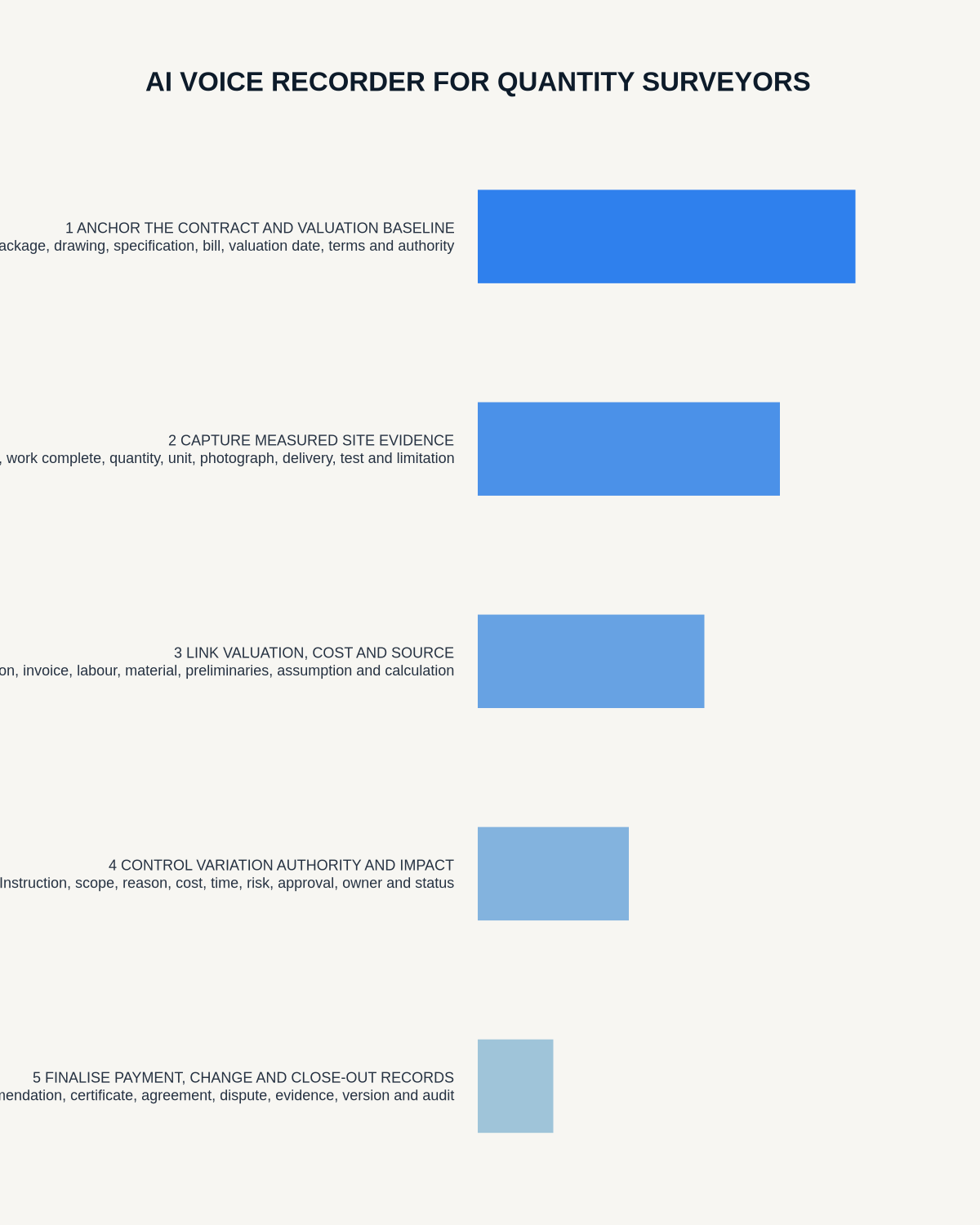
Visual map for AI Voice Recorder for Quantity Surveyors: Better Site Valuations and Variation Evidence
- Prepare the approved useDefine purpose, safe position, permission and the required formal record.
- Capture context firstState the case, asset, person, location or event identifier before detail.
- Human-verify evidenceCheck technical terms, units, names, dates, decisions and uncertainty.
- Complete the formal recordTransfer only verified information and apply access and retention controls.
On this page
Related guides
See whether Halo fits this workflow
Review the NERALVO Halo specifications, included services, delivery information and current offer only after completing the guide.
Found an error or an out-of-date claim? Email support@neralvo.com with the article address and a supporting source.