The 60-second verdict
Radiography work combines patient communication, technical setup, equipment use, image quality and safety decisions. An AI voice recorder for radiographers may support approved training, simulation, equipment debriefs and reflective learning, but routine patient capture is a separate clinical-governance issue and should not be introduced informally.
Best fit: Radiographers who need recoverable audio and human-verified notes in an authorised workflow. Use another method when: recording is prohibited, a participant declines or the approved process requires manual notes.
Evidence basis and limits
- Decision factors covered: Choose the recording purpose before the session; Keep four records separate; Use a before-during-after debrief.
- Evidence rule: A claim earns weight only when the source, date, configuration and limitation are clear enough for a reader to check.
- Boundary: Examples and workflow recommendations must be tested with representative recordings, the intended users and the actual approval process before rollout.
The useful boundary is clear: recording may support learning and authorised team review, while the patient record, examination details, exposure information and incident documentation remain in the approved clinical systems.
Choose the recording purpose before the session
Appropriate approved uses may include:
- simulation debriefs
- equipment training
- communication-skills review
- post-procedure team learning
- service-improvement workshops
- private reflective dictation
- authorised handover training
Do not record a clinical area simply because the device is convenient. Confirm organisational authority, participant process, patient-data controls and the exact learning purpose first.
Keep four records separate
| Record | Purpose |
|---|---|
| Clinical record | Approved patient information, examination and care documentation |
| Technical or incident record | Equipment, exposure, safety or governance documentation |
| Training transcript | Temporary source for approved learning review |
| Reflective note | Professional learning written without unnecessary patient identifiers |
An AI summary should never replace the clinical or incident record. If the discussion reveals missing documentation, complete it through the authorised system.
Use a before-during-after debrief
For simulation or approved team learning, structure the discussion around:
Before
- indication or scenario
- expected workflow
- equipment and staffing
- known constraints
- communication plan
During
- what actually occurred
- decision points
- image-quality or positioning challenge
- patient communication issue
- equipment behaviour
- escalation or adaptation
After
- outcome
- what worked
- what created risk or delay
- learning point
- action, owner and review date
This makes the transcript easier to convert into an action-focused learning record.
Describe observations before interpretation
A debrief should distinguish what happened from why the team thinks it happened.
Observation: “The sequence was paused twice while the team clarified the requested projection.”
Interpretation: “The referral wording and pre-procedure briefing may not have been sufficiently clear.”
The second statement is a hypothesis until reviewed against the referral, local process and participant accounts.
Technical terminology needs manual verification
Automatic transcription can mishear:
- anatomical terms
- projection names
- equipment models
- abbreviations
- dose or exposure figures
- measurements
- contrast agents and medicines
- staff roles
Check all material terminology and numerical values against the relevant source. Do not let AI generate clinical conclusions or incident classifications.
Use recording to improve communication practice
In approved training, review whether explanations were:
- clear and jargon-free
- paced appropriately
- adapted to communication needs
- checked for understanding
- respectful of privacy and dignity
- consistent with the procedure
The aim is not to score an individual from a rough transcript. Consider context, non-verbal communication and the purpose of the exercise.
Handover needs clinical economy
For approved handover learning, a useful structure includes:
- reason for examination or procedure
- current status
- important communication or mobility need
- technical issue or limitation
- action already taken
- required follow-up
- person responsible
Real patient handover should use the organisation’s approved method. Training recordings should avoid real identifiers wherever possible.
Reflective notes should preserve learning, not duplicate the case
A private reflective note can record:
- what challenged the practitioner
- which knowledge or skill was tested
- what evidence or guidance should be reviewed
- what would be done differently
- which learning action will be completed
- when effectiveness will be reviewed
Use a case reference only where necessary and permitted. Avoid copying detailed patient history into a personal reflection.
Equipment debriefs need reproducible facts
Where a session concerns equipment performance, capture:
- device or room reference
- software or configuration where relevant
- task being performed
- observable behaviour
- error message or output
- immediate safety action
- whether the issue could be reproduced
- service or engineering escalation
- evidence required for closure
The official technical report should contain verified details, not only the meeting summary.
Protect patients and staff
Recording may capture names, health details, voices, locations and professional discussion. Define:
- which sessions may be recorded
- whether real patient material is excluded
- participant notification
- where transcription occurs
- who can access audio and summaries
- how material is de-identified
- retention and deletion
- the approved destination for actions
If recording may distract from care or inhibit speaking, use ordinary notes instead.
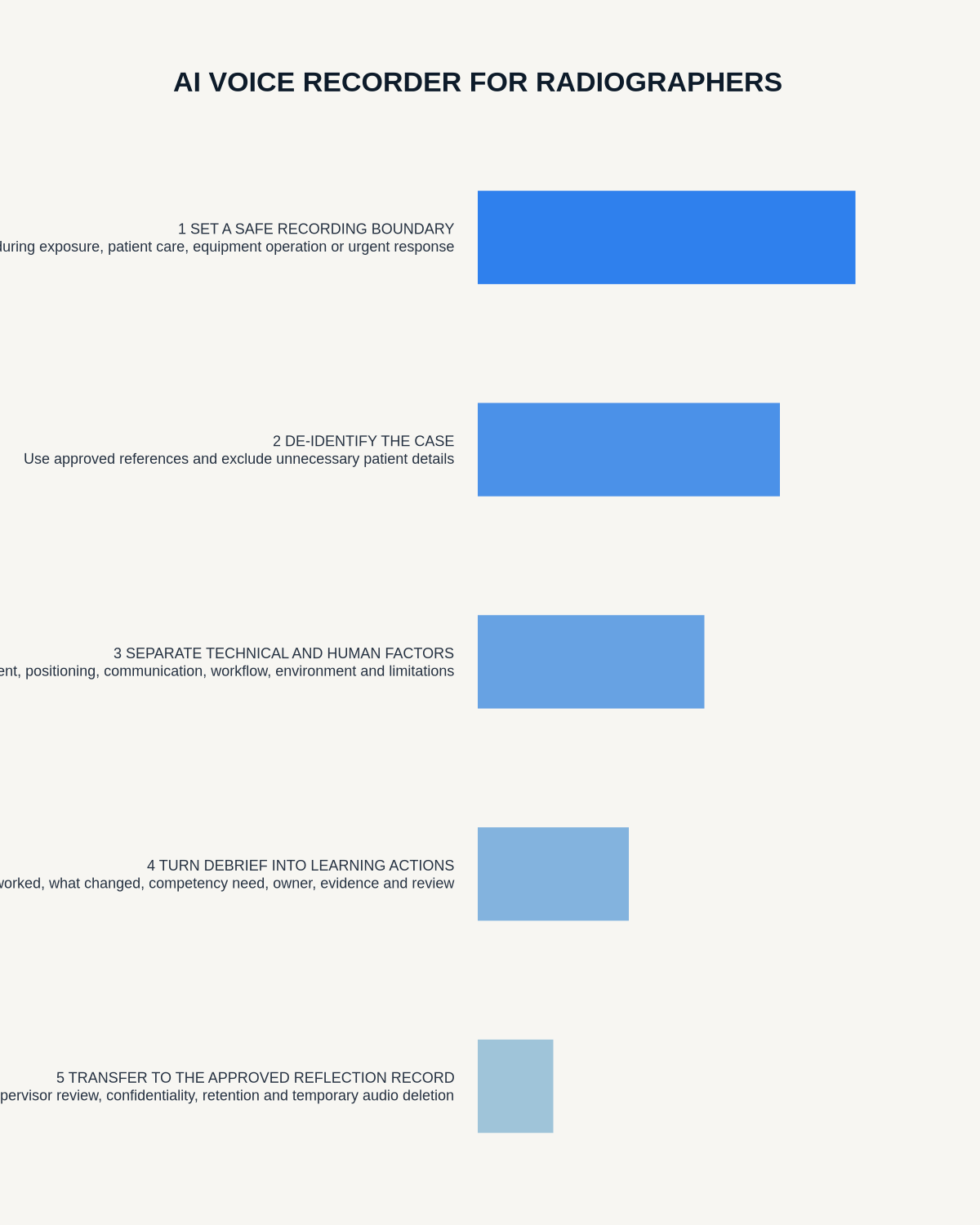
A governance-led learning workflow
- Define the learning purpose.
- Confirm organisational approval and participant process.
- Remove unnecessary patient identifiers.
- Use a structured debrief framework.
- Label observation and interpretation separately.
- Verify technical terms and figures.
- Extract learning actions and owners.
- Complete any clinical, technical or incident record separately.
- Create a concise reflective or training note.
- Delete or retain source audio under the approved policy.
How NERALVO Halo may support approved radiography learning
NERALVO Halo provides portable NOTE recording, 64GB local storage and current DOWAY transcription and structured-note tools. It may support approved simulation debriefs, equipment training and private reflective dictation.
Healthcare organisations should approve governance, data processing, access and retention before deployment. Test the exact acoustic environment and specialist vocabulary, and verify all clinical or technical details manually.
Learning-record check
- Was the recording purpose approved?
- Were real patient identifiers avoided or controlled?
- Are clinical, technical, training and reflective records separate?
- Are observations distinguished from interpretation?
- Were technical terms and figures checked?
- Did the debrief produce a specific learning action?
- Were required clinical or incident records completed independently?
- Is source audio handled under the approved policy?
An AI voice recorder can support radiography training and reflection when the governance boundary is respected. The reliable outcome is better learning and clearer action—not an uncontrolled substitute for the patient record, safety systems or professional judgement.
Cloud software, a dedicated recorder or manual notes?
For Radiographers, the right answer changes with the setting. This matrix deliberately gives each method a situation where it can be the strongest choice.
| Situation | Best starting point | Reason |
|---|---|---|
| scheduled remote meetings | Cloud meeting software | Auto-join and central collaboration can remove routine admin. |
| in-person or mobile work | Dedicated recorder | Dedicated hardware suits movement, variable rooms and offline source capture. |
| recording is refused or prohibited | Manual notes or an approved alternative | A clear alternative respects policy and participant choice. |
| mixed online and offline work | Governed hybrid | One governed process prevents gaps between desk and field work. |
Related guides
Profession workflow
Visual map for AI Voice Recorder for Radiographers: Safer Training, Debriefs and Reflection
- Prepare the approved useDefine purpose, safe position, permission and the required formal record.
- Capture context firstState the case, asset, person, location or event identifier before detail.
- Human-verify evidenceCheck technical terms, units, names, dates, decisions and uncertainty.
- Complete the formal recordTransfer only verified information and apply access and retention controls.
On this page
More in this topic: Health, care and clinical recording
Show 9 closely related guides
- AI Voice Recorder for Care Coordinators: Person-Centred Plans and Clear Handover
- AI Voice Recorder for Optometrists: Clearer Consultations and Safer Clinical Notes
- AI Voice Recorder for Audiologists: Better Hearing Assessments and Follow-Up Notes
- AI Voice Recorder for Coroners’ Officers: Clearer Family Calls and Case Coordination
- AI Voice Recorder for Occupational Health Advisers: Consultations and Adjustments
- AI Voice Recorder for Environmental Health Officers: Better Inspections and Evidence
- AI Voice Recorder for Food Safety Inspectors: Better Site Evidence and Follow-Up
- AI Voice Recorder for Clinical Researchers: Better Interviews and Audit Trails
- AI Voice Recorder for Lab Technicians: Better Procedures, Deviations and Handover
Related guides
See whether Halo fits this workflow
Review the NERALVO Halo specifications, included services, delivery information and current offer only after completing the guide.
Found an error or an out-of-date claim? Email support@neralvo.com with the article address and a supporting source.