The 60-second verdict
Food-safety inspections combine rapid observation with exact details: product, batch, temperature, time, location, process and corrective action. An AI voice recorder can help create a structured inspection log, but every measurement and formal finding must be verified through the approved inspection record.
Best fit: Food Safety Inspectors who need recoverable audio and human-verified notes in an authorised workflow. Use another method when: recording is prohibited, a participant declines or the approved process requires manual notes.
Evidence basis and limits
- Decision factors covered: Use the “what, where, when, evidence” pattern; Measurements must come from the official record; Inspection-log structure.
- Evidence rule: Claims are weighted by consequence: capture failure, changed meaning, access and recovery matter more than polished wording.
- Boundary: Examples and workflow recommendations must be tested with representative recordings, the intended users and the actual approval process before rollout.
Use the “what, where, when, evidence” pattern
For each issue, record:
- specific food, equipment or process
- exact location
- time observed
- measurement or condition
- instrument or record used
- photograph reference
- person’s explanation
- immediate corrective action
- matter requiring follow-up
“Cold food too warm” is weak. “Cooked chicken in display unit 2 measured at [verified value] at 13:40 using instrument reference recorded in field sheet” is traceable.
Measurements must come from the official record
AI transcription can confuse decimals, units and times. Read critical values clearly, but verify them against the contemporaneous field sheet or system before using them.
Never let AI infer a missing temperature, batch number or date.
Inspection-log structure
| Area | Observation | Evidence | Operator response | Action |
|---|---|---|---|---|
| Storage | Specific condition observed | Photo/log/measurement | Attributed explanation | Immediate and follow-up |
| Preparation | Process and hygiene observation | Direct observation/document | Attributed explanation | To assess |
| Allergen control | Procedure or information checked | Menu, label or record | Staff account | Required follow-up |
| Cleaning | Area, equipment and condition | Photo/schedule | Manager response | Corrective action |
Operator explanations
Record who said what and their role. An explanation may provide context but does not erase the observation. Keep direct observation, operator statement, documentary evidence, professional assessment and formal action as separate stages.
Corrective actions
When an immediate action is taken, record:
- what changed
- who carried it out
- time
- affected product or area
- how completion was checked
- what remains outstanding
AI should not decide whether the action is sufficient.
Allergen and composition information
These discussions can involve complex product names, ingredients and supplier documents. Spell names, reference the exact label or specification and verify the final note against source documents.
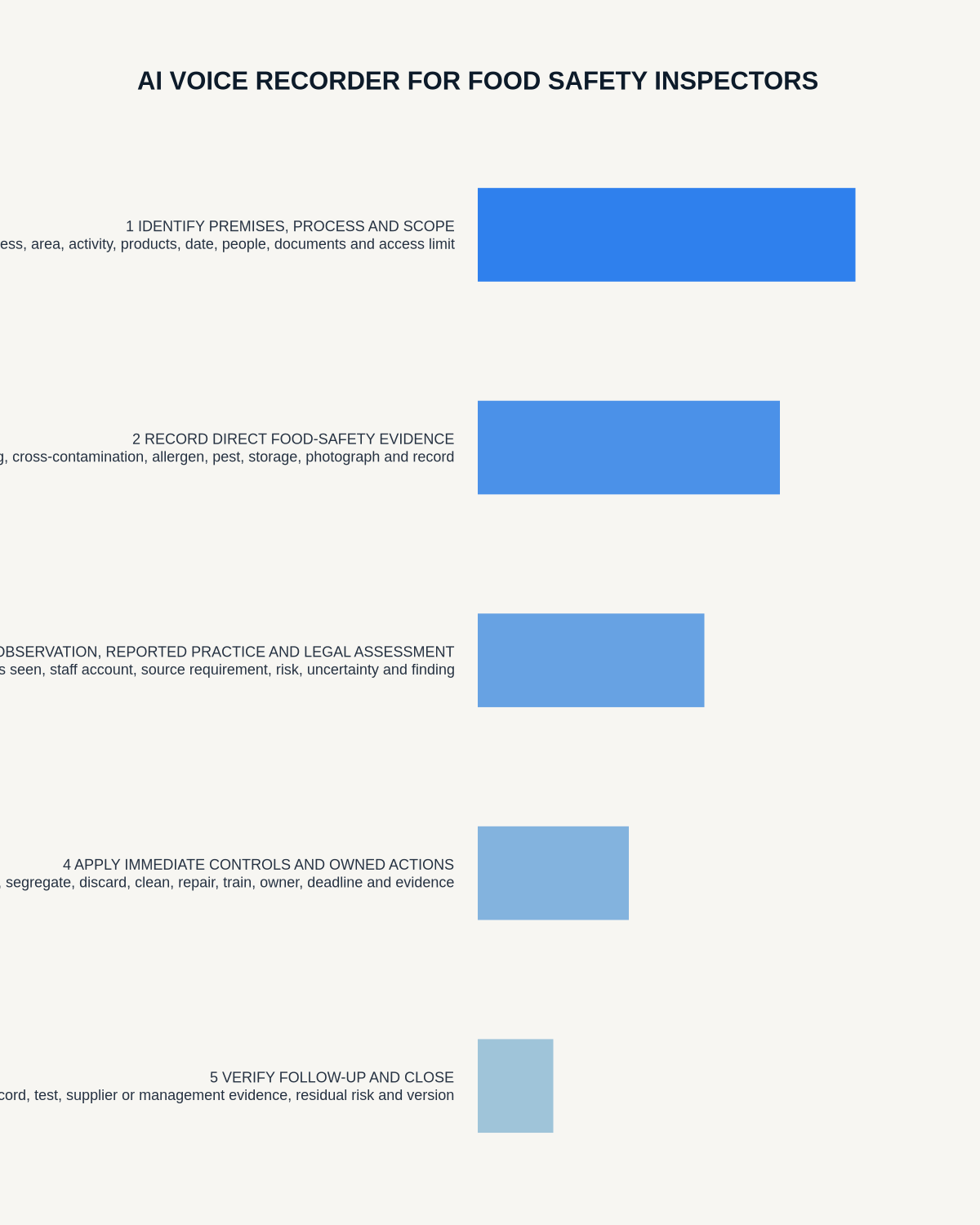
A practical inspection workflow
- Use the approved recording process.
- State premises, visit reference and purpose.
- Dictate by area and process.
- Record measurements in the required official system.
- Reference photos and documents.
- Attribute staff explanations.
- Generate a structured observation log.
- Check values, units, times and identifiers.
- Complete formal findings and actions through normal review.
- Apply evidence and retention rules.
Where NERALVO Halo fits
Check whether NERALVO Halo fits food safety inspectors work can support approved field dictation and post-inspection debriefs. Its current specification includes 64GB local storage, NOTE and CALL modes, up to 35 hours of recording and Bluetooth transfer to DOWAY.
DOWAY can create transcripts, summaries, speaker-separated notes, templates, translations and mind maps. Use only within authority procedures and food-area equipment controls.
Inspection-note quality check
- Are measurements verified from the official record?
- Are product and batch identifiers exact?
- Are observations tied to location and time?
- Are staff statements attributed?
- Are immediate and outstanding actions separated?
- Was the formal assessment completed independently?
Bottom line
For food-safety inspectors, an AI recorder is a field-note organiser. It can improve chronology and evidence references, but measurements, findings and formal action remain controlled professional records.
Cloud software, a dedicated recorder or manual notes?
For Food Safety Inspectors, the right answer changes with the setting. This matrix deliberately gives each method a situation where it can be the strongest choice.
| Situation | Best starting point | Reason |
|---|---|---|
| scheduled remote meetings | Cloud meeting software | Calendar automation and shared integrations are usually the strongest advantage. |
| in-person or mobile work | Dedicated recorder | Independent capture reduces reliance on an active phone or laptop. |
| recording is refused or prohibited | Manual notes or an approved alternative | The boundary takes priority over convenience. |
| mixed online and offline work | Governed hybrid | Use each method only in the setting it actually fits. |
Related AI voice recorder guides
Profession workflow
Visual map for AI Voice Recorder for Food Safety Inspectors: Better Site Evidence and Follow-Up
- Prepare the approved useDefine purpose, safe position, permission and the required formal record.
- Capture context firstState the case, asset, person, location or event identifier before detail.
- Human-verify evidenceCheck technical terms, units, names, dates, decisions and uncertainty.
- Complete the formal recordTransfer only verified information and apply access and retention controls.
On this page
More in this topic: Health, care and clinical recording
Show 9 closely related guides
- AI Voice Recorder for Care Coordinators: Person-Centred Plans and Clear Handover
- AI Voice Recorder for Radiographers: Safer Training, Debriefs and Reflection
- AI Voice Recorder for Optometrists: Clearer Consultations and Safer Clinical Notes
- AI Voice Recorder for Audiologists: Better Hearing Assessments and Follow-Up Notes
- AI Voice Recorder for Coroners’ Officers: Clearer Family Calls and Case Coordination
- AI Voice Recorder for Occupational Health Advisers: Consultations and Adjustments
- AI Voice Recorder for Environmental Health Officers: Better Inspections and Evidence
- AI Voice Recorder for Clinical Researchers: Better Interviews and Audit Trails
- AI Voice Recorder for Lab Technicians: Better Procedures, Deviations and Handover
Related guides
See whether Halo fits this workflow
Review the NERALVO Halo specifications, included services, delivery information and current offer only after completing the guide.
Found an error or an out-of-date claim? Email support@neralvo.com with the article address and a supporting source.