The 60-second verdict
Structural engineering site work requires attention to the physical evidence. Cracks change direction. Connections are partly concealed. Access is limited. A measurement that seemed clear in the moment may be difficult to place when the engineer returns to the office.
Best fit: Structural Engineers who need recoverable audio and human-verified notes in an authorised workflow. Use another method when: recording is prohibited, a participant declines or the approved process requires manual notes.
Evidence basis and limits
- Decision factors covered: Describe what exists before explaining why; Give every note a structural address; The evidence chain for a field observation.
- Evidence rule: Claims are weighted by consequence: capture failure, changed meaning, access and recovery matter more than polished wording.
- Boundary: Examples and workflow recommendations must be tested with representative recordings, the intended users and the actual approval process before rollout.
An AI voice recorder for structural engineers can support contemporaneous field notes while the engineer keeps their eyes on the structure. The recorder is useful only when each spoken observation can be traced to a location, photograph, sketch, instrument reading or drawing. Audio without that chain is memory, not an engineering record.
Describe what exists before explaining why
The most important discipline is separating observation from interpretation.
Observation: “Diagonal crack approximately two millimetres wide from the upper corner of the opening towards the beam bearing, photograph 24.”
Interpretation: “Pattern may be consistent with local movement; cause not confirmed.”
When those statements are merged, an early hypothesis may later appear to be a measured fact. Use verbal labels such as “observed”, “reported”, “possible cause”, “to verify” and “requires calculation”.
Give every note a structural address
A useful field note begins with enough information to locate the evidence without relying on memory:
- project and inspection reference
- building, block, grid or plot
- level
- room, elevation or structural element
- orientation or viewing direction
- date and time
- people present
- access or visibility limitation
“Crack beside window” is rarely sufficient on a large site. “Second floor, room 2.14, south elevation, east side of window W-17” is far more useful.
The evidence chain for a field observation
| Stage | Required link |
|---|---|
| Spoken observation | Location and neutral description |
| Image | Photograph number and scale where appropriate |
| Measurement | Instrument or field-sheet record and unit |
| Drawing | Drawing number, revision and detail reference |
| Interpretation | Hypothesis and confidence |
| Action | Calculation, opening-up, monitoring, testing or immediate control |
| Formal output | Reviewed inspection note, report or design record |
Repeat measurements—but never let the transcript become the only measurement record
Speech recognition can confuse units, decimals and similar numbers. Read the value clearly, repeat it and record it in the approved field sheet or digital inspection tool.
“Measured crack width two point zero millimetres at marker C3, using gauge reference G-4; repeat reading recorded on field sheet.”
For dimensions that influence safety, analysis or design, verify the source record and instrument rather than relying on the transcription.
Record what could not be inspected
Inspection limitations are part of the evidence. Note:
- concealed elements
- unsafe or inaccessible areas
- finishes preventing inspection
- poor lighting
- temporary works or stored materials blocking access
- missing drawings or records
- weather or operating conditions affecting the visit
A polished summary may focus only on what was seen. The final report must preserve what was not verified.
Use a hypothesis register for defects
Where several causes are possible, do not allow the first explanation to dominate. Create a simple hypothesis register:
- possible mechanism
- evidence supporting it
- evidence against it
- information still required
- test or inspection that could distinguish the options
- current confidence
For cracking, for example, possible contributors may include movement, restraint, shrinkage, thermal effects, loading, workmanship or adjacent activity. The recorder can preserve the discussion, but engineering judgement must test it.
Design meetings need a different structure from site notes
Do not reuse a field-inspection template for design reviews. A design decision record should capture:
- the question being resolved
- design basis and assumptions
- codes, standards or project criteria considered
- options reviewed
- calculation or modelling required
- chosen direction and reason
- checking and approval status
- impact on drawings, specification and other disciplines
- review trigger if an assumption changes
Mark whether the direction is preliminary, subject to calculation, checked or approved. Automatic summaries often remove these stages.
Immediate safety concerns require action, not later transcription
If the engineer identifies a condition requiring urgent control, follow the project’s safety and escalation process immediately. Do not rely on a future transcript to communicate the risk. Record the action taken, people notified and restrictions applied after the immediate response is complete.
A practical inspection workflow
- Confirm the device is permitted and safe to use on site.
- State the project and inspection reference.
- Use location-specific headers as you move.
- Describe visible evidence before interpretation.
- Reference photographs, sketches and drawings aloud.
- Record measurements in the required parallel system.
- State limitations and areas not inspected.
- Generate the transcript after the visit.
- Check technical terms, dimensions and identifiers.
- Transfer reviewed content into the formal inspection or design record.
Noise, PPE and site conditions
Wind, traffic, plant, echo and protective equipment can reduce intelligibility. Test microphone position before the inspection. Use a sheltered area for critical dictation and avoid operating the device where it distracts from safe movement or communication.
Where the site is too noisy, capture short reference markers and complete a structured debrief immediately afterwards while the evidence is fresh.
How NERALVO Halo may fit field engineering
Check whether NERALVO Halo fits structural engineers work offers portable recording, 64GB local storage and DOWAY transcription and structured-note tools. It may be useful for approved inspection narration, design-review capture and post-site debriefs.
Before relying on it, test technical vocabulary, drawing references, PPE, wind and reverberant spaces. Define how file names connect to project and photograph references. For statutory site-note considerations, see the related building control inspector guide.
Engineering review checklist
- Can every observation be located?
- Are photographs, sketches and drawings linked?
- Are measurements verified outside the transcript?
- Are observations separated from hypotheses?
- Are limitations and inaccessible areas recorded?
- Are urgent actions documented?
- Is design status—preliminary, checked or approved—clear?
- Has the reviewed information entered the formal project record?
An AI voice recorder can help structural engineers capture more detail without looking away from the structure. It adds value when the spoken note is one link in a traceable chain of evidence, calculation, checking and professional approval.
Cloud software, a dedicated recorder or manual notes?
For Structural Engineers, the right answer changes with the setting. This matrix deliberately gives each method a situation where it can be the strongest choice.
| Situation | Best starting point | Reason |
|---|---|---|
| scheduled video briefings | Cloud meeting software | Calendar automation and shared integrations are usually the strongest advantage. |
| site visits, inspections or mobile calls | Dedicated recorder | Independent capture reduces reliance on an active phone or laptop. |
| a restricted site or participant prevents recording | Manual notes or an approved alternative | The boundary takes priority over convenience. |
| office-to-site work | Governed hybrid | Use each method only in the setting it actually fits. |
Related guides
Profession workflow
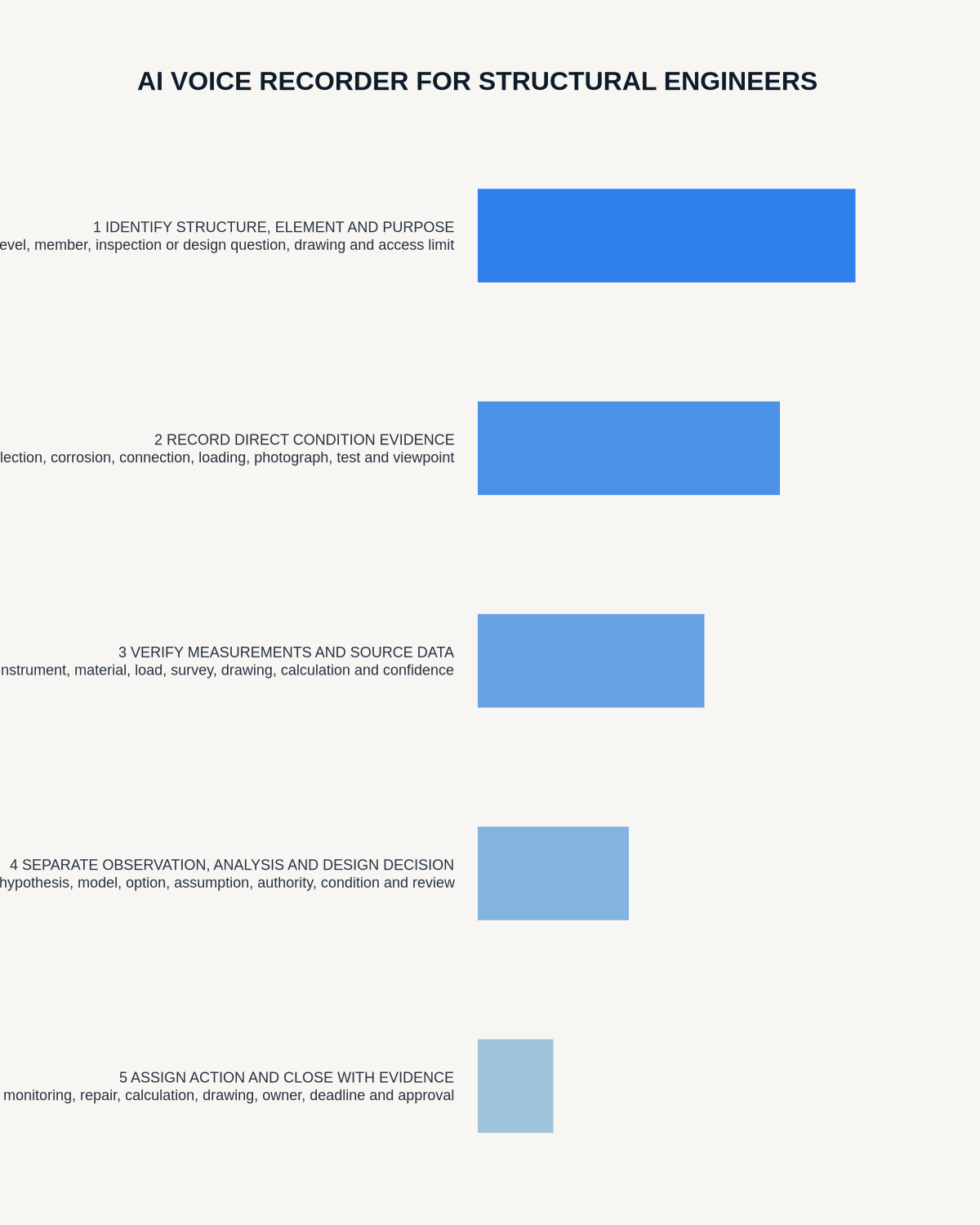
Visual map for AI Voice Recorder for Structural Engineers: Better Site Evidence and Design Decisions
- Prepare the approved useDefine purpose, safe position, permission and the required formal record.
- Capture context firstState the case, asset, person, location or event identifier before detail.
- Human-verify evidenceCheck technical terms, units, names, dates, decisions and uncertainty.
- Complete the formal recordTransfer only verified information and apply access and retention controls.
On this page
Related guides
See whether Halo fits this workflow
Review the NERALVO Halo specifications, included services, delivery information and current offer only after completing the guide.
Found an error or an out-of-date claim? Email support@neralvo.com with the article address and a supporting source.