The 60-second verdict
Property development projects do not lose control because nobody took minutes. They lose control because decisions are fragmented across planning calls, design workshops, site walks, contractor meetings, funding discussions and informal conversations between specialists.
Best fit: Property Developers who need recoverable audio and human-verified notes in an authorised workflow. Use another method when: recording is prohibited, a participant declines or the approved process requires manual notes.
Evidence basis and limits
- Decision factors covered: Think in decisions, not meetings; A project decision ledger; Consultant coordination: capture contradictions deliberately.
- Evidence rule: The decision is based on the complete capture-to-action workflow, not a single feature or marketing accuracy percentage.
- Boundary: Examples and workflow recommendations must be tested with representative recordings, the intended users and the actual approval process before rollout.
An AI voice recorder for property developers can help preserve the reasoning that sits between these workstreams. The useful output is not a universal transcript. It is a decision-memory system that shows what changed, why it changed, who had authority, what evidence supported it and which project records must now be updated.
Think in decisions, not meetings
One issue may appear in six meetings. A façade change could begin as a planning concern, become an architectural proposal, affect structural support, alter cost, create a procurement delay and change the maintenance strategy.
Do not store six unrelated summaries. Create one decision thread containing:
- issue and project area
- original assumption
- new information
- options considered
- consultants and parties involved
- cost and programme effect
- planning, legal or funding dependency
- authority required
- decision and date
- documents changed as a result
A project decision ledger
| Field | Purpose |
|---|---|
| Decision reference | One identifier used across meetings and systems |
| Question | The exact issue requiring resolution |
| Evidence | Drawings, surveys, advice, costs and site conditions |
| Options | Realistic alternatives and rejected routes |
| Consequences | Value, cost, programme, quality, compliance and operations |
| Authority | Person or forum permitted to approve |
| Status | Proposed, recommended, approved, instructed or superseded |
| Implementation | Drawings, contract records, procurement and actions to update |
| Review trigger | Assumption or event that would reopen the decision |
AI can draft the ledger entry, but the development team must confirm status and authority.
Consultant coordination: capture contradictions deliberately
Consultants may use different assumptions without recognising the conflict. A recorded workshop can expose them, but only if the output preserves disagreement rather than producing a smooth consensus.
After each coordination session, extract:
- assumptions shared by all disciplines
- assumptions that conflict
- information one discipline needs from another
- design interfaces without a clear owner
- decisions that cannot yet be made
- changes requiring updated drawings or calculations
Send the contradiction list to the responsible people. Do not circulate a full transcript and expect them to discover the issues themselves.
Site conversations need authority labels
Developers, project managers and contractors often discuss practical changes while standing beside the work. Use clear labels:
- Site observation
- Contractor proposal
- Consultant recommendation
- Developer preference
- Subject to approval
- Formal instruction issued
A recording may prove that a topic was discussed. It does not automatically establish a contractual instruction or statutory approval. Move the matter into the required formal route.
Record the assumption behind the programme
Programme dates are often repeated without the dependency that makes them possible. Capture:
- the milestone
- design information required
- approval or consent required
- procurement lead time
- site access or enabling work
- third-party action
- float or contingency
- date the assumption was last confirmed
When a milestone slips, the project can then identify the broken assumption rather than reconstructing several months of meetings.
Commercial decisions need the full cost story
A lower capital cost can create higher operating, maintenance or replacement cost. A value-engineering discussion should preserve:
- original performance requirement
- proposed change
- capital cost movement
- programme effect
- quality and durability effect
- operational or maintenance implication
- planning, warranty or marketability risk
- evidence and approval required
Do not let an AI summary reduce this to “saving approved”.
Planning discussions: separate likelihood from consent
Pre-application comments, officer discussions and consultant views may guide strategy, but they should not be described as permission. Record the speaker, context, caveats, documents discussed and next formal step.
Useful status language includes:
- informal view
- subject to full assessment
- application amendment proposed
- additional evidence requested
- committee or delegated decision pending
- formal consent received
Handover should begin when the first decision is made
Late handover problems often originate early: a product was substituted, a maintenance access assumption changed or commissioning evidence was never assigned. Add a handover field to the decision ledger.
Track:
- asset information required
- manufacturer and model
- warranty or guarantee
- testing and commissioning
- training
- operation and maintenance information
- statutory or certification evidence
- defect and outstanding-work status
- responsible provider and due date
This turns handover into a continuous evidence process rather than an end-of-project document chase.
A voice-to-project-control workflow
- Confirm the meeting or site discussion may be recorded.
- State the project, workstream and decision references.
- Use verbal labels for proposals, recommendations, approvals and instructions.
- Mark assumptions and conflicting views.
- Generate the transcript in the approved environment.
- Extract decisions, dependencies, contradictions and actions.
- Verify cost, programme, drawing and approval references.
- Update the decision ledger and relevant project systems.
- Issue formal instructions or submissions through their authorised routes.
- Delete or retain source audio under the project information plan.
Information security and commercial sensitivity
Development recordings may contain land strategy, pricing, funding, negotiations, personal information and security-sensitive building details. Limit access and avoid uploading material into tools not approved by the project or organisation.
A concise checked decision entry is usually more useful and safer to share than a raw transcript.
How NERALVO Halo may support development teams
View Halo specifications for property developers use provides portable NOTE recording, supported CALL capture, 64GB local storage and DOWAY tools for transcripts, summaries and structured notes. It may support consultant workshops, site debriefs and internal decision reviews.
Before use, define the projects and meeting types that permit recording, the naming convention and the person responsible for transferring outputs into the decision, risk and action systems. Commercial teams can also use the related quantity surveyor guide for variation-status control.
Decision-memory health check
- Does each major issue have one decision reference?
- Are assumptions and contradictions visible?
- Is approval status clear?
- Are cost and programme effects verified?
- Have drawings, contracts, submissions and registers been updated?
- Is handover evidence assigned early?
- Can the project explain why the decision was reasonable at the time?
An AI voice recorder can help a property developer connect decisions that would otherwise remain scattered across meetings. It creates value when the spoken discussion becomes controlled project memory with verified authority, consequences and implementation.
Cloud software, a dedicated recorder or manual notes?
For Property Developers, the right answer changes with the setting. This matrix deliberately gives each method a situation where it can be the strongest choice.
| Situation | Best starting point | Reason |
|---|---|---|
| scheduled remote meetings | Cloud meeting software | Native remote-meeting workflows can be more efficient here. |
| in-person or mobile work | Dedicated recorder | A separate battery and recoverable local source improve resilience. |
| recording is refused or prohibited | Manual notes or an approved alternative | Manual notes are the correct control when recording is unavailable. |
| mixed online and offline work | Governed hybrid | A hybrid can combine automation with reliable physical capture. |
Related guides
Profession workflow
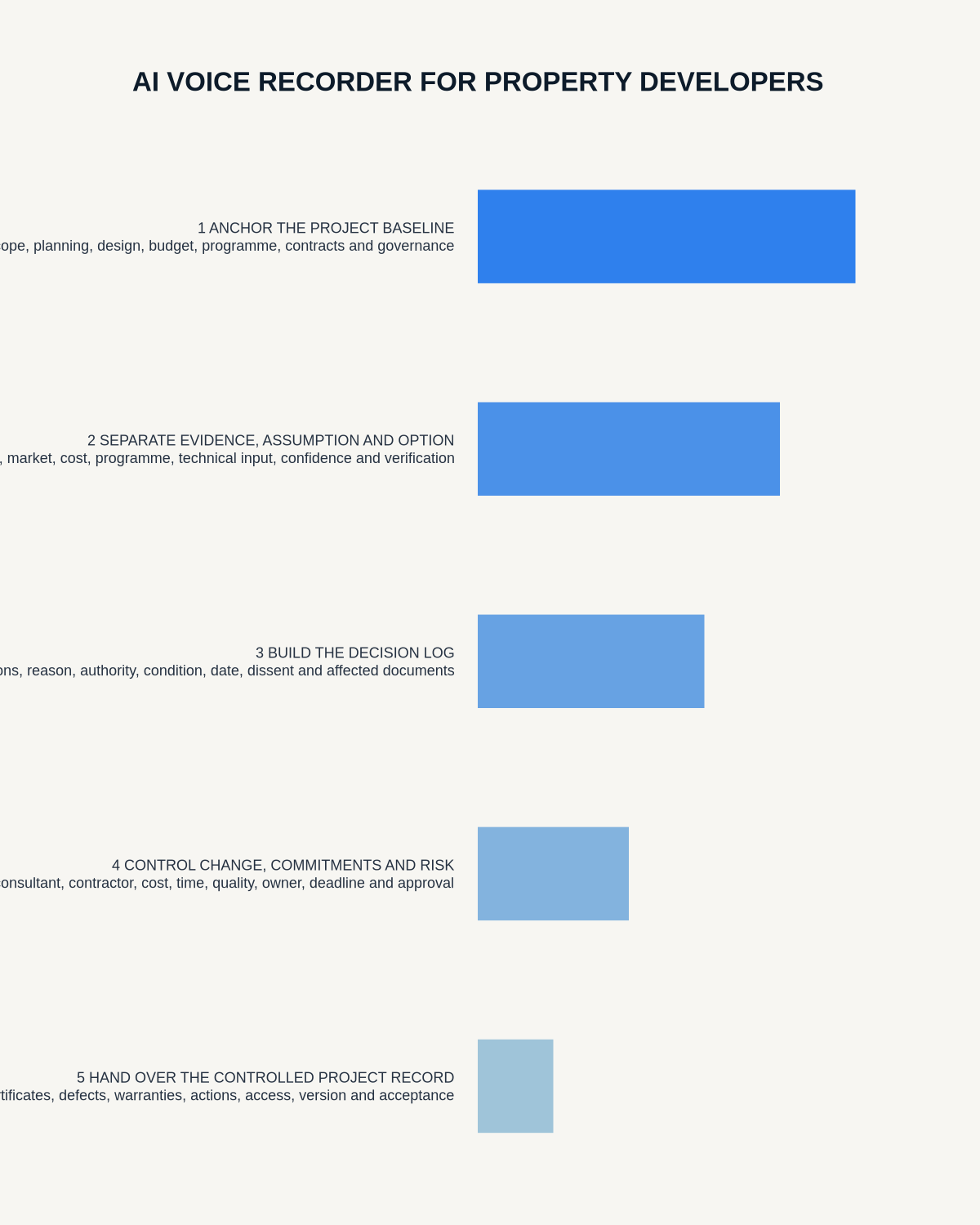
Visual map for AI Voice Recorder for Property Developers: Better Decision Logs and Project Handover
- Prepare the approved useDefine purpose, safe position, permission and the required formal record.
- Capture context firstState the case, asset, person, location or event identifier before detail.
- Human-verify evidenceCheck technical terms, units, names, dates, decisions and uncertainty.
- Complete the formal recordTransfer only verified information and apply access and retention controls.
On this page
Related guides
See whether Halo fits this workflow
Review the NERALVO Halo specifications, included services, delivery information and current offer only after completing the guide.
Found an error or an out-of-date claim? Email support@neralvo.com with the article address and a supporting source.