The 60-second verdict
Quick answer: an AI voice recorder can support wealth-management review notes only when verified facts, client goals, planning assumptions, options, recommendations and implementation status remain clearly separated and the final suitability record is human-approved.
Best fit: Wealth Managers who need recoverable audio and human-verified notes in an authorised workflow. Use another method when: recording is prohibited, a participant declines or the approved process requires manual notes.
Evidence basis and limits
- Decision factors covered: Begin with change since the last review; Keep four planning layers separate; Rank goals before discussing solutions.
- Evidence rule: A claim earns weight only when the source, date, configuration and limitation are clear enough for a reader to check.
- Boundary: Examples and workflow recommendations must be tested with representative recordings, the intended users and the actual approval process before rollout.

Assess Halo against the wealth managers workflow matrix can support approved reviews, case discussions and private dictation. It cannot determine suitability, verify current values or replace the firm’s authorised advice record.
Begin with change since the last review
Record changes in:
- Employment or business interests.
- Income and regular expenditure.
- Property and borrowing.
- Family and dependants.
- Health or care factors relevant to planning.
- Tax residence or expected relocation.
- Expected gifts, inheritances or major purchases.
- Retirement timing.
- Withdrawals or liquidity needs.
- Satisfaction with current arrangements.
Label every point as confirmed, estimated, planned or awaiting evidence. A future sale or inheritance must not appear as a current asset.
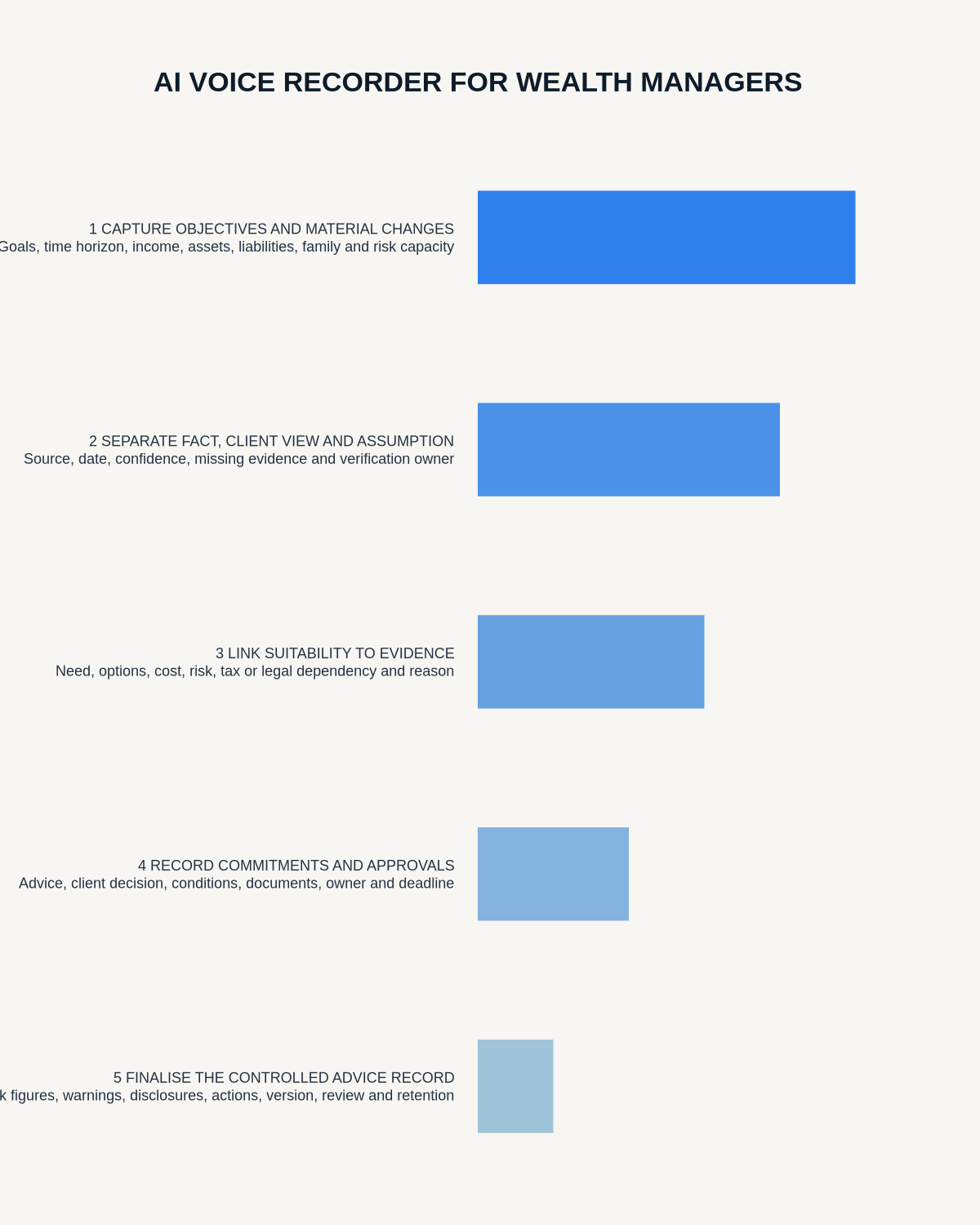
Keep four planning layers separate
| Layer | Examples | Control |
|---|---|---|
| Verified facts | Current statements, holdings, income evidence and arrangements | Check source and date |
| Client goals | Desired outcomes, dates, priorities and trade-offs | Preserve the client’s wording |
| Planning assumptions | Returns, inflation, spending, longevity and timing | Label scenario and source |
| Advice and decisions | Options, recommendation, questions and implementation | Human-approved regulated record |
Automatic summaries may merge these layers and make an assumption sound like a current fact or recommendation.
Rank goals before discussing solutions
For every goal, capture:
- Target date.
- Amount or desired standard of living.
- Priority.
- Flexibility.
- Dependencies.
- Acceptable trade-offs.
- Consequence if delayed or reduced.
Preserve conflicts such as earlier retirement, higher spending and a larger legacy competing for the same resources.
Record risk with context
Cover:
- Investment time horizon.
- Liquidity needs.
- Knowledge and experience.
- Emotional response to loss or volatility.
- Financial ability to absorb loss.
- Dependants and fixed commitments.
- Events that could force withdrawal.
- Differences between stated tolerance and observed behaviour.
The questionnaire supports the conversation; it does not replace the rationale.
Capacity for loss needs scenario context
When discussing downside, record the assumptions used and the effect on the client’s objectives. Ask:
- Which spending is essential?
- What emergency reserve is available?
- Which income can change?
- Which goal would be reduced first?
- Could retirement or another objective be delayed?
- What happens if markets fall shortly before withdrawals?
Check the client’s answers against verified financial information.
Separate scenarios, options and recommendations
- Background explanation.
- Illustrative scenario.
- Option discussed.
- Research required.
- Recommendation.
- Client decision.
- Implementation pending.
- Completed action.
An AI summary must not present every strategy or product mentioned as advice.
Verify every financial figure
Check values, percentages, fees, allowances, tax points, product names and dates against current approved sources. Record:
- The figure and unit.
- Source and source date.
- Whether exact, estimated or illustrative.
- The assumption or condition.
- The period and currency.
- Who must verify it.
Speech recognition can mishear decimals and percentages. Never rely on transcript wording alone for a consequential figure.
Client questions reveal suitability issues
Preserve questions about:
- Access to money.
- Loss and volatility.
- Guarantees.
- Tax.
- Fees.
- Beneficiaries.
- Provider security.
- Time commitment.
- What happens if circumstances change.
The final advice note should show how material questions were answered and which matters remained outside scope or required specialist input.
Review existing arrangements fairly
Record:
- Purpose of the arrangement.
- Cost and features.
- Performance context.
- Guarantees or benefits that may be lost.
- Tax or exit factors.
- Service issues.
- Client concerns.
- Evidence still required.
A new option should not erase the case for retaining an existing arrangement.
Create an evidence-and-action plan
Every outstanding item should identify:
- Document or information required.
- Responsible person.
- Deadline.
- Advice dependency.
- Approval or client decision required.
- Implementation status.
- Review point.
“Send paperwork” is weaker than naming the exact statement, authority or valuation needed.
Protect financial and family information
Before recording, define:
- The purpose and participant process.
- Who can access the source audio.
- Where transcription occurs.
- How exports enter the client file.
- Whether parts of the conversation should be excluded.
- Retention and deletion.
- Which document becomes the approved advice record.
Raw transcripts may contain more sensitive information than the final note and should not be circulated unnecessarily.
Use a controlled review-to-advice workflow
- Confirm the approved recording and confidentiality process.
- Identify changes since the last review.
- Verify the current financial position.
- Rank goals and trade-offs.
- Record risk and capacity-for-loss rationale.
- Label illustrations, options and recommendations separately.
- Check every figure and source date.
- Review existing arrangements fairly.
- Extract evidence gaps and actions.
- Create the reviewed advice note through the firm’s process.
- Record the client’s decision and implementation status.
- Delete temporary audio under policy.
How NERALVO Halo fits wealth management
NERALVO Halo provides NOTE mode, supported CALL capture, 64GB local storage, up to 35 hours of recording and Bluetooth sync with DOWAY. DOWAY provides transcripts, summaries, speaker-separated notes, templates, translations, mind maps and exports, with one year of DOWAY Max included.
Firms should approve recording, app processing, access, export and retention before use. Verify all values, percentages, product names and current rules against approved sources before advice is issued.
Cloud software, a dedicated recorder or manual notes?
For Wealth Managers, the right answer changes with the setting. This matrix deliberately gives each method a situation where it can be the strongest choice.
| Situation | Best starting point | Reason |
|---|---|---|
| scheduled remote client meetings | Cloud meeting software | Auto-join and central collaboration can remove routine admin. |
| in-person visits and travel | Dedicated recorder | Dedicated hardware suits movement, variable rooms and offline source capture. |
| a client declines or policy requires manual notes | Manual notes or an approved alternative | A clear alternative respects policy and participant choice. |
| mixed CRM and field work | Governed hybrid | One governed process prevents gaps between desk and field work. |
Frequently asked questions
Can the transcript become the advice note?
It can support drafting, but the final record requires verification, suitability analysis and authorised review.
Can AI determine suitability?
No. Suitability remains a professional, evidence-based responsibility under the firm’s approved process.
Should raw audio be kept indefinitely?
No. Apply the firm’s purpose, access and retention rules and remove temporary material when its justified purpose ends.
How should illustrative figures be recorded?
Label assumptions, source date, currency, period and status clearly so an illustration cannot be mistaken for a guaranteed outcome or recommendation.
Authoritative guidance and related reading
- FCA Handbook COBS 9 suitability requirements
- ICO guidance on artificial intelligence and data protection
- AI Voice Recorder for Financial Advisers
- AI Voice Recorder for Estate Planners
- AI Voice Recorder for Mortgage Brokers
Final advice-note check
- Facts, goals, assumptions and advice are separate.
- Changes and trade-offs are evidenced.
- Risk and capacity-for-loss rationale are documented.
- Figures and sources are verified.
- Client questions are preserved.
- Existing arrangements are assessed fairly.
- Actions have owners, deadlines and statuses.
- Confidentiality, access and retention are controlled.
Bottom line: an AI voice recorder can help wealth managers preserve fuller client reviews and decision reasoning. The reliable advice record still depends on verified facts, current approved sources, documented trade-offs and professional responsibility.
On this page
Related guides
See whether Halo fits this workflow
Review the NERALVO Halo specifications, included services, delivery information and current offer only after completing the guide.
Found an error or an out-of-date claim? Email support@neralvo.com with the article address and a supporting source.