Youth work depends on trust, boundaries and safeguarding. An AI voice recorder can help with approved staff debriefs, project planning and reflective practice, but recording direct sessions with young people should never be an informal shortcut. It must follow the organisation’s safeguarding, confidentiality, recording and retention framework.
Assess Halo against the youth workers workflow matrix may support controlled staff notes where the organisation has approved the complete device-and-app workflow. It is not a safeguarding or case-management system.
The safest high-value use: staff debrief
After a session, approved private voice dictation or a team debrief can capture:
- Session purpose and attendance reference.
- Activities completed.
- Engagement and group dynamics.
- Issues requiring follow-up.
- Safeguarding action already taken.
- Practical improvements.
- Staff reflections.
- Next-session plan.
Use case references rather than unnecessary full personal details.
Do not confuse reflection with case fact
| Type | Example |
|---|---|
| Observation | Young person left the activity at 19:20 |
| Reported information | Young person stated they had argued at home |
| Professional concern | Worker identifies the need to contact the safeguarding lead |
| Reflection | Activity instructions may have been unclear |
| Action | Named worker to follow the approved procedure |
An AI summary must not turn reflection, concern or a reported statement into a verified allegation.
Direct recording of youth sessions is not the default
Direct audio capture may be inappropriate because it can include minors, disclosures, third parties and sensitive background conversation. Before any such use, the organisation needs a clear authorised purpose and process.
- Why is audio necessary?
- Who approved the use?
- How are young people and responsible adults informed where required?
- Can anyone decline without disadvantage?
- What non-recorded alternative is available?
- Who can access the source and transcript?
- How soon will temporary audio be deleted?
- What happens if a safeguarding disclosure occurs?
A small device should never be used to make recording less visible.
Safeguarding action is not an AI task
If a concern arises, follow the organisation’s safeguarding procedure immediately. Do not wait for transcription or ask AI to assess credibility, severity or the correct response.
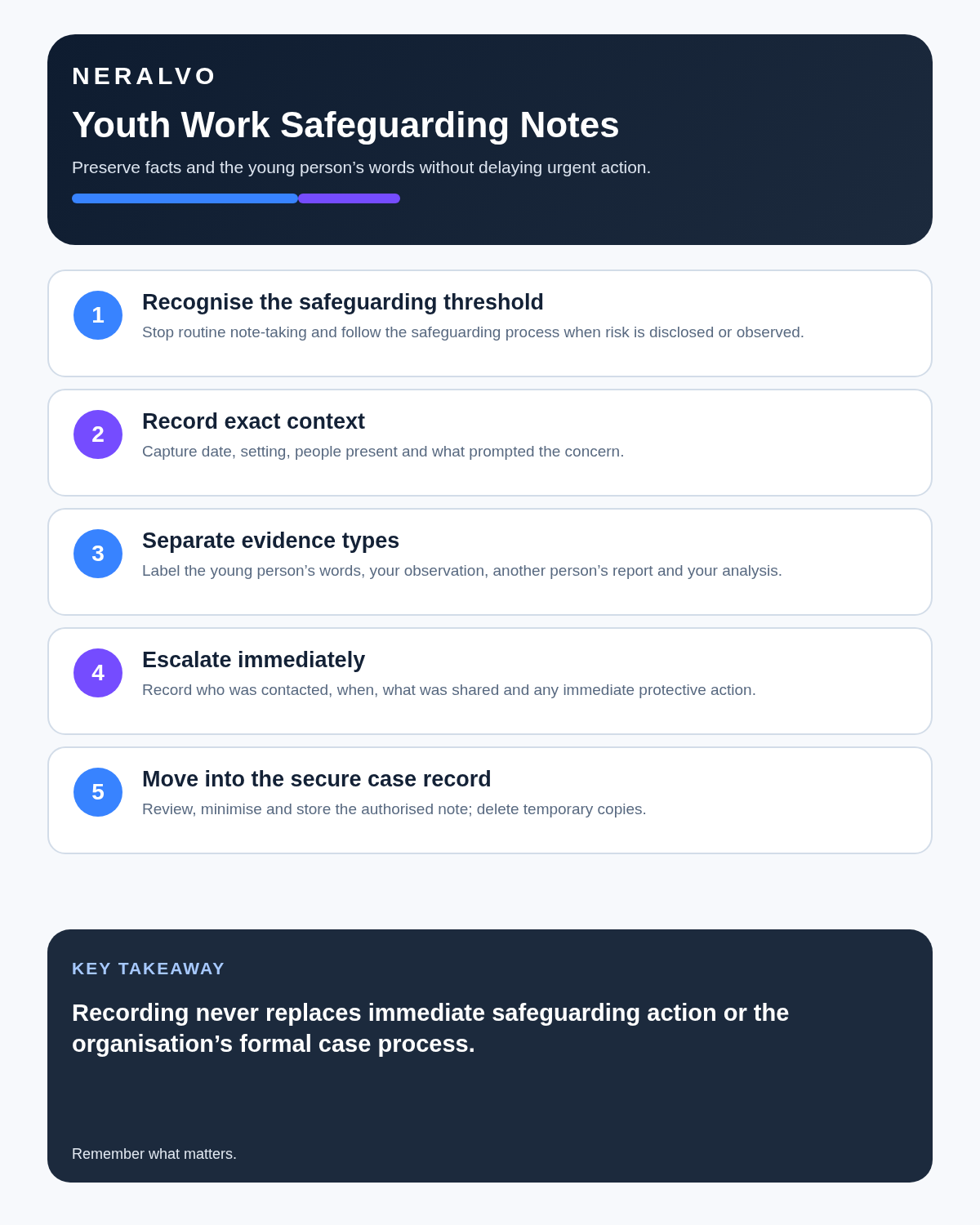
The safeguarding record should preserve the relevant words and facts and be completed promptly through the authorised restricted system. A reflective voice note is not a safeguarding referral.
Project and activity planning
Voice capture can support approved planning between venues. Useful outputs include:
- Objective.
- Activity steps.
- Materials.
- Accessibility considerations.
- Staff roles.
- Risk controls to review.
- Evaluation questions.
- Follow-up communication.
Team handover
A controlled handover should contain only information needed for continuity, safety and the next action. Do not create a broad audio archive of personal stories. Keep sensitive case information inside the approved case-management and safeguarding processes.
Reflective-practice workflow
- Move to a private approved environment.
- State the project, session and purpose.
- Use case references rather than unnecessary identifiers.
- Separate observation, report, concern and reflection.
- Complete urgent safeguarding or welfare action first.
- Generate a short reflective draft.
- Remove unnecessary personal information.
- Complete case, safeguarding or incident records separately.
- Store the approved reflection in the correct place.
- Delete temporary audio according to policy.
Protect young people and colleagues
Restrict source access, avoid uncontrolled personal accounts and do not retain background conversation simply because it was captured. Health, family, school, offending, immigration or safeguarding information may require particularly restricted handling.
Do not use voice or sentiment analysis to judge honesty, risk, motivation or engagement.
How NERALVO Halo fits youth work
NERALVO Halo can support approved staff debriefs, project planning, supervision preparation and private reflective dictation. It includes NOTE mode, supported CALL mode, 64GB local storage, up to 35 hours of recording and Bluetooth transfer to DOWAY.
DOWAY can create transcripts, summaries, speaker-separated notes, templates, translations, mind maps and exports, with one year of DOWAY Max included from activation. Use these outputs only within the youth organisation’s approved safeguarding, confidentiality, access and retention arrangements.
Cloud software, a dedicated recorder or manual notes?
For Youth Workers, the right answer changes with the setting. This matrix deliberately gives each method a situation where it can be the strongest choice.
| Situation | Best starting point | Reason |
|---|---|---|
| scheduled remote meetings | Cloud meeting software | Auto-join and central collaboration can remove routine admin. |
| in-person or mobile work | Dedicated recorder | Dedicated hardware suits movement, variable rooms and offline source capture. |
| recording is refused or prohibited | Manual notes or an approved alternative | A clear alternative respects policy and participant choice. |
| mixed online and offline work | Governed hybrid | One governed process prevents gaps between desk and field work. |
Frequently asked questions
Should routine sessions with young people be recorded?
No. Direct recording requires a specific necessary purpose, organisational approval and the complete safeguarding and information-governance process.
Can AI decide whether a disclosure is credible?
No. Follow the authorised safeguarding procedure immediately.
Can a private staff voice note replace the case record?
No. Verified information must be transferred into the authorised record.
Should full names be spoken into reflective notes?
Use the minimum approved identifier needed for the purpose.
Reflective-note quality check
- Was recording necessary and approved?
- Are observations separated from reports and interpretation?
- Were safeguarding actions completed through the proper route?
- Are identifiers and third-party details minimised?
- Is the reflection useful for improved practice?
- Were case and safeguarding records completed separately?
- Has temporary audio been handled correctly?
The 60-second verdict
Bottom line: for youth workers, the strongest recorder use is controlled staff debrief and reflective planning—not routine recording of young people. Safeguarding, trust and proportionate information handling always come before convenience.
Best fit: Youth Workers who need recoverable audio and human-verified notes in an authorised workflow. Use another method when: recording is prohibited, a participant declines or the approved process requires manual notes.
Evidence basis and limits
- Decision factors covered: The safest high-value use: staff debrief; Do not confuse reflection with case fact; Direct recording of youth sessions is not the default.
- Evidence rule: A claim earns weight only when the source, date, configuration and limitation are clear enough for a reader to check.
- Boundary: Examples and workflow recommendations must be tested with representative recordings, the intended users and the actual approval process before rollout.
Related guides
See the guides for recording children and young people, social workers, volunteer coordinators and speech and language therapists.
Profession workflow
Visual map for AI Voice Recorder for Youth Workers: Safer Debriefs and Safeguarding Notes
- Prepare the approved useDefine purpose, safe position, permission and the required formal record.
- Capture context firstState the case, asset, person, location or event identifier before detail.
- Human-verify evidenceCheck technical terms, units, names, dates, decisions and uncertainty.
- Complete the formal recordTransfer only verified information and apply access and retention controls.
On this page
Related guides
See whether Halo fits this workflow
Review the NERALVO Halo specifications, included services, delivery information and current offer only after completing the guide.
Found an error or an out-of-date claim? Email support@neralvo.com with the article address and a supporting source.