The 60-second verdict
Speech and language therapy involves listening closely to speech, language, voice, fluency and communication. An AI voice recorder can support approved speech-sample review and progress-note drafting, but ordinary transcription tools are not diagnostic instruments and may perform poorly on the very communication differences being assessed.
Best fit: Speech and Language Therapists who need recoverable audio and human-verified notes in an authorised workflow. Use another method when: recording is prohibited, a participant declines or the approved process requires manual notes.
Evidence basis and limits
- Decision factors covered: Define the recording purpose; Why general AI transcription may be misleading; Speech-sample record.
- Evidence rule: The decision is based on the complete capture-to-action workflow, not a single feature or marketing accuracy percentage.
- Boundary: Examples and workflow recommendations must be tested with representative recordings, the intended users and the actual approval process before rollout.
Define the recording purpose
Possible purposes include:
- Capturing a structured speech or language sample.
- Reviewing therapy activities.
- Supporting supervision or reflective practice.
- Drafting a progress note.
- Recording an agreed home-practice explanation.
The purpose determines consent, access, retention and whether audio is clinically appropriate.
Why general AI transcription may be misleading
Automatic speech recognition is trained to predict conventional words from typical speech patterns. It may “correct” or omit:
- Speech-sound errors.
- Repetitions and blocks.
- Word-finding pauses.
- Non-word responses.
- Atypical grammar.
- Augmentative communication.
- Quiet or breathy voice.
For clinical analysis, the source audio and the clinician’s established methods remain essential.
Speech-sample record
| Field | What to record |
|---|---|
| Purpose | Assessment sample, therapy review or practice |
| Context | Task, materials and communication partner |
| Conditions | Room, background noise and equipment |
| Consent | Recorded through the service’s process |
| Source file | Unique clinical reference |
| Clinical note | Completed by the qualified professional |
| Retention | Handled under service procedure |
Keep the source audio separate from the AI transcript
An AI transcript can help locate a section or draft ordinary contextual notes. It should not replace phonetic transcription, language analysis or other specialist assessment methods where those are required.
Progress-note workflow
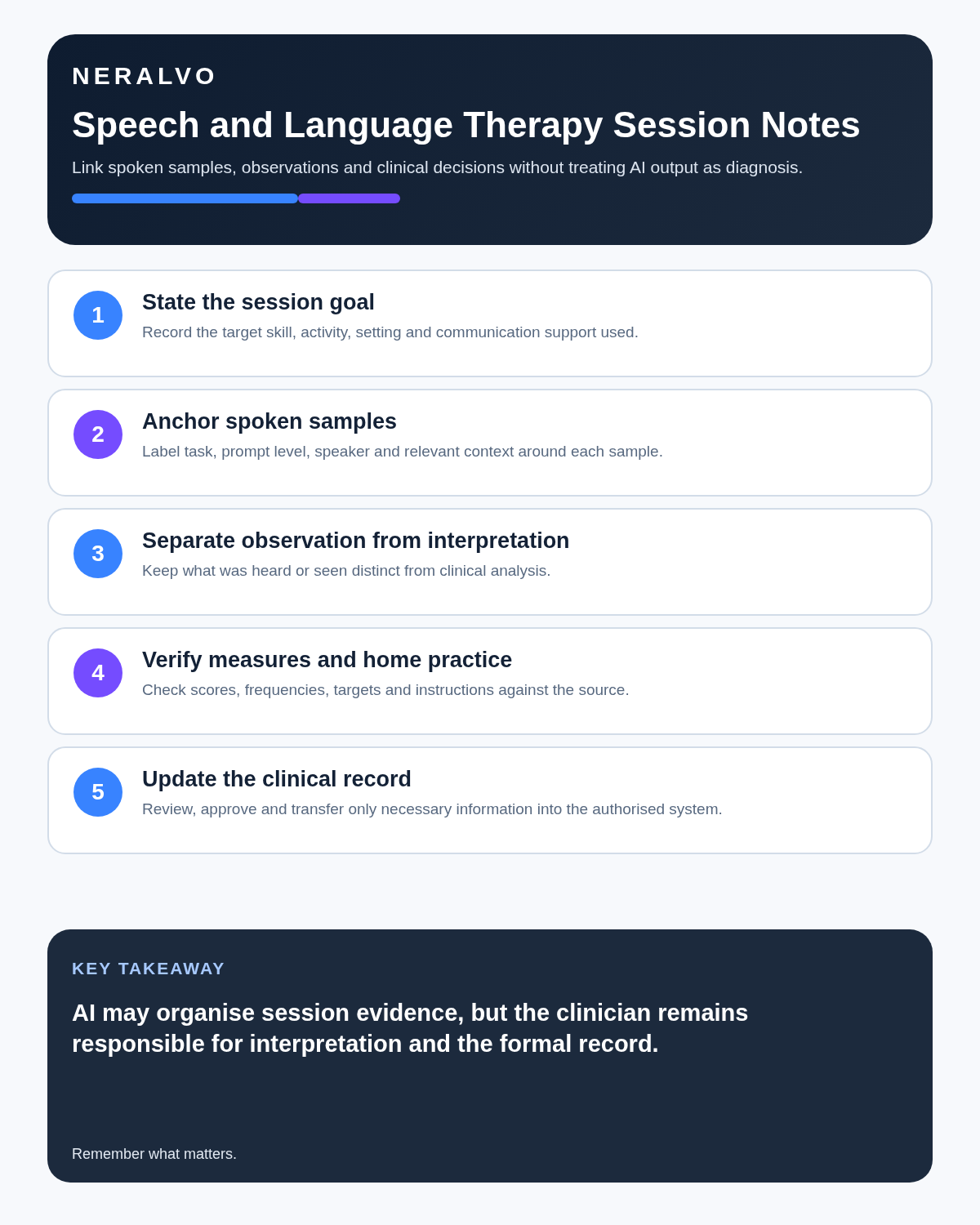
- Use the service’s approved recording process.
- State the clinical reference and purpose without unnecessary identifiers.
- Capture the agreed sample or session component.
- Confirm the complete source file.
- Use AI only for permitted administrative outputs.
- Review the audio using the appropriate clinical method.
- Draft goals, response, support and next steps.
- Check that AI has not normalised the communication sample.
- Store the approved clinical note in the authorised record.
- Apply the required retention decision to audio and drafts.
Children and vulnerable clients
Recording requires particular care, clear service procedures and appropriate agreement. Avoid capturing unrelated family conversation, names of third parties or background information that is not needed for the clinical purpose.
Telepractice and phone audio
Remote platforms compress audio and may change how speech characteristics are captured. A recording made through a phone or meeting platform should not be assumed equivalent to an in-person clinical sample.
Test the exact device, microphone, application, connection and environment, and document any limitations that could affect the sample or interpretation.
Supervision and reflective practice
Where authorised, a short de-identified reflective voice note can help prepare for supervision by capturing:
- The clinical question.
- What was tried.
- Client response.
- Uncertainty.
- Evidence or guidance to review.
- The next supervision question.
Do not include unnecessary identifying or sensitive details.
Where NERALVO Halo fits
View Halo specifications for speech and language therapists use can provide local audio capture for approved samples, clinician dictation and supervision preparation. Its current specification includes 64GB local storage, NOTE and CALL modes, up to 35 hours of recording and Bluetooth transfer to DOWAY.
DOWAY can create transcripts, summaries, speaker-separated notes, templates, translations and mind maps. These are general AI outputs, not substitutes for clinical assessment, specialist transcription or professional interpretation.
Use Halo and DOWAY only within the service’s clinical-governance, consent, security, access and retention procedures.
Clinical-use quality check
- Is the recording purpose documented?
- Was the approved consent process followed?
- Is the original audio available?
- Has AI normalised or omitted clinically relevant features?
- Were telepractice limitations documented?
- Was specialist analysis completed by the professional?
- Are identifiers, access and retention proportionate?
Bottom line
For speech and language therapists, an AI recorder can support source capture and administrative drafting. It cannot diagnose, interpret atypical communication reliably or replace clinical methods. The source audio and professional judgement remain central.
Cloud software, a dedicated recorder or manual notes?
For Speech and Language Therapists, the right answer changes with the setting. This matrix deliberately gives each method a situation where it can be the strongest choice.
| Situation | Best starting point | Reason |
|---|---|---|
| scheduled remote consultations | Cloud meeting software | Native remote-meeting workflows can be more efficient here. |
| in-person consultations or ward handovers | Dedicated recorder | A separate battery and recoverable local source improve resilience. |
| a patient declines or policy prohibits recording | Manual notes or an approved alternative | Manual notes are the correct control when recording is unavailable. |
| mixed remote and clinical work | Governed hybrid | A hybrid can combine automation with reliable physical capture. |
Related guides
See the guides for youth workers, faith leaders and choosing an AI voice recorder.
Profession workflow
Visual map for AI Voice Recorder for Speech and Language Therapists: Better Assessments and Session Notes
- Prepare the approved useDefine purpose, safe position, permission and the required formal record.
- Capture context firstState the case, asset, person, location or event identifier before detail.
- Human-verify evidenceCheck technical terms, units, names, dates, decisions and uncertainty.
- Complete the formal recordTransfer only verified information and apply access and retention controls.
On this page
Related guides
See whether Halo fits this workflow
Review the NERALVO Halo specifications, included services, delivery information and current offer only after completing the guide.
Found an error or an out-of-date claim? Email support@neralvo.com with the article address and a supporting source.